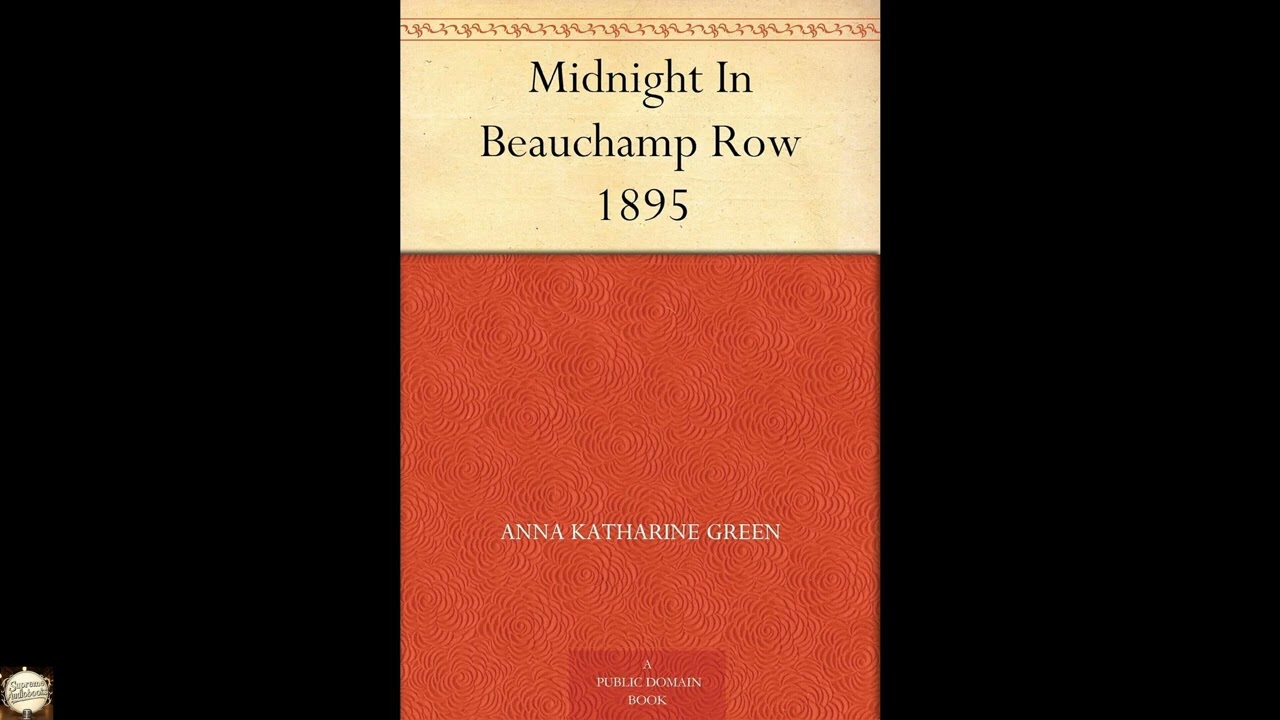
Midnight In Beauchamp Row 1895
In the shadowy, gaslit world of late Victorian London, a sinister event shatters the peace of a respectable address, drawing listeners into the very genesis of detective fiction. Anna Katharine Green's Midnight In Beauchamp Row 1895 is far more than a historical curiosity; it is a finely tuned engine of suspense, a demonstration of the power of logic against seemingly impenetrable mystery, and a vivid snapshot of an era obsessed with secrets and appearances. For anyone fascinated by the origins of the whodunit, by the meticulous process of deduction, or simply by a story that grips the mind and refuses to let go, this novella offers an engaging portal to the foundational narratives that would come to define an entire genre. It speaks to the enduring human desire to impose order on chaos, to find truth lurking beneath the surface, and to witness justice, however subtly, unfold. The story transports us directly to Beauchamp Row, a seemingly quiet, unassuming street where the lives of its inhabitants are played out with the decorum expected of their station. This veneer of respectability is brutally torn away by the discovery of a gruesome crime: a man, Mr. Beauchamp himself, found dead in his own home under circumstances that defy easy explanation. The crime scene is baffling, hinting at both careful planning and sudden violence, leaving the local authorities scratching their heads. Into this perplexing scenario steps the determined figure of the investigating officer, whose methodical approach and keen eye for detail become the listener's guide through a labyrinth of suspicion. He quickly learns that behind the closed doors of Beauchamp Row, personal histories are often guarded, resentments simmer, and every seemingly innocuous detail might conceal a vital clue. As the investigation progresses, the narrative skillfully introduces a small cast of characters, each with their own motives and secrets. There are the distraught neighbors, whose testimonies are as revealing for what they omit as for what they state outright; the household staff, whose loyalty and discretion are put to the test; and perhaps even a visitor or an unexpected presence whose role remains ambiguous. The detective must navigate this intricate social landscape, piecing together fragments of information, sifting through alibis, and interpreting the subtle cues that betray hidden truths. The tension mounts as the circle of suspicion narrows, but the solution remains tantalizingly out of reach, hidden just beyond the detective’s grasp, promising a resolution that challenges initial assumptions without ever revealing the final, shocking revelation. Anna Katharine Green, born in Brooklyn, New York, in 1846, established herself as a literary force long before many other women writers dared to enter the male-dominated field of popular fiction. Although she initially harbored ambitions as a poet, it was her groundbreaking detective novel, The Leavenworth Case, published in 1878, that catapulted her to fame and cemented her reputation. This single work is widely recognized as one of the first full-length detective novels written by an American woman, and its innovative structure and meticulous plotting set a new standard for the genre. Green continued to publish prolifically throughout her career, often featuring her beloved detectives, Ebenezer Gryce and the pioneering female sleuth, Amelia Butterworth, in a series of popular novels and short stories. She married actor and illustrator Charles Rohlfs in 1884, and their life together in Buffalo, New York, provided a stable backdrop for her sustained literary output. Green's enduring legacy stems from her keen intellect and her remarkable ability to construct intricate puzzles. She is frequently referred to as the "mother of detective fiction," a title earned not just by her early entry into the genre but by her profound influence on subsequent generations of writers, including giants like Arthur Conan Doyle and Agatha Christie. Her works are characterized by their logical progression, the careful dropping of clues, the introduction of red herrings, and the psychological depth she often lent to her characters. She understood the mechanics of suspense and the appeal of the intellectual game between author and reader, establishing many of the conventions that would become staples of the Golden Age of Detective Fiction. Her place in the literary canon is secure, representing a pivotal moment in the development of popular literature and the burgeoning role of women writers. At its core, Midnight In Beauchamp Row enacts several profound themes that resonate beyond its period setting. One central idea is the stark contrast between appearance and reality. The respectable facade of Beauchamp Row, with its seemingly upright residents, slowly cracks to reveal a substratum of deceit, hidden vices, and secret lives. For instance, the initial shock of the murder is amplified by the discovery that the victim himself harbored secrets, turning the seemingly tranquil domestic sphere into a stage for dark drama. Another prominent theme is the triumph of logic and deduction over initial confusion and emotional reactions. The detective in the story is not driven by passion or intuition alone, but by a painstaking process of observation, analysis, and the careful reconstruction of events. A seemingly insignificant detail—a misplaced object, a subtle inconsistency in a witness's statement, a peculiar mark on the floor—becomes a crucial piece of the puzzle, illustrating the power of objective reasoning. Furthermore, the novella touches upon the social anxieties and class distinctions prevalent in Victorian society. The careful dance between neighbors, the deference shown to certain figures, and the underlying currents of judgment and expectation all contribute to the atmosphere of a society where one's station dictates much, yet hides much more. The crime exposes the vulnerabilities and hypocrisies inherent in such a system, revealing how status can both protect and ensnare. Finally, there's the pervasive theme of the unseen threat in domestic spaces. The comfort and safety associated with one’s home are violently disrupted, forcing characters, and listeners, to confront the unnerving idea that danger can lie closest to home, transforming familiar surroundings into places of dread and mystery. The year 1895, when Midnight In Beauchamp Row was published, places the story firmly in the late Victorian era, a period of immense social, technological, and cultural change. Cities like London were booming, expanding with new industries and a burgeoning middle class, yet beneath the veneer of progress, anxieties about crime, morality, and social order simmered. Public fascination with scientific advancements, including the nascent fields of forensics and criminal psychology, fueled a desire for stories where order could be restored through intellect. In the literary world, the detective genre was coming into its own. While Edgar Allan Poe had laid groundwork decades prior, and Wilkie Collins popularized sensation novels, it was writers like Anna Katharine Green and Arthur Conan Doyle, whose Sherlock Holmes stories were already incredibly popular, who truly established the conventions of the modern detective story. Green’s work, appearing amidst this fertile ground, satisfied a public appetite for intellectual puzzles, moral order, and the reassuring presence of a logical mind dissecting chaos. Her success demonstrated that readers craved narratives where complex human motivations and meticulously crafted plots combined to create a satisfying, if sometimes unsettling, experience. Listening to Midnight In Beauchamp Row as an audiobook offers a unique and particularly atmospheric way to engage with this foundational work of crime fiction. The run length, several hours, is perfectly suited for a focused session, perhaps during a quiet evening or a prolonged commute, allowing the listener to fully immerse themselves in the unfolding mystery. A skilled narrator's voice can become the central conduit for the period setting, lending distinct vocal identities to the various characters—from the stoic detective to the nervous suspects—and subtly emphasizing the carefully chosen words of Green's prose. The measured pacing of Victorian narrative prose, when delivered by an accomplished reader, builds suspense gradually, allowing each clue and red herring to land with maximum impact. You can truly hear the hush of a hushed drawing-room, the tension in hushed dialogue, and the deliberate steps of the detective moving through the fog of uncertainty, making the historical atmosphere palpable and the intellectual challenge of the mystery immediate.
Enjoyed Midnight In Beauchamp Row 1895? A few ways to support us
Audible & Amazon links are affiliate; we may earn a small commission at no extra cost.
About this production
Human narration by a volunteer reader from LibriVox.org, the public-domain audiobook project. LibriVox volunteers record literary works whose copyright has expired in the United States, releasing the resulting recordings into the public domain.
Midnight In Beauchamp Row 1895 by Anna Katharine Green. The underlying text is in the U.S. public domain. We do not republish any modern copyrighted edition, translation, or commentary.
The 4K cinematic visuals accompanying this audiobook are generated by an AI image model from prompts derived from the source text. No copyrighted photos, paintings, or stock footage are used. AI generation is disclosed on every video on our YouTube channel as required by YouTube's altered/synthetic content policy.
English subtitles are transcribed from the LibriVox recording with OpenAI Whisper. Translations into the 11 other supported languages are produced by Meta's NLLB-200 neural translation model. No human translator's copyrighted translation is used.
Questions about sourcing or rights? See our DMCA & Sourcing policy or contact us.
Enjoyed this audiobook?
If you'd like to own a copy of Midnight In Beauchamp Row 1895 or hear a professionally produced edition, the links below help support free audiobook production at no extra cost to you.
As an Amazon Associate we earn from qualifying purchases. Audible / print links are affiliate.