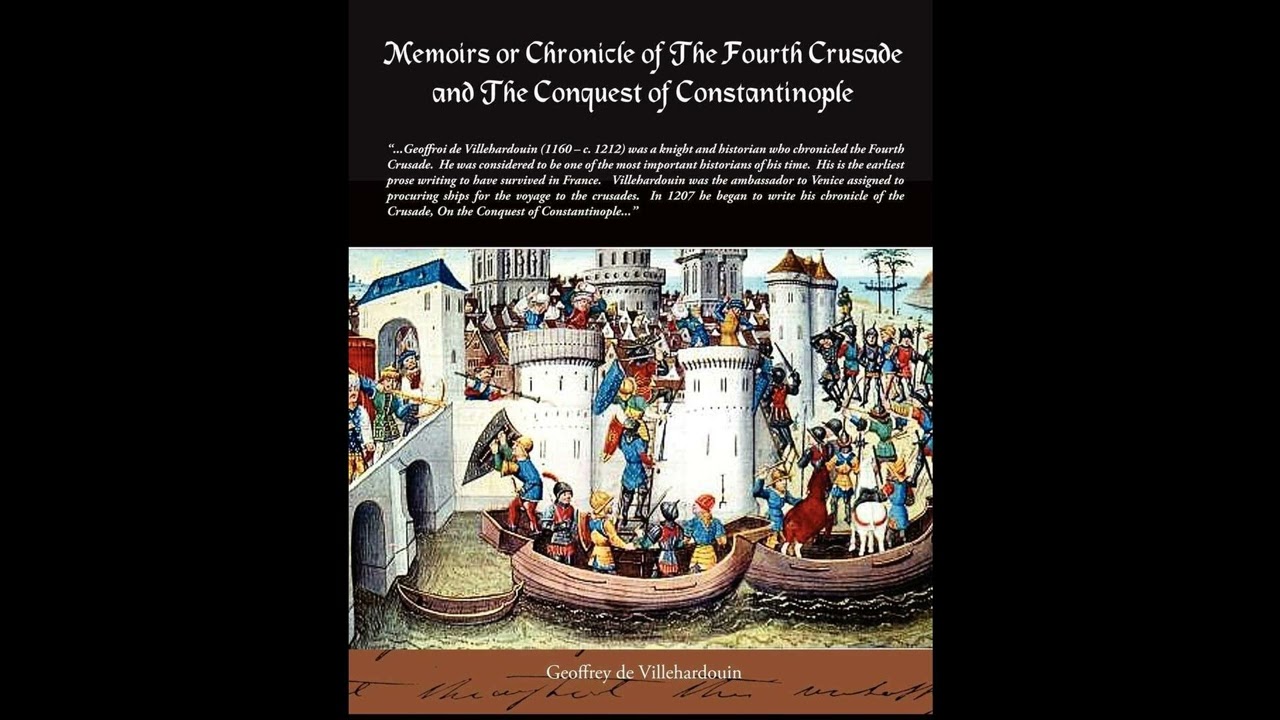
Memoirs or Chronicle of the Fourth Crusade and the Conquest of Constantinople- Full Audiobook
The Fourth Crusade remains one of history's most startling and controversial military expeditions, a venture that began with an oath to liberate Jerusalem and culminated instead in the shocking conquest and brutal sacking of Christian Constantinople. This Memoirs or Chronicle offers a unique, compelling window into those very events, a primary source document that lays bare the complex motives, the political machinations, and the stark realities faced by the crusaders themselves. Why should a listener care today? Because this account serves as a powerful testament to how easily high ideals can be corrupted by greed and circumstance, how alliances can shift with alarming speed, and how religious fervor can be twisted to justify profound acts of destruction. It is a stark reminder of the long shadow historical events cast and the chilling relevance of human ambition when unchecked. The narrative unfolds in the early years of the 13th century, a time when the call for a new crusade still resonated across Western Europe. Knights, counts, and dukes from France, Flanders, and other principalities gathered, pledging to reclaim the Holy Land. Their initial plan was to sail directly to Egypt, severing the Muslim power base, and so they made a crucial alliance with the formidable maritime republic of Venice, led by its aged but cunning Doge, Enrico Dandolo. The Venetians agreed to provide a massive fleet, but at a price—a cost which the crusaders, despite their noble intentions, could not fully meet. This financial shortfall becomes the pivotal turning point. Dandolo proposes an alternative payment: the crusaders would help Venice recapture the rebellious Christian city of Zara on the Dalmatian coast. Despite the Pope's stern warnings and subsequent excommunication of those involved, the desperate crusaders agreed, besieging and capturing Zara, a Christian city. From there, the entanglement only deepened. A deposed Byzantine prince, Alexios Angelos, offered a tempting deal: vast sums of money, military aid, and the reconciliation of the Eastern and Western Churches, if the crusaders would help him regain his throne in Constantinople. What began as a distant holy war in the Levant inexorably turned into an internal power struggle for the richest city in the Christian world. The chronicle meticulously details the approach to Constantinople, the initial awe at its immense fortifications, and the fierce but ultimately successful first siege that placed Alexios on the throne alongside his uncle. However, the promises proved impossible to keep, leading to unrest within the city and mounting frustration among the crusaders. The story builds towards the inevitable second siege, depicting the tactical challenges, the daring assaults, and the eventual, tragic breach of the city's defenses. The focus remains on the unfolding drama, the changing allegiances, and the descent into chaos as the crusaders, no longer restrained, descended upon Constantinople. The precise identity of the author of this Memoirs or Chronicle remains shrouded in the mists of time, a common occurrence for many foundational historical records from the medieval period. While we lack specific biographical details like birth or death dates, or other works to attribute, the very nature of the narrative strongly suggests an eyewitness account—someone who participated directly in the events described or stood very close to those who did. It is not an academic history written in retrospect, but rather an immediate, unfiltered perspective from the heart of the action. This anonymity, far from diminishing its significance, perhaps even enhances it, allowing the unfolding drama to take center stage without the overlay of a known individual’s personal agenda or renown. This chronicle stands as a vital counterpoint and complement to other contemporary Latin accounts of the Fourth Crusade, such as those by Geoffrey of Villehardouin, a prominent participant, or Robert de Clari, a less aristocratic knight. Each offers a slightly different angle, a unique lens through which to perceive the complex motivations and outcomes. This particular Memoirs captures the raw immediacy of the experience, offering insights into the evolving sentiments and practical considerations of the crusading army. Such historical chronicles were crucial in an era where literacy was not widespread, often serving to preserve events for future generations, to justify actions to contemporaries or to posterity, and to document the divine or human forces at play. While the specific hand that penned these words is unknown, the voice conveys authority, detailing strategy, assessing character, and narrating the dramatic turns of fortune with a directness that makes it an indispensable primary source for understanding this pivotal moment in medieval history. Several profound themes resonate throughout the Memoirs or Chronicle. One of the most striking is the corruption of ideals, vividly demonstrated by the crusaders’ dramatic diversion from their sacred oath to liberate Jerusalem. The initial fervent commitment to a holy war slowly erodes under the weight of financial pressures and political expediency. The chronicler details the moral compromise when the army turns its might against fellow Christians at Zara, an act that incurred papal excommunication. This moment exemplifies the tragic shift from spiritual calling to worldly ambition, a transformation that ultimately leads them away from their original, lofty goals. Another prominent theme is political pragmatism versus morality. This is particularly evident in the relentless drive of the Venetians, spearheaded by Doge Dandolo. His calculated maneuvers, from demanding payment to redirecting the entire crusading fleet towards Byzantine affairs, illustrate how political and economic self-interest can override religious imperatives. The chronicle presents these decisions as stark choices, often made under duress, highlighting the difficult balance—or imbalance—between strategic necessity and ethical conduct. The text also underscores the brutality of conquest and the sheer destructive power of armed conflict. The descriptions of the sieges of Constantinople, the fires, the subsequent looting of churches and palaces, paint a grim picture of unchecked violence and loss, reminding us that even "holy" wars exact a terrible human cost and leave behind deep wounds. This Memoirs or Chronicle emerged from a deeply turbulent and transformative period at the cusp of the High and Late Middle Ages. Western Europe was in an era marked by religious zeal and expansionist ambitions, with the Crusades having already shaped generations of military and political thought. Simultaneously, the Byzantine Empire, once the undisputed heir to Rome, was in a state of internal decline, plagued by dynastic struggles and growing territorial losses, making it vulnerable to external pressures. The Great Schism between Eastern and Western Christianity, formalized centuries earlier, also played a crucial role, fostering mutual suspicion and a sense of "otherness" that made the Latin conquest of Constantinople, while shocking, tragically plausible. The early 13th century was also a period when vernacular prose began to gain prominence in the literary world. While Latin remained the language of scholarship and the Church, powerful events demanded to be recorded in languages accessible to the noblemen and knights who participated in them. These chronicles served not only as historical records but also as instruments for shaping memory, justifying actions, and understanding a rapidly changing world. This specific chronicle, therefore, is not merely a record of events, but a product of its time—a reflection of the Latin perspective on a clash that would forever alter the balance of power between East and West, and which resonates through history as a stark warning about the consequences of unchecked power and misplaced zeal. Hearing this Memoirs or Chronicle as an audiobook transforms a vital historical text into an immediate, compelling experience. The singular voice of a skilled narrator breathes life into the complex chain of events, guiding the listener through the shifting alliances, the dramatic sieges, and the strategic decisions that shaped the Fourth Crusade. The narrative, spanning several hours, is ideal for extended listening sessions—during commutes, while performing household tasks, or on long walks—allowing ample time to immerse oneself in the unfolding drama. Listen for the narrator's pacing, which can emphasize the slow build-up of tension before a major siege or the rapid, disorienting pace of battle and betrayal. The clarity of vocalization helps in distinguishing the numerous individuals and factions, providing an anchor in a tumultuous period. An audiobook experience allows the atmosphere of that distant era—the clang of armor, the murmur of councils, the shouts of despair and victory—to become palpable, making this fundamental historical account feel less like a relic and more like an unfolding story directly told.
Enjoyed Memoirs or Chronicle of the Fourth Crusade and the Conquest of Constantinople- Full Audiobook? A few ways to support us
Audible & Amazon links are affiliate; we may earn a small commission at no extra cost.
About this production
Human narration by a volunteer reader from LibriVox.org, the public-domain audiobook project. LibriVox volunteers record literary works whose copyright has expired in the United States, releasing the resulting recordings into the public domain.
Memoirs or Chronicle of the Fourth Crusade and the Conquest of Constantinople- Full Audiobook. The underlying text is in the U.S. public domain. We do not republish any modern copyrighted edition, translation, or commentary.
The 4K cinematic visuals accompanying this audiobook are generated by an AI image model from prompts derived from the source text. No copyrighted photos, paintings, or stock footage are used. AI generation is disclosed on every video on our YouTube channel as required by YouTube's altered/synthetic content policy.
English subtitles are transcribed from the LibriVox recording with OpenAI Whisper. Translations into the 11 other supported languages are produced by Meta's NLLB-200 neural translation model. No human translator's copyrighted translation is used.
Questions about sourcing or rights? See our DMCA & Sourcing policy or contact us.
Enjoyed this audiobook?
If you'd like to own a copy of Memoirs or Chronicle of the Fourth Crusade and the Conquest of Constantinople- Full Audiobook or hear a professionally produced edition, the links below help support free audiobook production at no extra cost to you.
As an Amazon Associate we earn from qualifying purchases. Audible / print links are affiliate.
More by Unknown

Brown Wolf and Other Jack London Stories - Chosen and Edited By Franklin K. Mathiews- Full Audiobook
Beacon Lights of History: Renaissance and Reformation: Volume 3, Part 2

Memoirs of the Life and Correspondence of Henry Reeve, C.B., D.C.L.. In Two Volumes.- Full Audiobook

Blackwood's Edinburgh Magazine, Volume 56, Number 347, September, 1844- Full Audiobook
More Audiobooks
Memoirs of a Cavalier ; or a Military Journal of the Wars in Germany, and the Wars i- Full Audiobook
Dio's Rome, Volume 4 An Historical Narrative Originally Composed in Greek During

Our Casualty, and Other Stories - 1918
Memoirs Of The Courts Of Louis XV And XVI V1: Being Secret Memoirs Of Madame Du Haus- Full Audiobook