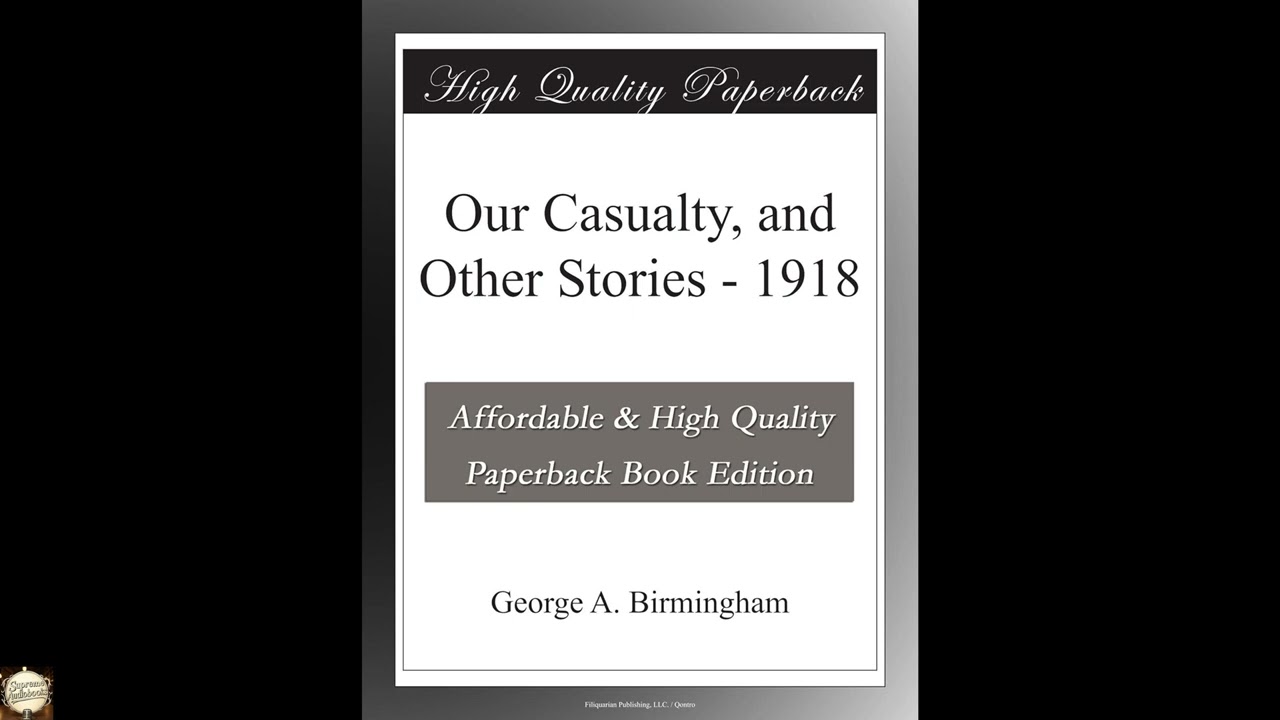
Our Casualty, and Other Stories - 1918
Step into a moment suspended between the tumult of war and the quiet anxieties of home with George A. Birmingham’s Our Casualty, and Other Stories, a collection first published in the momentous year of 1918. This assembly of short fiction offers listeners a unique vantage point on a world reeling from global conflict, seen through the distinctive lens of an Irish clergyman and satirist. It is a work that, even a century later, speaks to enduring human truths: the absurdity of bureaucracy, the resilience of the spirit, and the peculiar ways in which grand historical events infiltrate and transform ordinary lives. These are not merely tales from a bygone era; they are sharp observations on character and circumstance that resonate with anyone who has faced disruption, misunderstanding, or the unexpected humor found amidst hardship. The collection, anchored by its titular story, introduces a range of scenarios where the far-reaching tendrils of the Great War touch the unassuming corners of Irish life. Birmingham, with his keen eye for the foibles of human nature and the quirks of rural society, often places his characters in predicaments that highlight the gap between official pronouncements and local realities. We might find a small village receiving baffling communications about a soldier's fate, leading to a cascade of misinterpretations and well-meaning but ultimately misguided actions. Or perhaps a story will follow a group of individuals attempting to navigate the new rules and regulations imposed by wartime, often with a bewildered grace or an ingenious circumvention. Though each story stands alone, they collectively paint a nuanced picture of a nation grappling with its own identity while simultaneously caught in a world-altering conflict. The humor often springs from the clash between sincere patriotism and the very human desire for peace and normalcy, or from the charming illogicality that can arise when rigid systems meet the flexible realities of everyday existence. Expect to meet characters who are earnest and bewildered, officious and muddled, all rendered with an affectionate wit that underscores their humanity without diminishing the seriousness of their situations. The narrative arc across these stories is one of quiet revelation, showing how minor incidents can illuminate major cultural shifts, and how personal dramas unfold against a backdrop of global change, never quite resolving in predictable ways. The author behind the pseudonym George A. Birmingham was James Owen Hannay, an Anglican priest born in Belfast in 1865. His life, spanning the late Victorian era through the mid-20th century, saw immense changes in both Ireland and the wider world. Hannay served as the Rector of Westport in County Mayo for over twenty years, a period during which he became deeply familiar with the nuances of Irish rural life, its politics, and its people—knowledge he would skillfully weave into his extensive literary output. He was a prominent figure in the Anglo-Irish literary landscape, known for his witty and often satirical novels and short stories that frequently commented on Irish society, land, and the burgeoning nationalist sentiment. Hannay, a staunch advocate for Home Rule, navigated the complex political currents of his time, often expressing his views through his fiction, which reached a wide and appreciative audience. His first novel, The Seething Pot, appeared in 1905, and he quickly established a reputation for his humorous yet insightful portrayals. Perhaps his most famous work, Spanish Gold (1908), solidified his place as a popular storyteller, known for its engaging plots and memorable characters. Later in his life, he moved to England, continuing to write prolifically until his death in 1950, leaving behind a significant body of work that offers a distinctive perspective on a transformative period in Irish history and British-Irish relations. The stories within Our Casualty adeptly bring to life several significant themes. One prominent thread is the pervasive yet often indirect impact of war on civilian life. Rather than focusing on the battlefields, Birmingham illustrates how the conflict infiltrates everyday routines, official communications, and personal anxieties, even in a seemingly remote Irish parish. In "Our Casualty" itself, for instance, the arrival of a telegram regarding a soldier's fate might trigger a chain of reactions—confusion, misplaced grief, administrative blunders—that highlight the disconnect between the brutal realities of the front and the often-comic misunderstandings back home. This shows war not as a distant event but as a force that reshapes social structures and human interactions. Another key theme is the clash between Irish identity and broader imperial forces, often presented through humorous or satirical lenses. Birmingham frequently draws attention to the distinct character of Irish communities, their particular ways of communicating, their skepticism of authority, and their resilience in the face of external pressures. You might encounter characters who interpret official directives with a logic uniquely their own, or who respond to wartime demands in ways that expose the inherent tensions between local autonomy and central command. This dynamic often serves to underscore the resourcefulness and unique spirit of the Irish people, even as they face challenges imposed by a larger, external conflict. This collection emerged directly from the extraordinary circumstances of 1918. The Great War was finally nearing its end, but the preceding four years had profoundly reshaped Europe, causing immense human suffering and social upheaval. For Ireland, the period was especially tumultuous. The Easter Rising of 1916 had ignited a new fervor for independence, challenging British rule and pushing the nation towards a period of intense political struggle that would soon culminate in the War of Independence. Birmingham, writing from within this volatile environment, had a unique vantage point as both a British subject and an Irishman, a clergyman tasked with ministering to his community amidst such profound uncertainty. His stories, therefore, capture the immediate anxieties, the quiet patriotism, and the underlying political currents of a nation poised on the brink of radical change, all framed against the backdrop of a world war drawing to a close. They represent a literary snapshot of a world grappling with the aftershocks of trauma and the dawning of new, often unsettling, futures. Listening to Our Casualty, and Other Stories as an audiobook offers a singular opportunity to connect with these tales in their most immediate form. The length, several hours in total, provides ample time to immerse oneself in Birmingham's distinctive voice and the world he so skillfully evokes. A skilled narrator will bring the diverse range of characters to life, from the bumbling officials to the pragmatic villagers, allowing their individual inflections and rhythms of speech to shine through. Pay attention to the subtle shifts in tone—the underlying pathos beneath the humor, the quiet observations woven into the lively dialogue. The spoken word allows the atmosphere of rural Ireland in 1918 to unfold directly, making the social commentary feel fresh and immediate. It is an ideal companion for moments when you wish to be transported to another time and place, to hear the echoes of a bygone era through stories that continue to entertain and enlighten.
Enjoyed Our Casualty, and Other Stories - 1918? A few ways to support us
Audible & Amazon links are affiliate; we may earn a small commission at no extra cost.
About this production
Human narration by a volunteer reader from LibriVox.org, the public-domain audiobook project. LibriVox volunteers record literary works whose copyright has expired in the United States, releasing the resulting recordings into the public domain.
Our Casualty, and Other Stories - 1918 by George A. Birmingham. The underlying text is in the U.S. public domain. We do not republish any modern copyrighted edition, translation, or commentary.
The 4K cinematic visuals accompanying this audiobook are generated by an AI image model from prompts derived from the source text. No copyrighted photos, paintings, or stock footage are used. AI generation is disclosed on every video on our YouTube channel as required by YouTube's altered/synthetic content policy.
English subtitles are transcribed from the LibriVox recording with OpenAI Whisper. Translations into the 11 other supported languages are produced by Meta's NLLB-200 neural translation model. No human translator's copyrighted translation is used.
Questions about sourcing or rights? See our DMCA & Sourcing policy or contact us.
Enjoyed this audiobook?
If you'd like to own a copy of Our Casualty, and Other Stories - 1918 or hear a professionally produced edition, the links below help support free audiobook production at no extra cost to you.
As an Amazon Associate we earn from qualifying purchases. Audible / print links are affiliate.