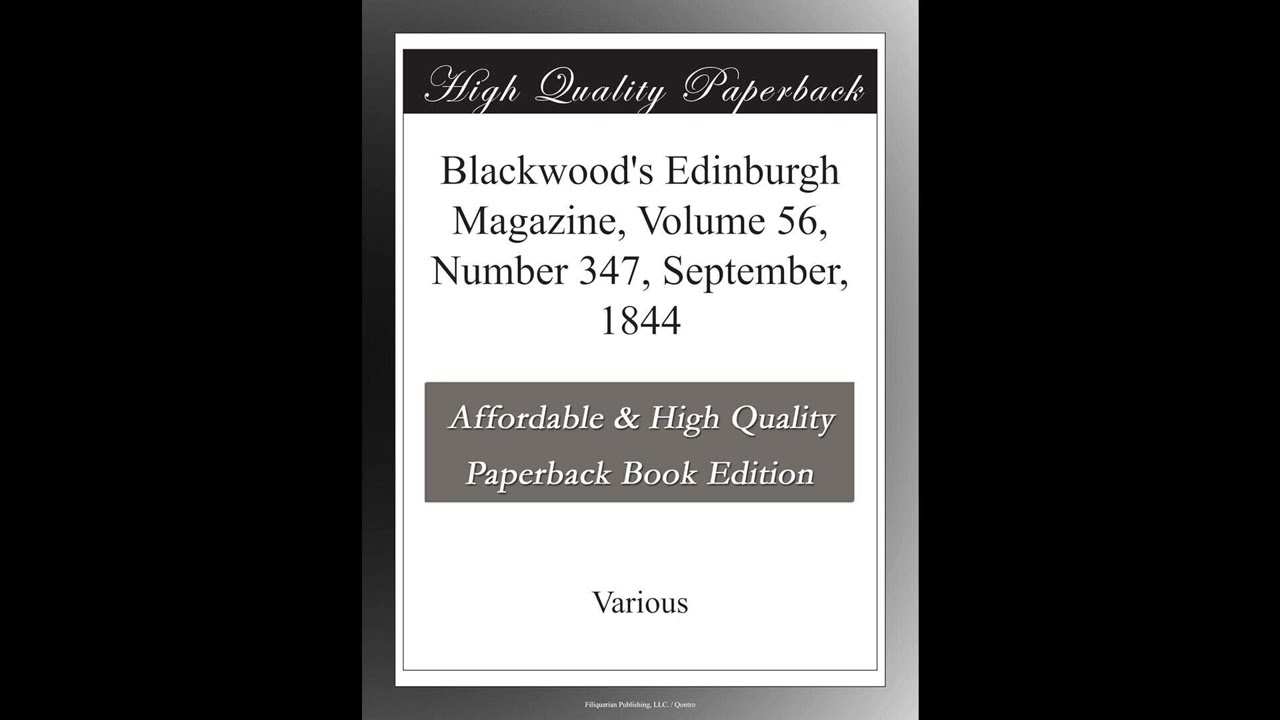
Blackwood's Edinburgh Magazine, Volume 56, Number 347, September, 1844- Full Audiobook
Step back in time to an era of profound change and intellectual ferment with Blackwood's Edinburgh Magazine, Volume 56, Number 347, published in September of 1844. This comprehensive audiobook offers a direct, unmediated gateway to the Victorian mind, presenting a complete issue of one of the most influential literary and political periodicals of its day. It is more than a historical document; it is a living collection of voices, opinions, and stories that shaped an age. Listening to this volume allows one to experience the raw flow of ideas and the diverse cultural landscape exactly as readers would have encountered it nearly two centuries ago, offering an unparalleled insight into the passions, anxieties, and curiosities of mid-nineteenth-century Britain. Within the pages of this specific issue, listeners will find themselves immersed in the bustling intellectual landscape of 1844 Edinburgh, a city then a major hub of British thought and letters. Blackwood's served as a vital forum for opinion and imagination, and this volume presents a range of "stories" from the serious to the whimsical. Imagine beginning with a trenchant political essay dissecting the latest parliamentary debates, perhaps scrutinizing the implications of a new policy on trade or a contentious social reform bill. The prose is sharp, the arguments robust, revealing the prevailing Tory perspective that characterized the magazine. As the issue unfolds, the narrative shifts, moving from the realm of public affairs to the more personal and literary. A listener might next encounter a serialized work of fiction, a short story perhaps tinged with the romanticism and gothic sensibilities that still held sway, or an early example of social realism beginning to challenge those traditions. There might be a detailed literary review, dissecting the merits and flaws of a contemporary poet or novelist, offering candid assessments that shaped critical reception at the time. Finally, the collection typically rounds out with original poetry, often reflective or lyrical, and perhaps some lighthearted sketches or travelogues, each piece contributing to a varied intellectual and emotional engagement with the era. The "central conflict" across these disparate pieces isn't a single plot point, but rather the ongoing societal dialogues, the clash of new ideas against established norms, and the human dramas—both real and imagined—that captivated the reading public. The "author" of this substantial collection is not a single individual but the collective literary and editorial force behind Blackwood's Edinburgh Magazine itself, a publication of immense renown and enduring legacy. Founded in 1817 by William Blackwood, the magazine quickly established itself as a formidable voice, particularly known for its staunch Tory politics and its fierce, often witty, literary criticism. It served as a critical platform for Scottish writers and intellectuals, providing a counterpoint to London-centric literary circles. The magazine was particularly associated with its long-serving editor, John Wilson, who wrote under the pseudonym "Christopher North," a persona whose boisterous wit and erudition defined much of the magazine's tone for decades. Over its impressive run, Blackwood's attracted contributions from many significant literary figures, though often published anonymously or pseudonymously. While the precise authors of every piece in this September 1844 issue may be unrecorded, the standard of writing and thought would have been consistently high. The magazine was instrumental in shaping public discourse and literary tastes, often engaging in lively—and at times scandalous—feuds with rival publications and authors. Its role in the literary landscape was pivotal, providing an outlet for essays, poetry, and serialized fiction that both reflected and influenced the broader cultural currents of the Victorian period, and giving a platform to diverse voices, many of whom would become central to the canon of British letters. Within the array of pieces presented in this 1844 volume, several compelling themes surface and resonate. One prominent theme is the ongoing social criticism and commentary on the rapidly industrializing British society. Essays might address the conditions of the working classes, the responsibilities of the landed gentry, or the impact of technological advancements, often through a lens that sought to preserve traditional values while acknowledging the inevitable march of progress. For instance, a detailed article might decry the moral decay perceived in urban centers or champion the virtues of rural life, reflecting the anxieties of a society grappling with rapid demographic and economic shifts. Another significant theme, particularly present in the fictional contributions, is the lingering influence of Romanticism and early Gothic sensibilities. While the Victorian era was moving towards realism, the allure of the mysterious, the sublime, and the psychologically complex remained strong. A short story within the magazine might feature a remote Scottish setting, a brooding character wrestling with a dark past, or an exploration of supernatural occurrences, demonstrating how literature offered a space for engaging with the unknown and the emotional depths of human experience. The magazine also regularly engaged in political discourse, offering sharp critiques of government policy and foreign relations, consistently articulating a conservative worldview that championed national interests and traditional institutions against the rising tide of liberalism. The year 1844 found Britain in the heart of the Victorian Age, a period marked by profound social, economic, and political shifts. Sir Robert Peel's Conservative government was in power, grappling with significant issues such as the Corn Laws, which protected domestic agriculture but were a source of intense debate regarding free trade and food prices for the burgeoning urban population. This was also a time of significant social unrest, with the Chartist movement advocating for greater political rights for the working class gaining momentum. The industrial revolution was transforming the landscape and society, creating immense wealth alongside stark poverty, prompting widespread commentary and calls for reform across the political spectrum. Culturally, the influence of scientific advancements was growing, challenging traditional religious views and fostering new ways of understanding the world. Literature was similarly in flux, with the grand narratives of Romanticism giving way to more realistic portrayals of life, yet still incorporating elements of the fantastical and the moralistic. Blackwood's operated squarely within this dynamic environment, offering its readers not just entertainment but also a robust intellectual framework through which to interpret these complex changes. The magazine's articles and stories acted as a mirror and a shaper of public opinion, reflecting the anxieties and aspirations of a nation at a critical juncture in its history. Listening to Blackwood's Edinburgh Magazine, Volume 56, Number 347 as an audiobook offers a unique and intimate way to connect with this pivotal moment in history. The narrator's interpretation brings the diverse content to life, giving distinct voices to the serious polemics, the evocative fiction, and the lyrical poetry. The duration of several hours allows for sustained immersion, inviting the listener to settle in and truly absorb the rhythm of thought and expression of the mid-19th century. Pay attention to the shifts in tone, the subtle nuances in dialogue, and the atmospheric descriptions that characterize the different genres. The experience is akin to having a well-read contemporary of 1844 present the very same issue to you, articulating the arguments, portraying the characters, and reciting the verses as they might have been discussed in an Edinburgh drawing-room or a London literary club. It's an opportunity to hear history speaking, unedited and unfiltered.
Enjoyed Blackwood's Edinburgh Magazine, Volume 56, Number 347, September, 1844- Full Audiobook? A few ways to support us
Audible & Amazon links are affiliate; we may earn a small commission at no extra cost.
About this production
Human narration by a volunteer reader from LibriVox.org, the public-domain audiobook project. LibriVox volunteers record literary works whose copyright has expired in the United States, releasing the resulting recordings into the public domain.
Blackwood's Edinburgh Magazine, Volume 56, Number 347, September, 1844- Full Audiobook. The underlying text is in the U.S. public domain. We do not republish any modern copyrighted edition, translation, or commentary.
The 4K cinematic visuals accompanying this audiobook are generated by an AI image model from prompts derived from the source text. No copyrighted photos, paintings, or stock footage are used. AI generation is disclosed on every video on our YouTube channel as required by YouTube's altered/synthetic content policy.
English subtitles are transcribed from the LibriVox recording with OpenAI Whisper. Translations into the 11 other supported languages are produced by Meta's NLLB-200 neural translation model. No human translator's copyrighted translation is used.
Questions about sourcing or rights? See our DMCA & Sourcing policy or contact us.
Enjoyed this audiobook?
If you'd like to own a copy of Blackwood's Edinburgh Magazine, Volume 56, Number 347, September, 1844- Full Audiobook or hear a professionally produced edition, the links below help support free audiobook production at no extra cost to you.
As an Amazon Associate we earn from qualifying purchases. Audible / print links are affiliate.
More by Unknown
Characters and Events of Roman History, from Caesar to Nero (Dodo Press)- Full Audiobook
A Collection of Old English Plays, Volume 1
Memoirs of the Life of the Rt. Hon. Richard Brinsley Sheridan — Volume 01- Full Audiobook
Rural Architecture: Being A Complete Description Of Farm Houses, Cottages, And Out
More Audiobooks
Notes and Queries, Index of Volume 2, May-December, 1850 (Classic Books)
Notes and Queries, Number 172, February 12, 1853
Notes and Queries, Index of Volume 3, January-June, 1851 (Classic Books)
Miscellanies upon Various Subjects (Perfect Library)