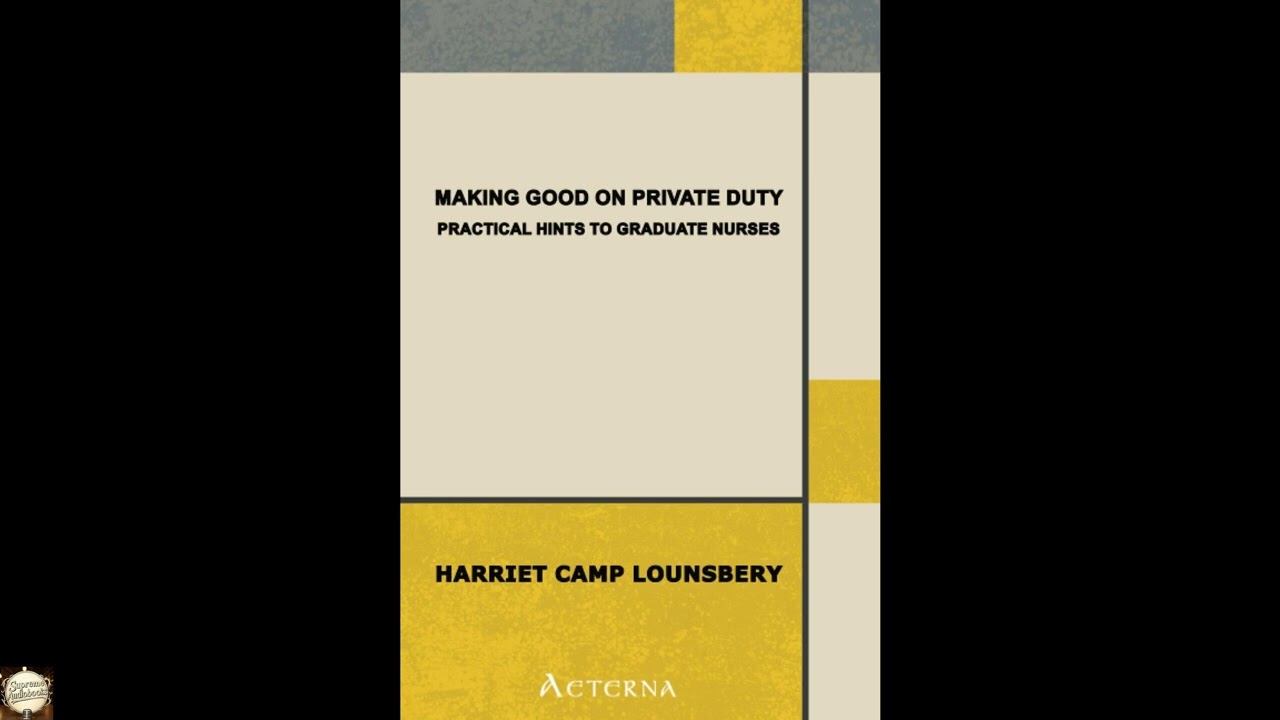
Making Good on Private Duty: Practical Hints to Graduate Nurses
Imagine stepping back into an era when medicine was rapidly evolving, and the role of the nurse, while increasingly professionalized, was still fraught with societal expectations and demanding personal sacrifice. Harriet Camp Lou's "Making Good on Private Duty: Practical Hints to Graduate Nurses," a foundational text from the early twentieth century, offers more than just historical instruction; it provides a profound glimpse into the values, challenges, and aspirations of a pivotal profession at a crucial moment. This audiobook presents a unique opportunity to experience the direct voice of an experienced nurse guiding her newly qualified peers through the often-unseen intricacies of private practice, revealing not only the practicalities of patient care but also the ethical fortitude and personal discipline required to excel. Far from being a mere relic, Lou's wisdom resonates today, speaking to the enduring human elements of compassion, duty, and the art of tending to others in their most vulnerable state. It’s a compelling listen for anyone interested in the history of medicine, the changing role of women in professions, or the timeless qualities of dedicated service. The narrative of "Making Good on Private Duty," while not a novel in the conventional sense, unfolds as a comprehensive instructional arc designed to shape the nascent professional identity of the graduate nurse. The primary "character" is undoubtedly this newly minted professional, fresh from training, who must now navigate the complex realities of individual patient care within the confines of private homes or small, nascent hospital settings. The story begins by establishing the ideal persona: disciplined, discreet, skilled, and utterly dedicated. Lou meticulously outlines the setting – from the orderly, sterile sickroom to the chaotic household of an anxious family – emphasizing the nurse's singular responsibility to create an environment conducive to healing. She sketches out the supporting players: the often-demanding patient, the authoritative physician, the sometimes-interfering family, and even the household staff, each presenting unique challenges to the nurse's authority and professionalism. The central "conflict" of this practical guide arises from the gulf between theoretical training and the messy, unpredictable demands of real-world application. How does a young woman, often working in isolation, uphold stringent medical standards while simultaneously managing social dynamics, financial expectations, and her own emotional well-being? Lou’s practical hints address these tensions directly, offering solutions for everything from managing a difficult doctor to ensuring proper hygiene in a less-than-ideal home environment, or subtly guiding a patient's family without overstepping bounds. The arc of the "story" follows the graduate nurse from an initial state of eager inexperience, through the trials of various private cases, to a position of respected competence and a solid professional reputation. It's a progression from self-doubt to self-assurance, forged through diligent application of principle and practice. Harriet Camp Lou, the astute and empathetic author of this seminal guide, was a significant figure in early American nursing education and practice. Born in 1872, Lou dedicated her life to the profession, graduating from the prestigious Philadelphia Hospital Training School for Nurses in 1893. Her extensive experience did not remain confined to the bedside; she quickly distinguished herself as an educator, returning to her alma mater as a respected instructor. Later, she rose to the esteemed position of Superintendent of Nurses, a role that placed her at the forefront of shaping the next generation of caregivers. This invaluable background informed her writing, allowing her to articulate the unspoken challenges and subtle nuances of private duty nursing with an authenticity that few others could match. "Making Good on Private Duty" (published in 1912) was Lou's principal literary contribution, a testament to her dedication to empowering her colleagues. While she may not have authored numerous other volumes, this single work cemented her place within the canon of professional literature, establishing her as an authoritative voice for early 20th-century nursing. Her perspective was rooted in the direct, practical application of medical knowledge tempered with an acute awareness of human psychology and social dynamics. Her insights were not abstract theories but hard-won lessons, meticulously compiled to arm newly qualified nurses with the tools they needed to navigate a demanding and often isolating profession. She remained active in nursing until her passing in 1963, a life that spanned decades of immense change in healthcare. The book enacts several powerful themes that remain pertinent even today. Foremost among these is professionalism, underscored by Lou's unwavering insistence on punctuality, impeccable uniform, and meticulous record-keeping. She illustrates this by describing the nurse’s careful preparation before arriving at a new case, ensuring every detail – from starched apron to polished shoes – projects competence and reliability, setting the stage for trust with both patient and physician. Another key theme is ethical conduct and discretion, particularly crucial in the intimate settings of private duty. Lou provides concrete examples, such as the absolute necessity of patient confidentiality, cautioning against sharing details of a case even with close friends, thereby safeguarding the patient's privacy and the nurse's integrity. Furthermore, "Making Good on Private Duty" highlights the theme of patient advocacy and compassionate care. Lou advises nurses to be attuned not only to physical symptoms but also to the emotional and psychological needs of their patients, encouraging a holistic approach. For instance, she might describe a scene where a nurse gently re-arranges a patient’s pillows or reads aloud from a favorite book, demonstrating that small acts of kindness and attention to comfort are as vital as administering medication. Finally, the text explores the burgeoning theme of women's empowerment through professionalization. At a time when many opportunities for women were limited, Lou’s guide implicitly champions nursing as a pathway to independence, skill, and respected societal contribution, arming women with the practical wisdom to forge successful careers on their own terms. This significant work emerged during a transformative period in American history, nestled between the Progressive Era and the advent of World War I. The early 1900s witnessed rapid advancements in medical science, the establishment of formal nursing schools, and a concerted effort to professionalize nursing beyond its earlier, often informal, origins. Culturally, women were increasingly seeking roles outside the domestic sphere, and the burgeoning women's suffrage movement was gaining momentum, challenging traditional gender roles. Politically, there was a growing awareness of public health needs and the importance of sanitation. Harriet Camp Lou's book directly responded to these developments, serving as a vital training manual and ethical compass for the expanding cohort of women entering this newly professionalized field. It filled a critical void, providing standardization and guidance where ad-hoc practices once prevailed, ensuring that graduate nurses were equipped not just with skills but also with a robust moral framework as they ventured into an often-unregulated and intimate sector of healthcare. Listening to "Making Good on Private Duty" as an audiobook offers a uniquely immersive experience, allowing the listener to truly inhabit the atmosphere and receive the direct, advisory tone of the text. The narration will bring Harriet Camp Lou's precise and authoritative voice to life, conveying her earnest counsel with clarity and gravitas. With a run length of several hours, it's an ideal companion for a long drive, thoughtful chores, or dedicated listening sessions, allowing ample time to absorb the period-specific language and social nuances. Listen for the careful pacing that mirrors the thoughtful deliberation Lou encourages in her nurses, and for the measured delivery that underscores the weight of responsibility inherent in the profession. The absence of traditional dialogue means the narrator's voice becomes the guiding presence, establishing an intimate, instructive atmosphere that draws you into the specific challenges and triumphs of early 20th-century private duty nursing. It's a chance to hear history speak, offering practical wisdom that transcends its original context.
Enjoyed Making Good on Private Duty: Practical Hints to Graduate Nurses? A few ways to support us
Audible & Amazon links are affiliate; we may earn a small commission at no extra cost.
About this production
Human narration by a volunteer reader from LibriVox.org, the public-domain audiobook project. LibriVox volunteers record literary works whose copyright has expired in the United States, releasing the resulting recordings into the public domain.
Making Good on Private Duty: Practical Hints to Graduate Nurses by Harriet Camp Lou. The underlying text is in the U.S. public domain. We do not republish any modern copyrighted edition, translation, or commentary.
The 4K cinematic visuals accompanying this audiobook are generated by an AI image model from prompts derived from the source text. No copyrighted photos, paintings, or stock footage are used. AI generation is disclosed on every video on our YouTube channel as required by YouTube's altered/synthetic content policy.
English subtitles are transcribed from the LibriVox recording with OpenAI Whisper. Translations into the 11 other supported languages are produced by Meta's NLLB-200 neural translation model. No human translator's copyrighted translation is used.
Questions about sourcing or rights? See our DMCA & Sourcing policy or contact us.
Enjoyed this audiobook?
If you'd like to own a copy of Making Good on Private Duty: Practical Hints to Graduate Nurses or hear a professionally produced edition, the links below help support free audiobook production at no extra cost to you.
As an Amazon Associate we earn from qualifying purchases. Audible / print links are affiliate.