Louis Agassiz As a Teacher: Illustrative Extracts On His Method of Instruction
What does it truly mean to learn, to observe, to understand? The answer, according to the renowned Swiss-American naturalist Louis Agassiz, was not found in books alone, but in the patient, rigorous, often frustrating act of direct encounter with the natural world. "Louis Agassiz As a Teacher: Illustrative Extracts On His Method of Instruction" offers a rare and profound window into the revolutionary pedagogical approach of a man who reshaped scientific education in America. This collection of firsthand accounts and distilled wisdom isn't merely a historical document; it’s a living testament to the power of authentic learning, challenging listeners today to re-examine their own methods of acquiring knowledge and fostering intellectual growth, urging us to look closer, think deeper, and truly see. Imagine stepping into the spartan laboratory of Louis Agassiz, perhaps at Harvard University or his pioneering summer school on Penikese Island in the mid-1800s. A new student, fresh from an education steeped in lectures and textbooks, is presented with a specimen—a fish, perhaps—and given a single instruction: "Study it." No books, no immediate explanations, just the specimen and the student's own eyes. This is the central "drama" of Agassiz's method, the silent, often bewildering confrontation between an eager but uninitiated mind and the seemingly simple object placed before it. The narrative arc, woven through these illustrative extracts, follows the initial bewilderment of the student, accustomed to being told facts rather than discovering them. Days might pass. The student draws the fish, examines its scales, its fins, its mouth, its subtle variations. Agassiz offers no easy answers, only pointed questions that guide the observation, pushing the student past superficialities towards deeper, structural understanding. The "conflict" lies in the student's internal struggle to abandon ingrained habits of passive learning, to move beyond rote memorization and embrace the demanding discipline of truly seeing. Slowly, a transformation begins. What was initially just "a fish" reveals itself as a complex system of interconnected parts, a living textbook of anatomy, adaptation, and evolution (a concept Agassiz himself resisted, though his methods were perfectly suited for its study). The student’s patience is stretched, their intellect honed, until a moment of profound insight, a personal discovery, illuminates the specimen in a way no lecture ever could. The "story" is one of intellectual metamorphosis, witnessed through the anecdotes and principles that define Agassiz's enduring legacy as an educator. The author of this specific compilation of illustrative extracts is not named, reflecting the collaborative and often anonymous nature of preserving influential pedagogical traditions. Instead, the real "author" is the collective memory and documentation of those who experienced Louis Agassiz's teaching firsthand or sought to perpetuate his unique philosophy. Louis Agassiz (1807-1873) was a towering figure in nineteenth-century science, a Swiss-born naturalist who emigrated to the United States in 1846 and profoundly influenced the development of American science. A pioneering glaciologist, geologist, and zoologist, he became a professor at Harvard University and founded the influential Museum of Comparative Zoology, which still stands today as a testament to his vision. His contributions extended beyond pure scientific discovery; he was an impassioned advocate for scientific education, establishing the first marine biological station in North America on Penikese Island in 1873. These extracts likely derive from memoirs, essays, or published accounts by his students and admirers, compiled to disseminate his revolutionary teaching approach to a wider audience. The absence of a single "author" underscores the fact that this text is less a single original work and more a curated testament to a monumental pedagogical force, celebrating Agassiz's lasting impact on how science—and indeed all subjects—could be taught and learned. Several core themes emerge from Agassiz’s instructional methodology, illuminated vividly in these extracts. Foremost among them is the primacy of direct observation. Agassiz did not merely advocate for observation; he enforced it with uncompromising rigor. The recurring image of the student spending days, even weeks, with a single specimen—say, a fish—without recourse to textbooks or outside information, perfectly illustrates this theme. The lesson isn't about identifying the species, but about understanding its form, its structure, its adaptations through patient, detailed scrutiny, forcing the student to see beyond initial impressions. Another crucial theme is intellectual self-reliance. Agassiz deliberately withheld information, guiding his students with pointed questions rather than ready answers. This approach, which often frustrated students initially, was designed to cultivate their ability to formulate their own hypotheses, make their own discoveries, and build knowledge from the ground up, fostering a profound sense of ownership over their understanding. Furthermore, the extracts highlight the transformative role of the teacher. Agassiz emerges not as a purveyor of facts, but as a master facilitator, an intellectual drill sergeant who knows precisely how to push, challenge, and inspire profound independent thought. His method was a carefully orchestrated process of intellectual awakening, demonstrating that the best teachers don’t just convey knowledge, they cultivate the capacity for discovery. Finally, the text underscores the theme of humility and patience in the pursuit of knowledge. The prolonged periods of study, the repeated examinations, the insistence on thoroughness before explanation, instill in the student a deep respect for the complexity of the natural world and the time required to truly comprehend it. It’s a powerful argument against superficiality and for the deliberate, disciplined pursuit of genuine understanding. This particular work of illustrative extracts emerged from a crucial period in American intellectual history: the mid-to-late nineteenth century. After the Civil War, the United States was rapidly industrializing and expanding, and there was a growing demand for scientific expertise and innovation. American higher education, heavily influenced by European models, was also evolving, with increasing emphasis on specialized scientific training. Agassiz arrived in America at a time when traditional pedagogical methods—often characterized by rote memorization and lectures—were beginning to be questioned. His empirical, hands-on approach offered a powerful alternative, aligning with a broader cultural shift towards practical application and direct engagement with the natural world. This era saw the establishment of major scientific institutions and a concerted effort to foster an indigenous scientific community, rather than merely importing European advancements. Agassiz's method, though somewhat unique in its intensity, resonated with the spirit of inquiry and discovery that defined the burgeoning scientific landscape of his adopted nation, cementing his status as a foundational figure in American science and education. Listening to "Louis Agassiz As a Teacher" as an audiobook offers a unique resonance, particularly given its subject matter. The very nature of Agassiz's teaching was oral, conversational, a series of directed questions and patient prompts. Hearing these extracts read aloud captures that didactic atmosphere, allowing the listener to absorb the rhythm and intensity of his method. The run length of several hours provides ample time for reflection, inviting the listener to pause, consider, and truly internalize the principles being discussed, much like Agassiz’s students were encouraged to take their time with their specimens. Pay close attention to the pacing of the narration, which can convey the deliberateness Agassiz demanded, and to the voice, which can imbue the often-challenging instructions with authority, encouragement, and the quiet passion of discovery. It becomes an act of listening that mirrors the act of focused observation Agassiz championed, transforming an intellectual text into an immersive experience of learning how to learn.
Enjoyed Louis Agassiz As a Teacher: Illustrative Extracts On His Method of Instruction? A few ways to support us
Audible & Amazon links are affiliate; we may earn a small commission at no extra cost.
About this production
Human narration by a volunteer reader from LibriVox.org, the public-domain audiobook project. LibriVox volunteers record literary works whose copyright has expired in the United States, releasing the resulting recordings into the public domain.
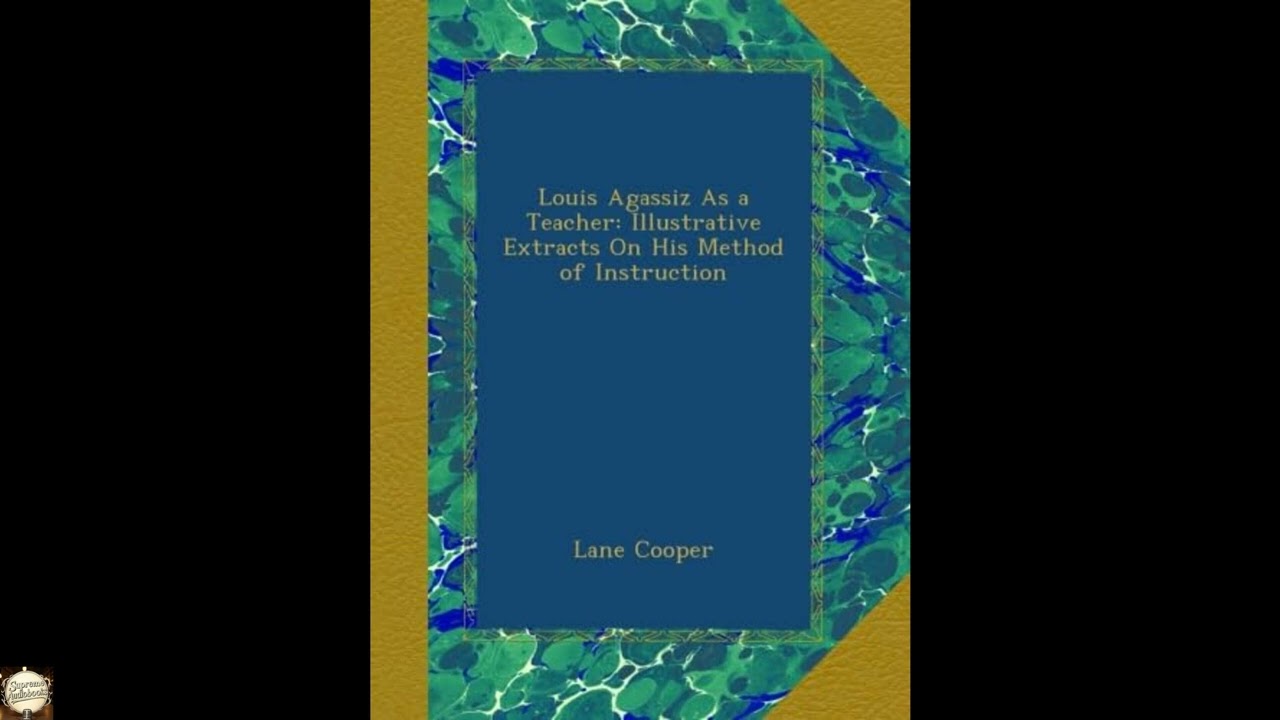
Louis Agassiz As a Teacher: Illustrative Extracts On His Method of Instruction by Lane Cooper. The underlying text is in the U.S. public domain. We do not republish any modern copyrighted edition, translation, or commentary.
The 4K cinematic visuals accompanying this audiobook are generated by an AI image model from prompts derived from the source text. No copyrighted photos, paintings, or stock footage are used. AI generation is disclosed on every video on our YouTube channel as required by YouTube's altered/synthetic content policy.
English subtitles are transcribed from the LibriVox recording with OpenAI Whisper. Translations into the 11 other supported languages are produced by Meta's NLLB-200 neural translation model. No human translator's copyrighted translation is used.
Questions about sourcing or rights? See our DMCA & Sourcing policy or contact us.
Enjoyed this audiobook?
If you'd like to own a copy of Louis Agassiz As a Teacher: Illustrative Extracts On His Method of Instruction or hear a professionally produced edition, the links below help support free audiobook production at no extra cost to you.
As an Amazon Associate we earn from qualifying purchases. Audible / print links are affiliate.