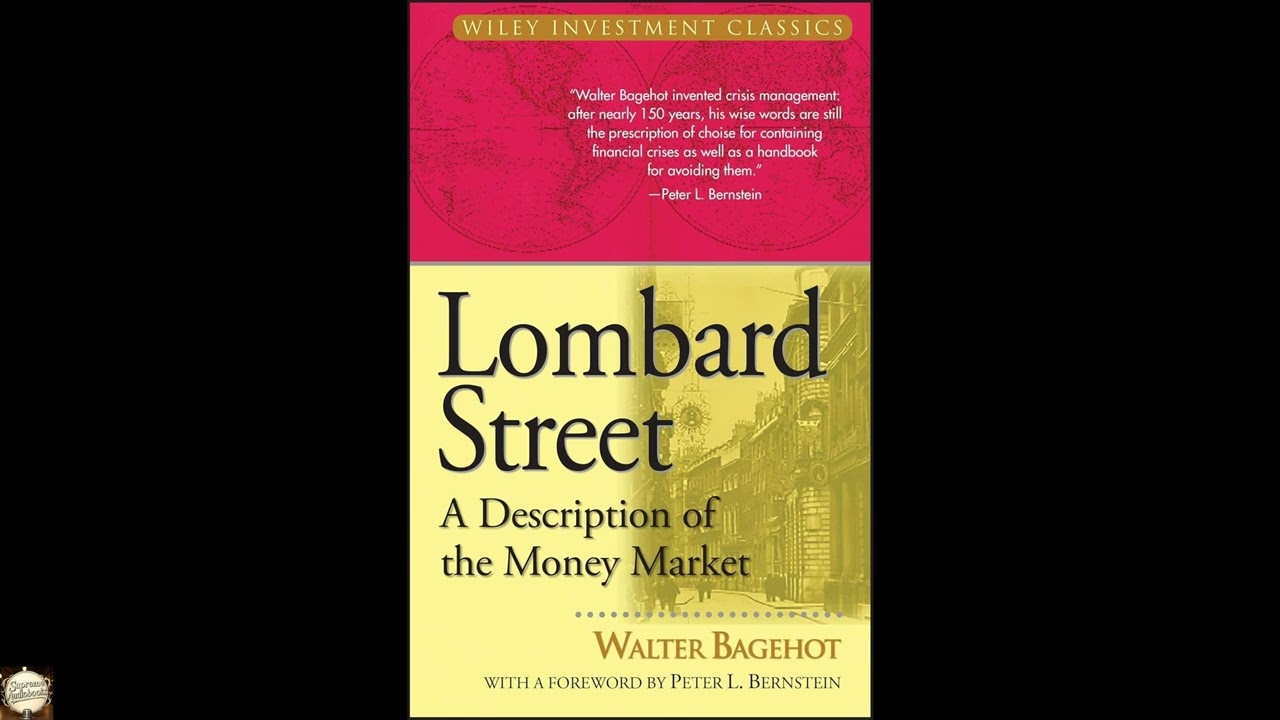
Lombard Street: A Description of the Money Market (Wiley Investment Classics)
Imagine a world where the very foundation of commerce–money and credit–feels precarious, subject to sudden collapses that ripple through every aspect of life. Now, consider that many of the financial anxieties we face today, from banking stability to the role of a central authority, were keenly observed and analyzed over a century ago. Lombard Street: A Description of the Money Market, despite its historical setting, offers an arresting look into the mechanisms of finance that remain strikingly relevant. This foundational text peels back the layers of the global economic engine, making sense of how capital flows, how credit is built and destroyed, and what crucial safeguards are needed to prevent widespread ruin. It’s a compelling intellectual challenge that illuminates the enduring logic and vulnerabilities of our modern financial systems. The scene opens in the bustling financial heart of Victorian London, specifically Lombard Street itself, the narrow artery crowded with banks, discount houses, and merchants. This confined geographic space serves as the central stage for a dramatic interplay of economic forces. The "main characters" are not individuals in the conventional sense, but rather the powerful institutions and abstract concepts that govern the flow of money: the Bank of England, with its unique, evolving responsibilities; the various joint-stock banks and private bankers competing for deposits and lending opportunities; and the discount houses, acting as crucial intermediaries in the short-term money market. The central conflict animating this narrative is the inherent instability of a credit-based economy. The author meticulously details how periods of speculative fervor give way to widespread panic, how trust can evaporate overnight, threatening to bring down the entire system. We witness the recurring crises of the mid-nineteenth century, presented as case studies in the fragility of financial confidence. The "arc of the story" is therefore an intellectual one, tracing the historical development of the London money market, identifying its strengths and critical weaknesses, and then systematically arguing for a new, more robust framework for stability. The author's investigation ultimately leads to a profound revelation about the essential, but often misunderstood, role of a central bank as the ultimate guardian of financial liquidity, a concept that changed banking theory forever. This remarkable volume, a cornerstone of financial literature, emerged from a period of intense economic transformation and recurrent crises in Great Britain. While the identity of its original author remains unrecorded, the work itself stands as a testament to the keen insight and analytical prowess of a truly acute financial observer of the era. Its enduring presence within the "Wiley Investment Classics" series underscores its monumental contribution to economic thought, particularly concerning central banking and the structure of money markets. The text is celebrated not just for its descriptive power but for its profound policy recommendations, which would go on to shape monetary policy around the globe. Its status as a classic comes from its precise analysis and prescriptive vision. It became, and remains, an authoritative statement on the principles guiding a central bank's actions during times of crisis. The book's anonymous author’s clear-sighted logic has informed generations of economists, bankers, and policymakers, making it an essential touchstone in understanding the evolution of modern financial systems. Its continued study is a recognition of its foundational role in shaping our current understanding of monetary policy and financial regulation. Among the specific themes permeating this insightful work, the most prominent is arguably the crucial role of a lender of last resort. The text repeatedly illustrates, through vivid historical examples of financial panics, how private banks, operating purely for profit, cannot reliably provide the necessary liquidity to stem a widespread crisis. During these moments, public confidence vanishes, and even solvent institutions face ruin due to a lack of available cash. The book argues forcefully that only a central bank, detached from commercial interests and possessing the power to issue currency, can step in to lend freely against good collateral, thereby stabilizing the system and preventing a spiral into full-blown depression. Another powerful theme is the fluid and often precarious nature of credit and confidence. The author shows how a country's effective "capital" is not merely its physical assets or gold reserves, but also the network of promises, bills of exchange, and trust that allows economic activity to function. When this trust falters, as it does during a crisis, even robust businesses can collapse simply because credit dries up. The text explains that the very strength of a developed money market, with its complex interconnections, also makes it vulnerable to sudden shifts in sentiment, demonstrating how essential it is to maintain public belief in the stability of financial institutions. This seminal text was born out of a specific historical crucible: the dynamic, yet volatile, British economy of the mid-to-late nineteenth century. This was a period when London stood unchallenged as the world's financial capital, the engine room of the vast British Empire. However, this era was also marked by a series of devastating financial panics – notably in 1825, 1847, 1857, and 1866 – each threatening the stability of the entire commercial system. These recurrent crises highlighted the ad-hoc, often inadequate, responses from the then-evolving Bank of England. Culturally, the period was one of burgeoning industrialization and global trade, which demanded sophisticated financial mechanisms, but also created new avenues for speculation and risk. Politically, there was a growing awareness that economic stability was not just a commercial matter but a national imperative. It was against this backdrop of rapid economic development, punctuated by periods of acute financial distress, that Lombard Street emerged. The work provided the theoretical clarity and practical policy prescriptions that were desperately needed to tame the wild swings of the market and establish a more resilient financial order. Listening to Lombard Street as an audiobook transforms what could be a dry academic study into an engaging narrative of economic principles in action. The sustained, clear narration allows the listener to fully absorb the intricate arguments and historical analyses without the distraction of a printed page. Its several-hour run length is perfectly paced for such a foundational work, giving ample time for the ideas to sink in without feeling rushed. You can appreciate the author's precise language and logical progression, following the unfolding of complex financial concepts and their practical implications. The voice brings a sense of gravity and authority to the subject, making the historical examples and policy recommendations resonate with renewed power, proving that the concerns of the nineteenth-century London money market are very much still our own.
Enjoyed Lombard Street: A Description of the Money Market (Wiley Investment Classics)? A few ways to support us
Audible & Amazon links are affiliate; we may earn a small commission at no extra cost.
About this production
Human narration by a volunteer reader from LibriVox.org, the public-domain audiobook project. LibriVox volunteers record literary works whose copyright has expired in the United States, releasing the resulting recordings into the public domain.
Lombard Street: A Description of the Money Market (Wiley Investment Classics) by Walter Bagehot. The underlying text is in the U.S. public domain. We do not republish any modern copyrighted edition, translation, or commentary.
The 4K cinematic visuals accompanying this audiobook are generated by an AI image model from prompts derived from the source text. No copyrighted photos, paintings, or stock footage are used. AI generation is disclosed on every video on our YouTube channel as required by YouTube's altered/synthetic content policy.
English subtitles are transcribed from the LibriVox recording with OpenAI Whisper. Translations into the 11 other supported languages are produced by Meta's NLLB-200 neural translation model. No human translator's copyrighted translation is used.
Questions about sourcing or rights? See our DMCA & Sourcing policy or contact us.
Enjoyed this audiobook?
If you'd like to own a copy of Lombard Street: A Description of the Money Market (Wiley Investment Classics) or hear a professionally produced edition, the links below help support free audiobook production at no extra cost to you.
As an Amazon Associate we earn from qualifying purchases. Audible / print links are affiliate.