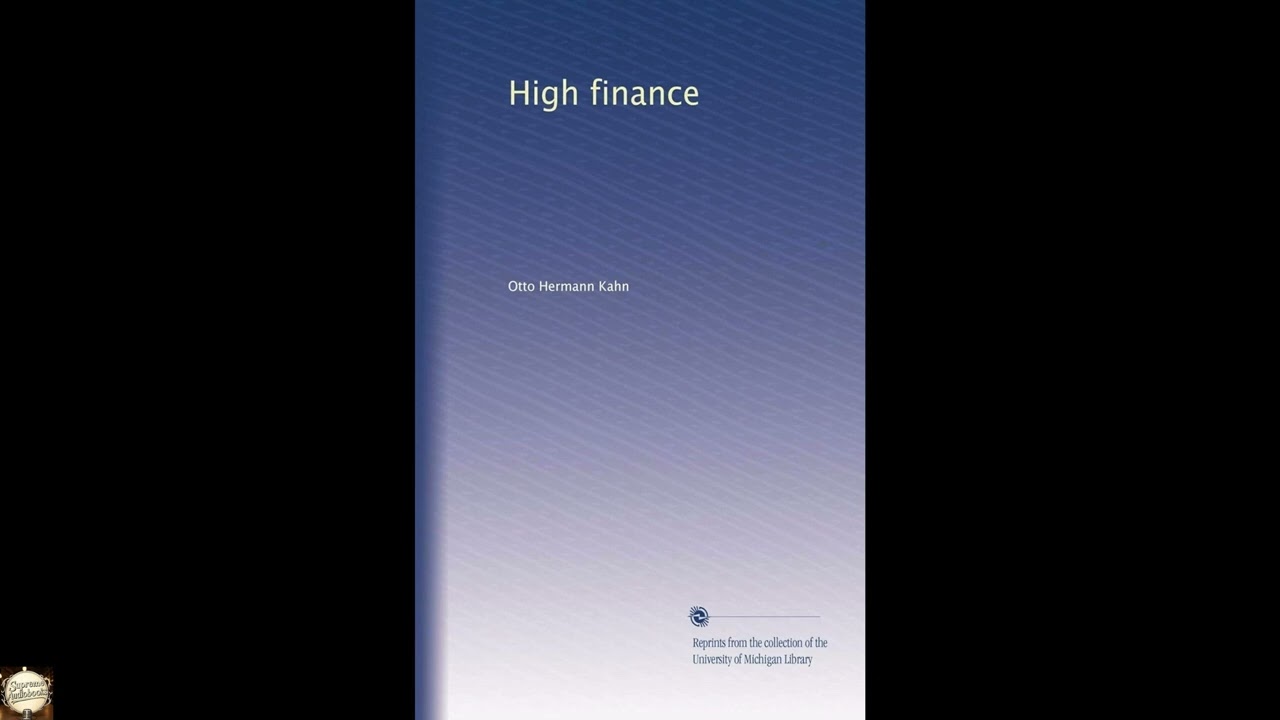
High finance
The world of high finance often appears opaque, a realm of complex dealings and immense power, removed from everyday life. Yet, its currents shape our societies, drive our economies, and dictate the fortunes of nations. High Finance, a powerful collection of insights from the legendary financier Otto Hermann Kahn, invites listeners into this often-misunderstood world, not as passive observers, but as intellectual partners. Here, the listener encounters the mind of a man who stood at the very nexus of capital and industry during an era of unprecedented growth and transformation. What resonates most strikingly today is Kahn's prescient understanding of finance not merely as a mechanism for profit, but as a profound instrument of societal construction and, when misused, destruction. His voice, emanating from the heart of early twentieth-century capitalism, offers enduring wisdom on the ethical obligations, systemic challenges, and vital role of wealth creation, providing a historical lens through which to examine our own economic landscape. This audiobook ushers listeners into the formidable intellectual arena where Otto Hermann Kahn spent his extraordinary career. It is less a conventional narrative and more an expansive philosophical excursion, guided by Kahn himself, through the intricate structures and moral dimensions of the financial system. We meet Kahn as the central guide, a figure of immense influence in American banking, who meticulously articulates his vision for responsible capitalism. The "setting" for this intellectual drama is the burgeoning financial landscape of the late nineteenth and early twentieth centuries: the bustling corridors of Wall Street, the boardrooms of powerful corporations, and the public forums where the very nature of wealth and its societal impact were hotly debated. Kahn confronts head-on the central conflicts inherent in the pursuit of capital: the tension between individual ambition and collective welfare, the fine line separating productive investment from destructive speculation, and the responsibility of the few who control vast sums for the many whose lives are affected. The arc of his discourse traces a compelling argument for integrity, foresight, and a profound sense of public duty as fundamental pillars of finance. He dissects the mechanics of capital formation, the imperative of robust credit systems, and the crucial partnership between industry and finance that powered the American economic miracle. Throughout, Kahn is less interested in merely describing the system than in challenging it, defending its vital role, and advocating for its principled evolution. Otto Hermann Kahn (1867-1934) was an American investment banker, collector, philanthropist, and patron of the arts. Born in Mannheim, Germany, into a family with a strong banking tradition, Kahn's early life steeped him in European culture and the practicalities of international finance. His path to prominence began in London before he immigrated to the United States in 1893, quickly rising through the ranks of the New York financial world. He became a partner at Kuhn, Loeb & Co. in 1897, one of the most powerful and influential investment banks of its era. There, he became a central figure in financing American railroads and major industrial enterprises, playing a crucial role in the nation's economic expansion. Beyond his financial prowess, Kahn possessed an extraordinary intellect and a deeply cultivated appreciation for the arts. He became a titan of philanthropy, famously serving as the chairman of the Metropolitan Opera and a significant benefactor to countless cultural institutions, including the New York Philharmonic and the Theatre Guild. His public pronouncements and writings, collected in this volume, established him as a leading public intellectual of his time, articulate in his defense of capitalism but equally fervent in his call for its ethical practice. Kahn's place in the canon is not as a novelist, but as a seminal voice in the literature of economics and social thought, a rare example of a financier who could both shape markets and articulate their broader moral implications with clarity and conviction. A prominent theme running through High Finance is the social responsibility of wealth. Kahn persistently argues that those entrusted with capital hold a stewardship, not merely ownership. He illustrates this by distinguishing between the financier who builds industries and provides employment, thereby advancing societal well-being, and the speculator who seeks quick profits without contributing tangible value. For Kahn, the true test of high finance lies in its capacity to uplift and empower communities, exemplified by investments in essential infrastructure or innovative enterprises that serve a public good. Another central theme is the inherent tension between progress and peril within capitalism. While a staunch defender of the free market as an engine of human advancement, Kahn frequently warns against the dangers of unbridled greed and the speculative excesses that can lead to economic instability. He critiques the mindset that prioritizes short-term gain over long-term stability, drawing lessons from past financial panics to advocate for prudential oversight and ethical conduct. Additionally, Kahn grapples with the intricate relationship between government and business. He believed in minimal governmental interference in market mechanisms but recognized the necessity of thoughtful regulation to prevent monopolies and safeguard the public interest. His discussions often highlight instances where excessive governmental control stifles innovation, yet equally condemns the abuses of power that emerge in an unregulated environment. Finally, Kahn's writings implicitly and explicitly address the role of individuals in shaping economic morality. He posits that the character and integrity of financiers are as crucial as any market mechanism, underscoring the personal choices that can either uphold or compromise the entire financial system. These themes, presented with Kahn's characteristic rigor and eloquence, remain remarkably relevant in today's global economy. The period in which Otto Hermann Kahn was most active was one of profound change for American society and its economy. Spanning the late Gilded Age, the Progressive Era, and the aftermath of World War I, this was a time when the United States transformed from an agrarian nation into an industrial and financial superpower. The rapid consolidation of wealth, the rise of powerful trusts, and the periodic financial panics provoked widespread public anxiety and ignited heated debates about the role and power of Wall Street. It was an age marked by growing calls for reform, including anti-trust legislation and the establishment of institutions like the Federal Reserve System in 1913. Kahn’s writings emerged directly from this maelstrom, offering an insider’s perspective that sought to explain, defend, and, in many ways, humanize the complex world of finance. Culturally, there was a deep societal fascination with, and often suspicion of, the "money kings" and "robber barons" of the era. High Finance stands as Kahn's considered response to these perceptions, an attempt to articulate a more nuanced and ethical understanding of the financier's craft. His work arose as a powerful counterpoint to the more simplistic narratives that often demonized or lionized financial power, serving as a sophisticated plea for balance and responsibility in an era prone to extremes. It offers a crucial window into the intellectual battles waged over the future of American capitalism and the moral compass guiding its expansion. Listening to High Finance as an audiobook offers a singular opportunity to engage directly with the intellect of a towering figure in financial history. With a run length of several hours, the narration provides ample time for Kahn's nuanced arguments to unfold, allowing listeners to absorb complex economic concepts and ethical frameworks at their own pace. A skilled narrator ensures that Kahn’s sophisticated prose, often filled with detailed analysis and carefully constructed logic, is delivered with clarity and measured authority. This allows for an atmosphere of contemplative learning, perfect for commutes, long walks, or dedicated study sessions. Hearing Kahn’s arguments voiced enables a deeper appreciation of his conviction and his persuasive style, transforming a historical text into an immediate and engaging intellectual discourse on the enduring principles that ought to govern the world of capital.
Enjoyed High finance? A few ways to support us
Audible & Amazon links are affiliate; we may earn a small commission at no extra cost.
About this production
Human narration by a volunteer reader from LibriVox.org, the public-domain audiobook project. LibriVox volunteers record literary works whose copyright has expired in the United States, releasing the resulting recordings into the public domain.
High finance by Otto Hermann Kahn. The underlying text is in the U.S. public domain. We do not republish any modern copyrighted edition, translation, or commentary.
The 4K cinematic visuals accompanying this audiobook are generated by an AI image model from prompts derived from the source text. No copyrighted photos, paintings, or stock footage are used. AI generation is disclosed on every video on our YouTube channel as required by YouTube's altered/synthetic content policy.
English subtitles are transcribed from the LibriVox recording with OpenAI Whisper. Translations into the 11 other supported languages are produced by Meta's NLLB-200 neural translation model. No human translator's copyrighted translation is used.
Questions about sourcing or rights? See our DMCA & Sourcing policy or contact us.
Enjoyed this audiobook?
If you'd like to own a copy of High finance or hear a professionally produced edition, the links below help support free audiobook production at no extra cost to you.
As an Amazon Associate we earn from qualifying purchases. Audible / print links are affiliate.