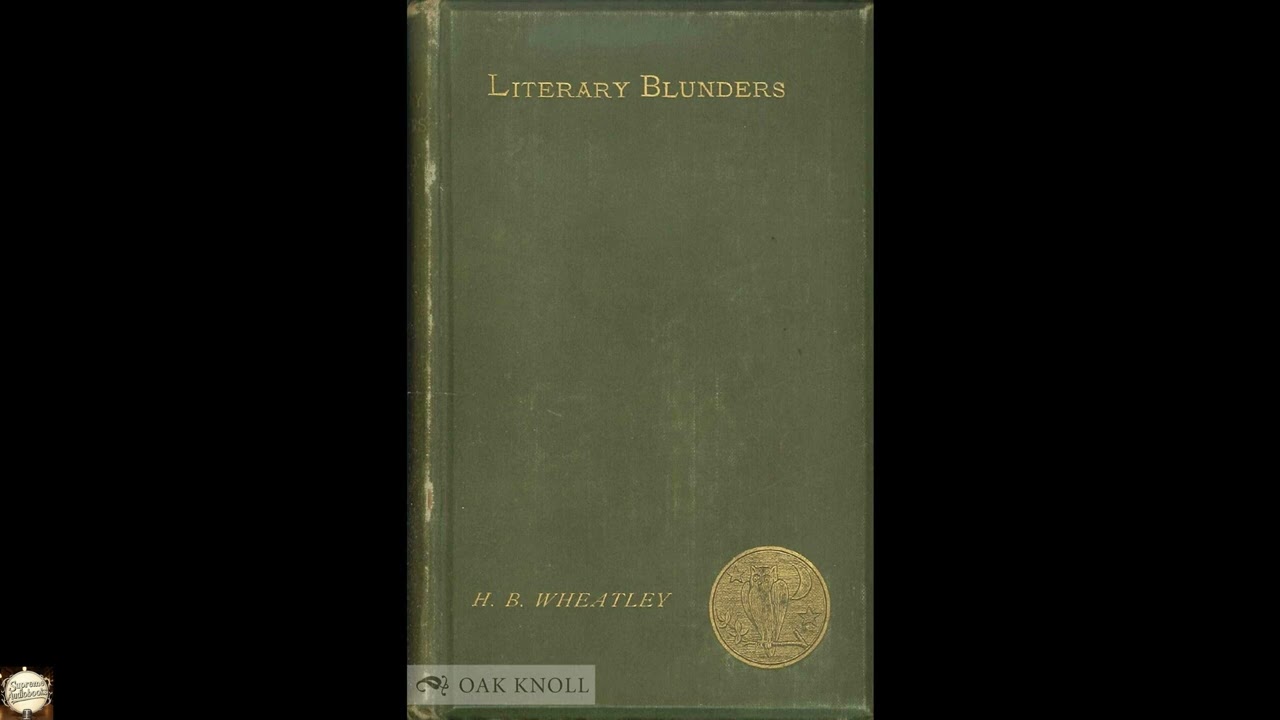
Literary blunders. A chapter in the history of human error
Step into a fascinating realm where even the most hallowed texts reveal their human origins, where perfection proves an elusive dream, and the march of knowledge is often punctuated by charming, baffling, or even scandalous missteps. Henry B. Wheatley's Literary Blunders. A chapter in the history of human error is not merely a catalog of mistakes; it is a profound and often humorous meditation on human fallibility itself, viewed through the magnifying glass of literature and scholarship. This work, originally published in the late nineteenth century, resonates profoundly with listeners today as we navigate an age of instant information and proliferating digital texts. It serves as a vital reminder that precision has always been a struggle, and that the foundations of our understanding are built upon countless attempts to correct, clarify, and sometimes simply guess at the truth. It offers a counterpoint to our contemporary pursuit of flawless data, celebrating instead the enduring quirks and triumphs of the human mind, both in its brilliance and its delightful imperfection. Wheatley functions as an erudite guide, leading the listener on a grand intellectual tour through centuries of textual misfires. His "setting" is nothing less than the entire sweep of printed and written history, from ancient manuscripts to contemporary journals and books. The "main characters" are not individuals in the typical sense, but rather the blunders themselves—the misplaced commas, the misremembered dates, the accidental omissions, the spurious attributions, and the bewildering errors introduced by zealous but misguided editors. Wheatley organizes these textual gaffes into various categories, systematically laying out how seemingly minor errors can propagate, morph, and occasionally take on a life of their own, altering meanings, reputations, and even historical narratives. The central tension driving this scholarly work is the perpetual struggle between the ideal of pristine, uncorrupted knowledge and the persistent, often humorous reality of human error in transcription, translation, and interpretation. The narrative arc of Literary Blunders is one of progressive revelation, demonstrating the sheer ubiquity of mistakes across all forms of written communication. Wheatley begins by chronicling the most basic of errors—printer's mishaps, spelling inconsistencies, and transcriptional slips—before moving into more complex territory, such as errors arising from misquotation, faulty memory, and the often-fraught process of translation. He presents examples that span disciplines, from poetic verse to scientific treatises, from historical accounts to legal documents, revealing that no field is immune. While the book avoids a traditional dramatic climax, its overarching progression reveals how certain errors can become so deeply embedded that they fundamentally alter the understanding of a text or historical event, prompting generations of scholars to unravel their origins. The listener gains a profound appreciation for the immense labor involved in achieving accuracy, and the sometimes-absurd consequences when that labor falls short. The author, Henry Benjamin Wheatley (1838–1917), was a towering figure in Victorian English bibliography, an editor of meticulous precision, and a widely respected antiquary. Born in London, Wheatley dedicated his long and distinguished career to the preservation, analysis, and accurate presentation of historical texts. His pivotal role as Secretary of the Early English Text Society for nearly fifty years underscores his commitment to making ancient and medieval English literature accessible and reliable for scholars and the public. He was also instrumental in the Index Society and the Bibliographical Society, tirelessly advocating for systematic approaches to knowledge organization and the study of books as physical objects. Beyond Literary Blunders, Wheatley's monumental achievements include producing the definitive, most complete edition of Samuel Pepys's diary in the late 19th century—a painstaking effort that brought one of history's most intimate and revealing personal accounts to light with unprecedented accuracy. His extensive work on London's history, notably London Past and Present, stands as another testament to his scholarly rigor and keen eye for detail. Wheatley's contributions solidified his place in the canon of Victorian scholarship, representing a generation of intellectuals deeply invested in philology, textual criticism, and the systematic cataloging of human knowledge. His work reflects the era's grand ambition to classify, understand, and restore the past, ensuring its legacy for future generations. At its heart, Literary Blunders enacts several profound themes. Foremost is the inescapable reality of human fallibility. Wheatley demonstrates, through countless examples, that no one is immune to error—not the most brilliant author, the most diligent printer, nor the most learned scholar. For instance, he details how even the most celebrated editions of classic works have harbored persistent misprints or misattributions, showing that errors can arise from simple oversight, a momentary lapse in concentration, or the limitations of early printing technology. Secondly, the book champions the critical importance of meticulous scholarship. By painstakingly collecting and categorizing these blunders, Wheatley implicitly makes a powerful case for the hard work of bibliographers, editors, and textual critics, whose efforts are essential to unearthing and correcting mistakes, thus preserving the integrity of knowledge. The very existence of this book, a careful examination of errors, stands as a testament to the rigorous standards Wheatley himself upheld. A third prominent theme is the dynamic and evolving nature of texts and knowledge. Wheatley illustrates how a single error in an initial printing can be copied and perpetuated through subsequent editions, sometimes even altering the generally accepted meaning of a passage or historical fact for centuries. He might present examples where a misplaced punctuation mark inadvertently transforms a solemn declaration into an ironic statement, or a forgotten word shifts the entire philosophical thrust of an argument. Finally, the book often reveals the unintended humor and absurdity inherent in error. While scholarly and serious in intent, many of the examples Wheatley presents are genuinely amusing in retrospect, offering a lighthearted perspective on human imperfection. The sheer oddity of certain historical misprints or the comical consequences of a simple typo often illicit a wry smile, reminding us that even the pursuit of accuracy can have its lighter side. When Literary Blunders was published in 1893, the cultural and intellectual landscape of Britain was deeply shaped by Victorian values of order, progress, and systematic inquiry. The late nineteenth century witnessed an explosion in literacy, the expansion of public libraries, and an accelerating pace of scientific and historical discovery. There was a profound public appetite for comprehensive knowledge and a desire to categorize and understand the world, both natural and historical, in unprecedented detail. This was also an era when the professionalization of literary scholarship was gaining significant momentum. Organizations like the Early English Text Society, with which Wheatley was intimately involved, were at the forefront of establishing accurate, scholarly editions of historical documents and literary works. The emergence of a book like Literary Blunders during this period was no accident. It perfectly aligned with the Victorian emphasis on textual criticism and philology, disciplines dedicated to the meticulous study of language in historical and literary sources. Scholars of the time were keenly aware that errors in transmission and printing could distort original meanings, and there was a concerted effort to create authoritative texts based on the most rigorous research. Wheatley's work, therefore, served both as a fascinating compendium for the curious lay reader and as a cautionary, educational tool for fellow scholars, reinforcing the necessity of vigilance and precision in the noble pursuit of truth. It reflected an era's dedication to laying robust intellectual foundations for future generations. Listening to Literary Blunders as an audiobook offers a unique and intimate way to appreciate Wheatley's erudition and wit. The experience becomes akin to settling into a comfortable chair in a grand, oak-paneled library, listening as a learned and amiable professor recounts an endless series of engaging anecdotes drawn from the vast annals of literature. The "several hours" run length is perfectly suited to the material, allowing for a measured pace that lets each fascinating example sink in, without feeling rushed or overwhelming. A skilled narrator will bring a subtle gravitas and perhaps a touch of wry amusement to Wheatley's observations, giving voice to the gentle scholarly humor that pervades the text. There isn't traditional dialogue, but the narrator's interpretation shapes the atmosphere, transforming what could be a dry academic listing into a compelling chronicle of human endeavor. It encourages a thoughtful, unhurried immersion in the history of ideas and the charming imperfections of the printed word, inviting reflection on the continuous effort required to build and maintain accurate knowledge.
Enjoyed Literary blunders. A chapter in the history of human error? A few ways to support us
Audible & Amazon links are affiliate; we may earn a small commission at no extra cost.
About this production
Human narration by a volunteer reader from LibriVox.org, the public-domain audiobook project. LibriVox volunteers record literary works whose copyright has expired in the United States, releasing the resulting recordings into the public domain.
Literary blunders. A chapter in the history of human error by HENRY B. WHEATLEY. The underlying text is in the U.S. public domain. We do not republish any modern copyrighted edition, translation, or commentary.
The 4K cinematic visuals accompanying this audiobook are generated by an AI image model from prompts derived from the source text. No copyrighted photos, paintings, or stock footage are used. AI generation is disclosed on every video on our YouTube channel as required by YouTube's altered/synthetic content policy.
English subtitles are transcribed from the LibriVox recording with OpenAI Whisper. Translations into the 11 other supported languages are produced by Meta's NLLB-200 neural translation model. No human translator's copyrighted translation is used.
Questions about sourcing or rights? See our DMCA & Sourcing policy or contact us.
View 10 famous quotes from this book →
Enjoyed this audiobook?
If you'd like to own a copy of Literary blunders. A chapter in the history of human error or hear a professionally produced edition, the links below help support free audiobook production at no extra cost to you.
As an Amazon Associate we earn from qualifying purchases. Audible / print links are affiliate.