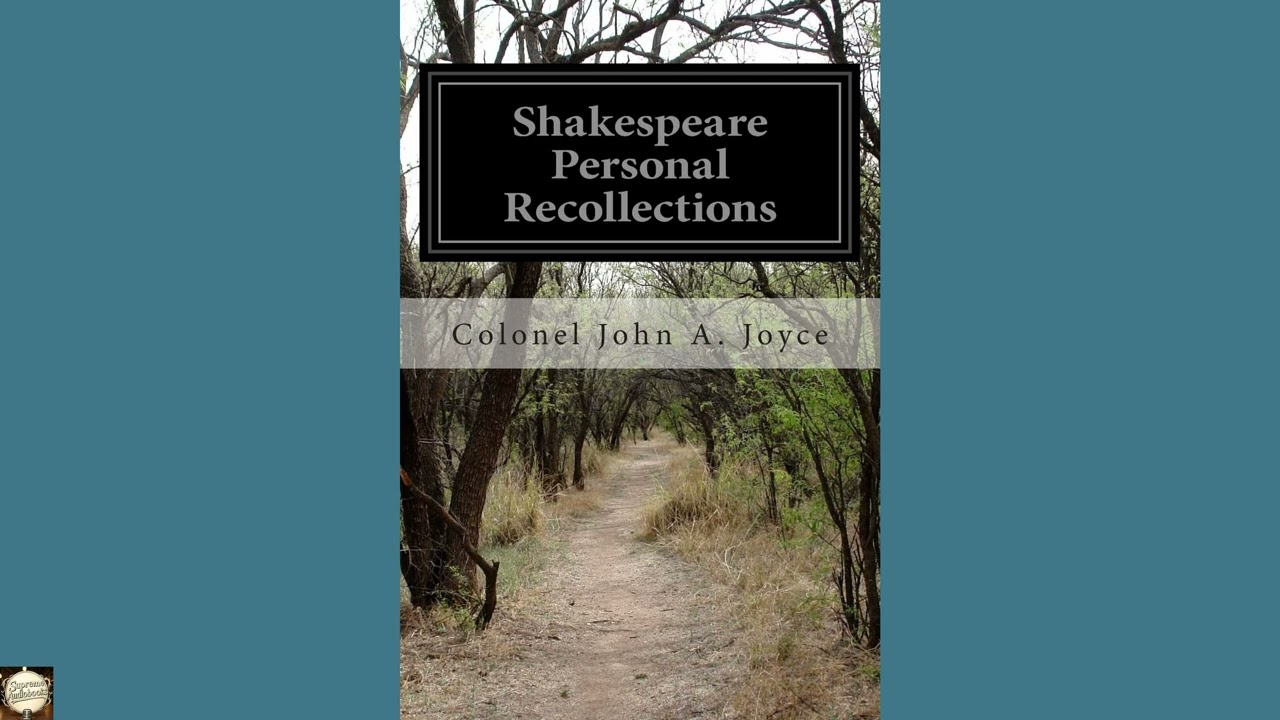
Shakespeare Personal Recollections
Imagine stepping back into a quieter time, when the giants of literature were not just subjects of academic study, but figures brought to life through passionate, personal reflection. Colonel John A. Joyce’s “Shakespeare Personal Recollections” offers precisely such an experience—a unique invitation into the mind of a devoted admirer grappling with the enduring genius of William Shakespeare. This is not a dry academic treatise, nor is it a conventional biography. Instead, it serves as a fascinating meditation, a collection of musings and imagined encounters that reveal as much about the late nineteenth-century American intellect as it does about the Bard himself. Listeners today find in Joyce’s words a window into a past cultural landscape, reminding us that the conversation with our literary heritage is ever-evolving and deeply personal. The pages of "Shakespeare Personal Recollections" unfold less like a traditional narrative and more like a series of thoughtful conversations with the past. Colonel Joyce transports the listener through his own literary imagination, painting impressionistic portraits of William Shakespeare from childhood in Stratford-upon-Avon to his prolific career on the London stage and his eventual return to his country home. The setting shifts fluidly between documented historical backdrops and the vivid landscape of Joyce’s own contemplation, allowing the English countryside and the bustling Elizabethan city to blend with the reflective quiet of a study in the late 1800s. The central "character" is, of course, Shakespeare himself, seen through the admiring, interpretive lens of Joyce. We encounter him not as a distant historical figure, but as a living presence, a man whose everyday experiences and extraordinary gifts are pondered with genuine affection and wonder. Beyond Shakespeare, the book introduces us to a supporting cast of historical figures, briefly glimpsed or speculated upon: Anne Hathaway, Ben Jonson, the actors and patrons of the Globe Theatre. But perhaps the most compelling character is Colonel Joyce himself, who emerges as a earnest, erudite, and sometimes delightfully anachronistic guide. The driving force, if one could call it a "conflict," is the perennial human desire to truly know and understand genius across the chasm of centuries. Joyce wrestles with the fragmentary nature of historical records, using his considerable intellect and personal empathy to bridge gaps, to imagine scenes, and to infer motivations. His "recollections" are an attempt to penetrate the mystery of Shakespeare's creative process, to understand the source of his boundless imagination, and to bring the mythical figure of the Bard closer to human scale. Rather than presenting a definitive account, the book’s arc follows Joyce’s evolving understanding and appreciation, a journey of intellectual fascination that never quite reaches a final, simplistic conclusion, leaving the ultimate enigma of Shakespeare’s greatness wonderfully intact. Colonel John A. Joyce, born in 1842 and passing away in 1915, lived a life as varied and compelling as the historical figures he wrote about. A Maryland native, Joyce distinguished himself early through his service in the American Civil War, rising to the rank of Colonel for the Union Army. His post-war career was equally diverse, encompassing roles as a lawyer and in government service, reflecting a keen intellect and a commitment to public life. Yet, it was perhaps his passion for letters that defined his later years, solidifying his reputation as an author and a public intellectual. Beyond "Shakespeare Personal Recollections," Joyce penned several other notable works that provide further insight into his expansive interests and writing style. His autobiographical "A Checkered Life" offers a firsthand account of his experiences and reflections, while collections of poetry such as "Pictures from My Nook" and "Bright Rays from Dark Caves" showcase his lyrical abilities and his penchant for thoughtful observation. Joyce was not aligned with a specific literary movement in the academic sense, but his writings embody many characteristics of the Victorian and early Edwardian eras in America: a strong interest in biography and history, a sentimental reverence for established literary giants, and a style of prose that aimed for accessibility and moral instruction alongside intellectual engagement. Though not considered a revolutionary figure in literary criticism, Joyce’s place in the broader literary canon is significant for demonstrating the intellectual pursuits and cultural tastes of his time, presenting the figure of the autodidact scholar whose enthusiasm for his subject shines through every page. At its core, "Shakespeare Personal Recollections" enacts several profound themes. One prominent idea is the nature of literary genius itself. Joyce consistently attempts to grasp the inexplicable brilliance of Shakespeare, moving beyond mere biographical facts to touch upon the spiritual and intellectual essence of his creativity. For instance, Joyce muses on Shakespeare’s unique ability to create characters who feel timeless and universally human, perhaps imagining Shakespeare observing a common tailor or a bustling merchant in London, drawing inspiration from the mundane to craft the immortal. Another compelling theme is that of memory and recollection, both personal and historical. The book itself is an act of "recollecting" a figure from the past, highlighting how personal memory – even when imagined or empathetic – profoundly shapes historical understanding. Joyce reflects on the inherent unreliability of distant historical accounts, contrasting them with the powerful clarity offered by empathetic projection, inviting the listener to consider how we reconstruct the past. Furthermore, the book beautifully illustrates the American engagement with English heritage. As an American writer of the late 19th century, Joyce brings a transatlantic perspective to Shakespeare, demonstrating how the Bard transcended national boundaries to become a figure of universal admiration, influencing even the emerging American identity. He might draw connections between the spirit of inquiry found in Shakespeare’s plays and American democratic ideals, or reflect on how Shakespeare’s language resonated deeply across the Atlantic. Finally, a strong theme emerges in the personalization of history. Joyce's method involves injecting his own personality, opinions, and sometimes even anachronistic insights into his portrayal of Shakespeare. This approach makes history feel immediate and subjective, as if the listener is privy to a private conversation between Joyce and the Bard, or observing Joyce’s personal interpretation of a specific sonnet, rendering the distant past surprisingly intimate and vibrant. The period in which Colonel Joyce penned his reflections on Shakespeare, broadly the late nineteenth and early twentieth centuries, was a time of immense cultural and societal flux in America. The nation was grappling with the aftermath of the Civil War, undergoing rapid industrialization, and forging a distinct national identity separate from its European roots. Despite this drive for American uniqueness, there was a robust and widespread interest in "high culture," particularly European literature, which was seen as a cornerstone of education and intellectual development. Shakespeare, in particular, occupied a unique and revered place in American homes, schools, and public discourse, often featuring in public readings, theatrical performances, and popular literary clubs. In the literary world, while realism and naturalism were gaining prominence, there remained a strong and popular strain of romantic reverence for established literary figures. This era saw the rise of popular biography and literary criticism designed for a general readership, often presented in an engaging, narrative style rather than purely academic prose. Joyce’s work fits perfectly within this cultural tendency—a desire to make Shakespeare accessible, to humanize history, and for authors like Joyce to connect with foundational texts in a manner that resonated deeply with a broad public hungry for knowledge and inspiration. His "Personal Recollections" emerged from a period when cultural engagement was not just academic, but a heartfelt pursuit of understanding and appreciation. Listening to "Shakespeare Personal Recollections" as an audiobook transforms Joyce’s intimate musings into a truly immersive experience. The conversational, reflective tone of Joyce’s prose, designed to feel like a fireside chat with a knowledgeable friend, translates beautifully to the spoken word. The narrator’s voice becomes the very embodiment of Colonel Joyce, guiding the listener through his thoughts with a measured pace that allows for full absorption of his arguments and evocative descriptions. With a run length of several hours, this audiobook provides ample opportunity for dedicated listening, whether during a commute, a long walk, or quiet contemplation at home. A skilled narrator will undoubtedly capture Joyce’s blend of earnest admiration, his scholarly yet approachable interest, and that touch of anachronistic charm that makes his perspective so unique. While not a play, the narrator's interpretation of Joyce’s imagined scenes or quoted lines from Shakespeare will further enrich the atmosphere, creating a palpable sense of literary contemplation and a seamless bridge between the present listener and the timeless genius of Shakespeare, as seen through Joyce’s remarkably personal lens.
Enjoyed Shakespeare Personal Recollections? A few ways to support us
Audible & Amazon links are affiliate; we may earn a small commission at no extra cost.
About this production
Human narration by a volunteer reader from LibriVox.org, the public-domain audiobook project. LibriVox volunteers record literary works whose copyright has expired in the United States, releasing the resulting recordings into the public domain.
Shakespeare Personal Recollections by Colonel John A. Joyce. The underlying text is in the U.S. public domain. We do not republish any modern copyrighted edition, translation, or commentary.
The 4K cinematic visuals accompanying this audiobook are generated by an AI image model from prompts derived from the source text. No copyrighted photos, paintings, or stock footage are used. AI generation is disclosed on every video on our YouTube channel as required by YouTube's altered/synthetic content policy.
English subtitles are transcribed from the LibriVox recording with OpenAI Whisper. Translations into the 11 other supported languages are produced by Meta's NLLB-200 neural translation model. No human translator's copyrighted translation is used.
Questions about sourcing or rights? See our DMCA & Sourcing policy or contact us.
View 10 famous quotes from this book →
Enjoyed this audiobook?
If you'd like to own a copy of Shakespeare Personal Recollections or hear a professionally produced edition, the links below help support free audiobook production at no extra cost to you.
As an Amazon Associate we earn from qualifying purchases. Audible / print links are affiliate.