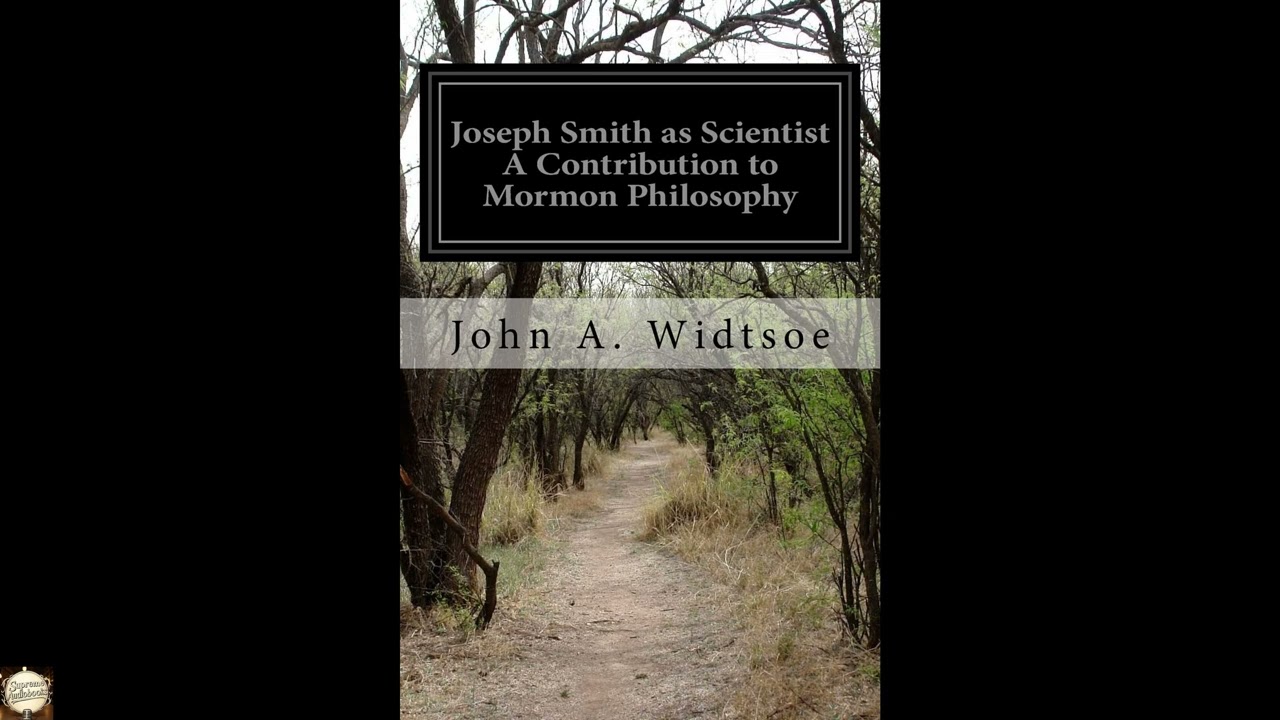
Joseph Smith as Scientist A Contribution to Mormon Philosophy
The title alone of John A. Widtsoe's Joseph Smith as Scientist A Contribution to Mormon Philosophy prompts immediate intrigue. How does one reconcile the prophet-founder of a distinct religious movement, traditionally understood through spiritual revelation, with the rigorous methodologies of scientific inquiry? Widtsoe’s foundational text, a unique contribution to American intellectual thought, presents a compelling argument that Joseph Smith’s worldview, his pronouncements, and the very structure of the faith he established were remarkably aligned with, and in some ways even anticipated, the scientific spirit of his time. For listeners today, living in an age frequently characterized by a perceived chasm between faith and reason, Widtsoe's work offers not only a provocative re-evaluation of a pivotal historical figure but also a profound meditation on the potential for compatibility between scientific pursuit and religious conviction. Widtsoe constructs his argument not as a typical biography, but as an extended intellectual thesis, systematically dissecting the philosophical underpinnings of Joseph Smith's teachings and actions. The setting for this examination is the dynamic intersection of early American religious revivalism and the burgeoning scientific advancements that began to redefine human understanding of the natural world. Widtsoe’s focus is on Joseph Smith himself, viewed through a particular lens: not just as a prophet, but as a pragmatic thinker, an observer of natural law, and a system builder whose insights, Widtsoe posits, mirrored scientific principles. The central tension arises from the widely held assumption that religion and science are inherently antithetical—faith requiring belief without proof, science demanding empirical verification. Widtsoe directly confronts this dichotomy, asserting that Smith's approach to knowledge, his cosmology, and his practical organizational efforts exhibit characteristics akin to the scientific method. The arc of Widtsoe's presentation unfolds as he moves through various facets of Smith’s life and teachings. He establishes Smith’s intellectual curiosity and his desire for demonstrable truth. From there, the exposition examines Smith’s statements on the nature of God, humanity, and the universe, demonstrating how they often align with principles of order, natural law, and progressive understanding—ideas that resonate deeply with scientific philosophy. Widtsoe highlights instances where Smith’s actions or pronouncements seem to prefigure later scientific discoveries or principles, presenting a portrait of a mind remarkably attuned to the patterns and structures of existence, even if articulated through a religious lexicon. John Andreas Widtsoe (1872-1952) was a figure of considerable intellectual stature, embodying the very synthesis of faith and reason his prominent work championed. Born in Norway, he immigrated to Utah as a young boy. Widtsoe pursued a rigorous education, graduating from Harvard University with a degree in chemistry in 1894, and later earning his Ph.D. from the University of Göttingen in Germany. His academic background was not merely theoretical; he applied his scientific training directly to real-world challenges, becoming a pioneer in dry farming techniques and reclamation, revolutionizing agricultural practices in arid regions of the American West. Widtsoe’s distinguished career saw him serve as President of Utah Agricultural College and later as President of the University of Utah. In 1921, he was called to serve as an apostle in The Church of Jesus Christ of Latter-day Saints, a position he held until his death. This unique trajectory—a respected scientist and university administrator who simultaneously served in one of the highest ecclesiastical offices of his church—made him an authoritative voice in discussions bridging secular learning and religious belief. Beyond Joseph Smith as Scientist, Widtsoe authored numerous works that articulated Latter-day Saint theology through a lens of rational inquiry, cementing his place as a foremost intellectual voice in twentieth-century Mormonism. One prominent theme running through Joseph Smith as Scientist is the reconciliation of faith and science. Widtsoe challenges the notion of inherent conflict, arguing instead for profound harmony. He illustrates this by examining Smith’s cosmology, which posits an ordered universe governed by immutable laws—principles deeply compatible with scientific inquiry. For instance, Smith’s teachings on the eternal nature of matter and intelligence are presented as intellectual frameworks that invite investigation rather than demand blind acceptance, mirroring the scientific drive to understand universal mechanisms. Another central theme is progressive revelation and the continuous search for knowledge, emphasizing Smith’s teaching that truth is not static but continually unfolds through both spiritual insight and diligent study of the natural world. This significant work emerged from a specific and dynamic historical crucible: the late nineteenth and early twentieth centuries, a period marked by profound shifts in intellectual and cultural landscapes. Western society was grappling with the transformative implications of Darwinian evolution and advancements in various sciences, which placed traditional religious narratives under intense scrutiny. Many religious institutions felt compelled to either retreat into fundamentalism or attempt awkward compromises. Within this broader context, the Church of Jesus Christ of Latter-day Saints itself was maturing, seeking to articulate its theology and history in a way that resonated with modern sensibilities. Widtsoe, with his dual training, was uniquely positioned to bridge this intellectual divide, demonstrating the inherent rationality and intellectual robustness of a faith tradition in an age increasingly skeptical of unexamined belief. To experience Joseph Smith as Scientist in its audiobook form is to engage with its arguments on a uniquely intimate and contemplative level. The sustained, measured delivery of the narrator brings clarity to Widtsoe’s careful exposition and systematic reasoning, allowing the listener to absorb complex philosophical ideas without the visual distractions of a printed page. Spanning several hours, this listening experience provides ample opportunity to immerse oneself fully in Widtsoe’s compelling case, following the logical unfolding of his insights as if engaged in a personal dialogue with the author. The pacing is designed for thoughtful assimilation, emphasizing the deliberate construction of the argument. It offers a focused intellectual encounter with a text that re-shapes perceptions about faith, science, and the remarkable legacy of Joseph Smith.
Enjoyed Joseph Smith as Scientist A Contribution to Mormon Philosophy? A few ways to support us
Audible & Amazon links are affiliate; we may earn a small commission at no extra cost.
About this production
Human narration by a volunteer reader from LibriVox.org, the public-domain audiobook project. LibriVox volunteers record literary works whose copyright has expired in the United States, releasing the resulting recordings into the public domain.
Joseph Smith as Scientist A Contribution to Mormon Philosophy by John A. Widtsoe. The underlying text is in the U.S. public domain. We do not republish any modern copyrighted edition, translation, or commentary.
The 4K cinematic visuals accompanying this audiobook are generated by an AI image model from prompts derived from the source text. No copyrighted photos, paintings, or stock footage are used. AI generation is disclosed on every video on our YouTube channel as required by YouTube's altered/synthetic content policy.
English subtitles are transcribed from the LibriVox recording with OpenAI Whisper. Translations into the 11 other supported languages are produced by Meta's NLLB-200 neural translation model. No human translator's copyrighted translation is used.
Questions about sourcing or rights? See our DMCA & Sourcing policy or contact us.
Enjoyed this audiobook?
If you'd like to own a copy of Joseph Smith as Scientist A Contribution to Mormon Philosophy or hear a professionally produced edition, the links below help support free audiobook production at no extra cost to you.
As an Amazon Associate we earn from qualifying purchases. Audible / print links are affiliate.