Jailed for Freedom: American Women Win the Vote
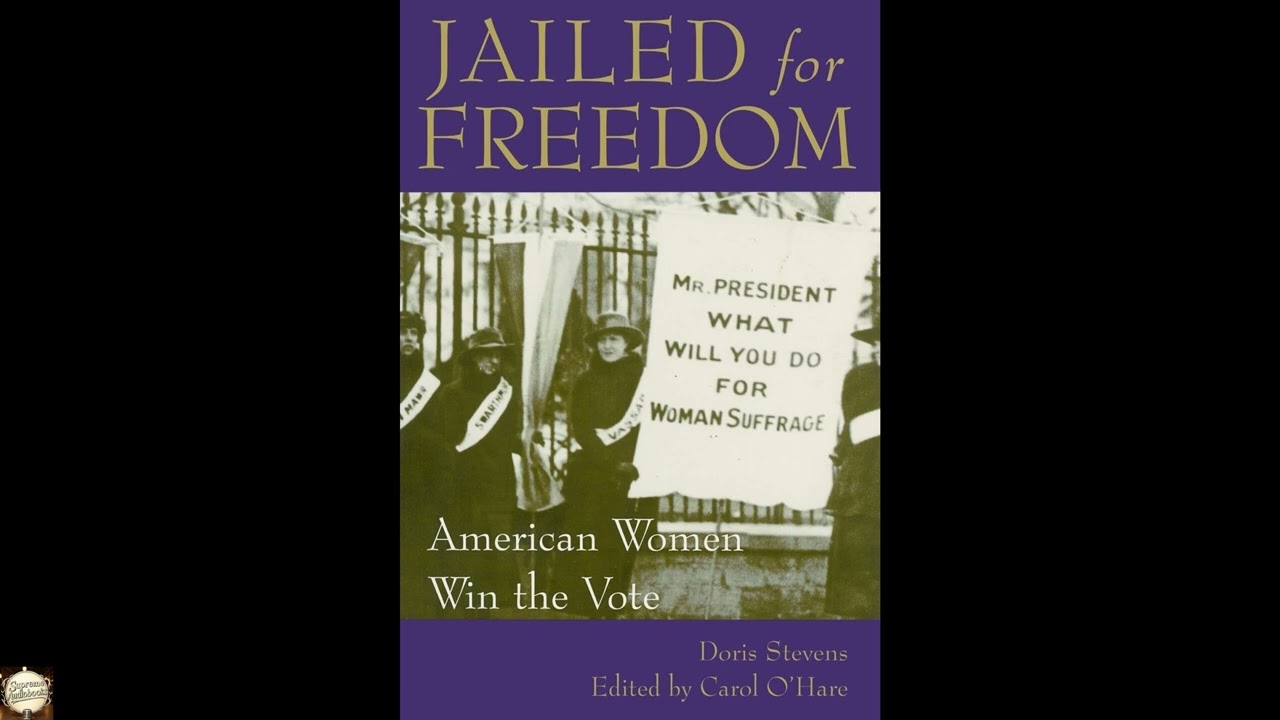
Imagine a fundamental right, universally accepted today as the bedrock of democracy, yet a mere century ago, it was a fiercely contested privilege denied to half the population. Doris Stevens’s powerful firsthand account, Jailed for Freedom: American Women Win the Vote, rips away any romanticized notions of how American women achieved suffrage, instead offering a stark, visceral chronicle of struggle, sacrifice, and unwavering defiance. This isn't a dry historical treatise but a living document, penned by a woman who not only witnessed history but actively shaped it, suffering imprisonment and brutality for the simple demand to be heard. Listeners today will find its pages ringing with urgent echoes, illuminating the enduring power of nonviolent protest and the personal cost of fighting for justice, making it an essential listen for anyone seeking to understand the deep roots of activism and equality in America. The story unfolds in the early years of the twentieth century, primarily in the nation’s capital, Washington D.C., where a dedicated group of suffragists, led by figures like Alice Paul and Lucy Burns, abandoned traditional, quiet lobbying for more confrontational tactics. Stevens herself stands among these courageous women, documenting their escalating efforts to compel President Woodrow Wilson and Congress to act on a federal suffrage amendment. What begins with organized parades and petitions soon evolves into a groundbreaking strategy: picketing the White House, even as America enters World War I. These "Silent Sentinels" stood day after day, year after year, bearing banners that called out the hypocrisy of fighting for democracy abroad while denying it to women at home. Their protests, initially met with amused tolerance, quickly devolved into outrage and then violent suppression. As the political climate tightened and public patience wore thin, especially during wartime, the government’s response grew harsher. Stevens details the arrests of these women, often on trumped-up charges like "obstructing traffic," and their subsequent imprisonment in facilities like the Occoquan Workhouse. Here, the true horror of their ordeal becomes chillingly clear. Stevens describes the unsanitary conditions, the harsh discipline, the brutal beatings, and the forced feeding of women who went on hunger strikes to protest their political imprisonment. This relentless mistreatment, far from breaking their spirit, galvanized them and, crucially, began to turn public opinion in their favor, creating a growing wave of sympathy and outrage that put immense pressure on a reluctant political establishment. Doris Stevens, born in Omaha, Nebraska, in 1888, was far more than just a chronicler of the suffrage movement; she was a central figure in its most audacious and effective campaigns. A graduate of Oberlin College and a former teacher, Stevens quickly channeled her intellectual rigor and passion for justice into activism. She served as a national organizer for the National Woman’s Party (NWP), working closely with Alice Paul to devise the strategies of direct action and civil disobedience that characterized the final, crucial push for the Nineteenth Amendment. Her unwavering commitment saw her arrested multiple times for picketing the White House and enduring the horrific conditions she so vividly recounts. After the successful passage of the suffrage amendment, Stevens did not rest. Her commitment to women’s rights broadened internationally. She dedicated herself to the cause of equal nationality rights for women, tirelessly working with the Inter-American Commission of Women and the League of Nations. Through her advocacy, she aimed to ensure that women would not lose their citizenship upon marrying a foreign national, a significant hurdle for many women at the time. "Jailed for Freedom," published in 1920, stands as her most enduring work, a foundational text that not only captures the raw intensity of a pivotal historical moment but also embodies the spirit of an activist whose life was dedicated to the relentless pursuit of equality. The book pulses with themes that resonate profoundly, even a century later. Foremost is the undeniable power of civil disobedience. Stevens illustrates how the suffragists, through their steadfast refusal to yield to unjust laws and brutal treatment, forced the nation to confront its own democratic ideals. One sees this in the chilling accounts of hunger strikes, where women willingly risked their lives, turning their own bodies into a final, irrefutable protest against political oppression. Their willingness to endure suffering rather than abandon their principles became a potent moral weapon, exposing the brutality of their captors and stirring the national conscience. Another central theme is the sheer courage and resilience of ordinary women facing extraordinary adversity. Stevens details how these women, often from diverse backgrounds, found strength in unity and an unshakeable belief in their cause. The narrative often highlights moments of profound solidarity within the prisons, where women supported one another through beatings, forced feedings, and solitary confinement, forging an unbreakable sisterhood born of shared sacrifice. Their stories challenge simplistic narratives of passive womanhood, revealing instead a formidable and determined cohort who met oppression with unparalleled fortitude. Published in 1920, the same year the Nineteenth Amendment was ratified, Jailed for Freedom arrived at a critical juncture in American history. The nation was emerging from the shadows of World War I, grappling with its newfound global power and a domestic landscape simmering with social and political change. The Progressive Era, with its focus on reform and expanding democratic participation, had laid some groundwork, but the suffrage movement's confrontational tactics diverged sharply from more traditional, genteel approaches. Stevens's book thus served as an immediate, impassioned testament to the brutal realities of the struggle, a triumphant yet sobering account penned directly after the victory, ensuring that the sacrifices made would not be forgotten as women prepared to exercise their newly won right. Listening to Jailed for Freedom as an audiobook offers a unique and deeply affecting experience. The spoken word brings a raw immediacy to Stevens's firsthand account, transforming historical text into a living narrative. You can hear the unwavering determination in the suffragists' voices, the chilling details of their prison experiences, and the strategic urgency of their protests. With several hours of running time, it provides an immersive understanding, perfect for quiet reflection or accompanying your daily routines. The pacing and narration allow you to fully absorb the emotional weight of each arrest, each act of defiance, and the slow, arduous march toward freedom, creating an atmosphere that makes the bravery and resolve of these women palpably real.
Enjoyed Jailed for Freedom: American Women Win the Vote? A few ways to support us
Audible & Amazon links are affiliate; we may earn a small commission at no extra cost.
About this production
Human narration by a volunteer reader from LibriVox.org, the public-domain audiobook project. LibriVox volunteers record literary works whose copyright has expired in the United States, releasing the resulting recordings into the public domain.
Jailed for Freedom: American Women Win the Vote by Doris Stevens. The underlying text is in the U.S. public domain. We do not republish any modern copyrighted edition, translation, or commentary.
The 4K cinematic visuals accompanying this audiobook are generated by an AI image model from prompts derived from the source text. No copyrighted photos, paintings, or stock footage are used. AI generation is disclosed on every video on our YouTube channel as required by YouTube's altered/synthetic content policy.
English subtitles are transcribed from the LibriVox recording with OpenAI Whisper. Translations into the 11 other supported languages are produced by Meta's NLLB-200 neural translation model. No human translator's copyrighted translation is used.
Questions about sourcing or rights? See our DMCA & Sourcing policy or contact us.
Enjoyed this audiobook?
If you'd like to own a copy of Jailed for Freedom: American Women Win the Vote or hear a professionally produced edition, the links below help support free audiobook production at no extra cost to you.
As an Amazon Associate we earn from qualifying purchases. Audible / print links are affiliate.