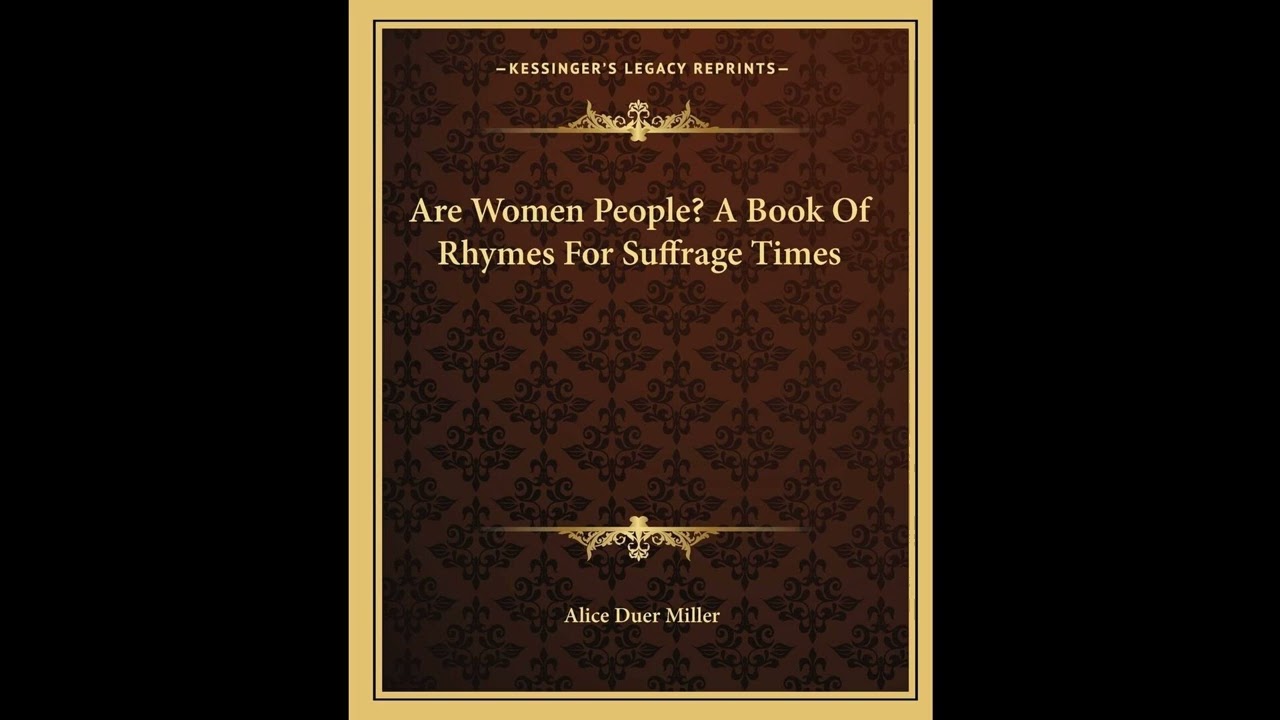
Are Women People? A Book Of Rhymes For Suffrage Times
Is the question posed in the title a serious one? In Alice Duer Miller's brilliant collection of satirical verse, “Are Women People? A Book of Rhymes for Suffrage Times,” the question is not just serious but an urgent, political demand—one delivered with such incisive wit and playful mockery that it became a rallying cry for a movement. Published in 1915, at the height of the American women's suffrage campaign, this book remains a potent reminder of the absurdities faced by those fighting for fundamental rights. It is a work that still resonates deeply today, offering a masterclass in how humor and logic can dismantle prejudice, and reminding us that battles for equality often involve questioning deeply ingrained assumptions about who counts as "people." The book presents its argument not through heavy-handed polemic, but through a series of short, rhyming poems, each a miniature play of logic and irony. Miller's technique is to take the most common anti-suffrage arguments of her era—the notion that women are too emotional for politics, too domestic, too fragile, or that giving them the vote would somehow unravel the fabric of society—and turn them on their head. She reframes these familiar objections with a clever twist, often applying the same flawed reasoning to men or to entirely different, nonsensical situations. For example, in the renowned "Why We Oppose Votes for Men," she lists reasons such as men's "logical" disposition making them unfit for the polls, or that their excessive public presence might neglect their families. The collection features no single overarching plot or conventional character development, yet it tells a compelling story: the systematic, humorous dismantling of entrenched prejudice. Each poem acts as a scene in this intellectual comedy, where the "main characters" are the voices of condescension and the clear-eyed, sharp-tongued suffragist retort. The central conflict is the clash between antiquated notions of gender roles and the burgeoning demand for equal civic participation. The arc of the story, then, is the gradual exposure of logical fallacies and hypocrisies, building a powerful, undeniable case for women’s right to vote, all without ever losing its clever, light touch. Alice Duer Miller (1874-1942) was a formidable intellectual and a prolific writer, recognized as a vital voice in American literature during the early 20th century. Born in New York City, she came from a prominent family, with her mother being a descendant of Peter Stuyvesant. Miller attended Barnard College before transferring to Vassar, graduating in 1899, and later pursued graduate studies at Columbia University. Her early career saw her publishing numerous short stories and novels, often exploring themes of societal expectations and women's roles, frequently with a keen, observant eye for social dynamics. Before “Are Women People?” brought her widespread fame as a suffrage advocate, she had established herself as a respected literary figure. Miller's writing style was marked by its clarity, wit, and engaging narrative. While her fiction was popular, it was her foray into political satire with "Are Women People?" that cemented her place as a significant cultural commentator. Her ability to distill complex arguments into memorable, rhyming verse made her an indispensable voice for the suffrage movement, reaching a broad audience beyond traditional political tracts. In later years, Miller continued her literary output, even moving to Hollywood to become a successful screenwriter, contributing to films like "Come and Get It" (1936), further demonstrating her versatility and adaptability as an artist. Her work consistently reflected a commitment to intelligent observation and social commentary. At its core, "Are Women People?" brilliantly enacts the theme of logical fallacy as a tool of oppression. Miller consistently highlights how anti-suffrage arguments, when stripped of their emotional appeal, reveal themselves to be fundamentally illogical and often contradictory. For instance, in the poem "A Lady's Reason," she satirizes the idea that women should not vote because they are already represented by their husbands, then flips it to suggest men might equally be represented by their wives, exposing the inherent bias. Another prominent theme is the power of satire and humor in social movements. Miller understood that a well-placed joke or a clever turn of phrase could be far more effective in changing hearts and minds than earnest appeals alone. Her short, sharp verses were easily shared, quoted, and remembered, providing a palatable yet pointed critique. The collection also touches upon hypocrisy in public discourse and the contested definitions of citizenship and personhood. Miller exposes the double standards applied to men and women, demonstrating how qualities praised in one gender were used to disqualify the other from public life. For example, she questions why "nervous energy" might be a disqualification for voting, yet not for running large corporations. By forcing readers to consider these arguments in a new, often absurd, light, she compels a re-evaluation of what it truly means to be a citizen with rights and responsibilities. The simple, direct question of the title, repeated implicitly throughout the book, is a profound challenge to the very foundation of patriarchal society. The period surrounding the publication of "Are Women People?" in 1915 was a crucible for social and political change in the United States. The women's suffrage movement, which had been gaining momentum since the mid-19th century, was nearing its culmination. Activists employed a wide array of strategies, from parades and protests to lobbying and legal challenges. However, they also faced deeply entrenched resistance. Anti-suffrage arguments often centered on the "separate spheres" ideology, which dictated that women's place was strictly in the domestic realm, while men dominated public life. There was a genuine fear among some that granting women the vote would disrupt family structures, lead to the "masculinization" of women, or even bring about the collapse of civilization. Amidst this fervent debate, Miller's book emerged as a particularly effective weapon. Her unique approach allowed suffragists to counter their opponents with accessible, often hilarious, counter-arguments that resonated with a broad public. Instead of dry rhetoric, Miller offered a weapon of wit, making the anti-suffragists' positions appear not just wrong, but foolish. The book became immensely popular, widely circulated, and frequently quoted, undoubtedly contributing to the shift in public opinion that eventually led to the passage of the 19th Amendment in 1920, guaranteeing women the right to vote. Its cultural impact was significant, providing not only intellectual ammunition but also a much-needed dose of levity and shared laughter during a serious political struggle. Listening to "Are Women People? A Book of Rhymes for Suffrage Times" as an audiobook offers a unique and particularly fitting experience. The inherent rhythm and meter of Miller's satirical verse truly come alive when spoken, allowing the listener to fully appreciate the clever wordplay, the subtle nuances of irony, and the comedic timing embedded in each line. A skilled narrator can amplify the gentle mockery and the sharp intelligence that might be missed in a silent reading, bringing out the various implied voices—the earnest suffragist, the bewildered anti-suffragist, the witty observer. The approximately several-hour run time allows for absorbing these potent arguments at a measured pace, letting each point settle, while the directness of the language ensures clarity. It is a work meant to be heard, its rhetorical power enhanced by the human voice, offering an engaging way to connect with a pivotal moment in social history and the enduring fight for equality.
Enjoyed Are Women People? A Book Of Rhymes For Suffrage Times? A few ways to support us
Audible & Amazon links are affiliate; we may earn a small commission at no extra cost.
About this production
Human narration by a volunteer reader from LibriVox.org, the public-domain audiobook project. LibriVox volunteers record literary works whose copyright has expired in the United States, releasing the resulting recordings into the public domain.
Are Women People? A Book Of Rhymes For Suffrage Times by Alice Duer Miller. The underlying text is in the U.S. public domain. We do not republish any modern copyrighted edition, translation, or commentary.
The 4K cinematic visuals accompanying this audiobook are generated by an AI image model from prompts derived from the source text. No copyrighted photos, paintings, or stock footage are used. AI generation is disclosed on every video on our YouTube channel as required by YouTube's altered/synthetic content policy.
English subtitles are transcribed from the LibriVox recording with OpenAI Whisper. Translations into the 11 other supported languages are produced by Meta's NLLB-200 neural translation model. No human translator's copyrighted translation is used.
Questions about sourcing or rights? See our DMCA & Sourcing policy or contact us.
Enjoyed this audiobook?
If you'd like to own a copy of Are Women People? A Book Of Rhymes For Suffrage Times or hear a professionally produced edition, the links below help support free audiobook production at no extra cost to you.
As an Amazon Associate we earn from qualifying purchases. Audible / print links are affiliate.