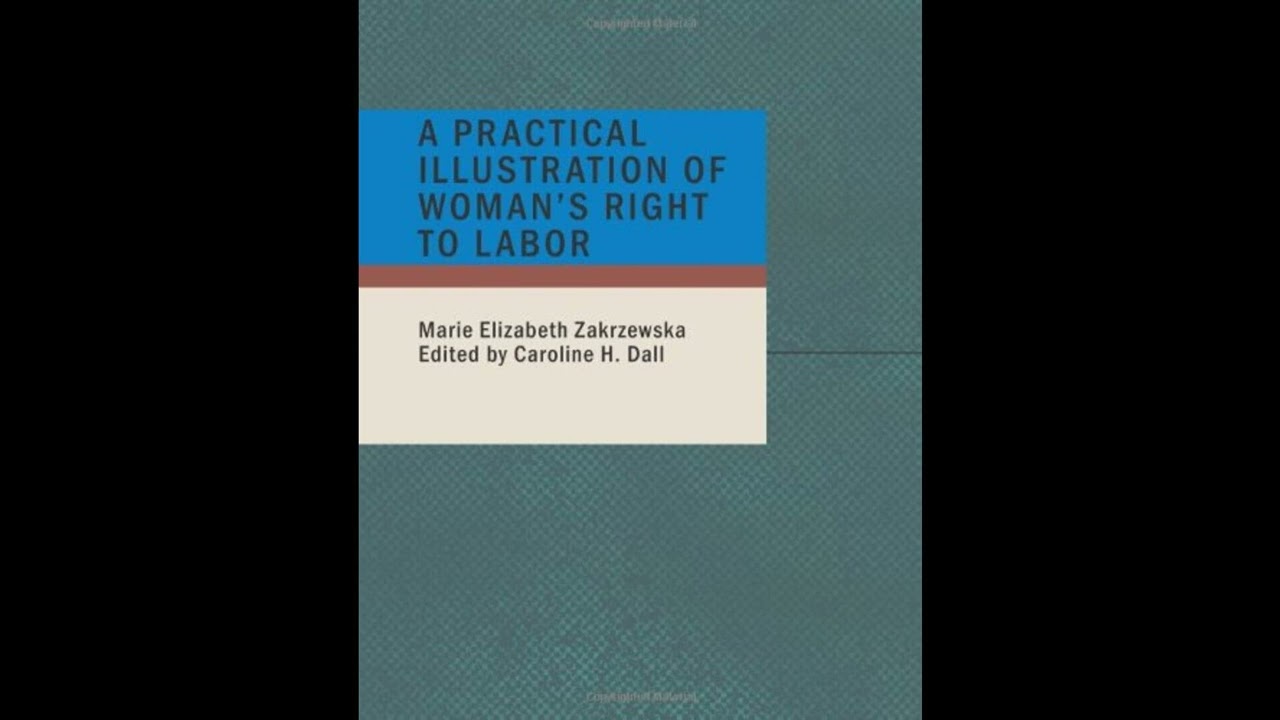
A Practical Illustration of Woman's Right to Labor: A Letter from Marie E. Zakrzewsk- Full Audiobook
In an era when the very notion of a woman pursuing a professional career was considered radical, even scandalous, a powerful voice emerged to challenge these entrenched beliefs. A Practical Illustration of Woman's Right to Labor: A Letter from Marie E. Zakrzewska stands as a vital testament to the strength of conviction and the undeniable force of individual example. Though presented as a letter, this audiobook is far more: it is a compelling narrative, a meticulously argued case, and a historical document that resonates profoundly with contemporary discussions about gender equality, professional access, and the right to meaningful work. It directly confronts the societal structures that confined women, making a passionate argument for their professional liberation through the very real experiences of a pioneering woman. The "letter" unfurls the remarkable life and struggles of Marie E. Zakrzewska, presenting her experiences as a living proof of women's inherent capabilities and their right to pursue labor in any field. The setting is mid-19th century America, a society grappling with rapid change but still deeply rooted in patriarchal traditions, particularly concerning women's roles outside the home. The central character, Marie E. Zakrzewska, is introduced not merely as an individual but as a representative figure, her personal ambitions and professional drive becoming a microcosm of a larger societal struggle. From an early age, her aptitude and desire for medical work are evident, leading her to formal training in Europe at a time when such opportunities were virtually nonexistent for women in America. The core conflict of her story arises upon her arrival in the United States, where her European qualifications and practical experience meet a wall of prejudice and institutional resistance. Despite her demonstrable skill, Zakrzewska finds herself repeatedly denied the opportunity to practice medicine or even gain further clinical experience in established hospitals, simply because of her sex. The letter details the frustrations and indignities she faced, recounting specific instances of her determination to overcome these barriers. Her arc is one of relentless perseverance: when conventional paths are blocked, she seeks out and helps create new ones, demonstrating an unwavering commitment to her calling and to the principle that talent, not gender, should dictate one's professional destiny. The narrative builds a powerful case through these lived experiences, illustrating how societal restrictions stifled not only individual potential but also collective progress. While the specific author of this compelling "Letter" remains unknown to history, the life it illustrates belongs to the extraordinary Marie E. Zakrzewska. Born in Berlin (then part of the Kingdom of Prussia) in 1829, Zakrzewska's early exposure to the medical field came through her mother, a skilled midwife. Marie herself trained as a midwife and became proficient, eventually heading a midwifery school in Berlin. Driven by an insatiable desire to expand her medical knowledge and practice, she emigrated to the United States in 1853. Her ambition quickly collided with the rigid gender norms of American society. Despite her advanced training, she initially found it impossible to gain admission to medical schools or secure hospital positions. It was only through the determined efforts of Elizabeth Blackwell, America's first female physician, that Zakrzewska was finally able to enroll in the Western Reserve University medical department in Cleveland, graduating in 1856. Zakrzewska's career became a testament to her belief in women's right to labor. She worked closely with the Blackwell sisters, Elizabeth and Emily, helping to establish the New York Infirmary for Indigent Women and Children in 1857, which provided medical care and training opportunities for women. Her greatest achievement, however, was the founding of the New England Hospital for Women and Children in Boston in 1862. This institution was groundbreaking, not only offering medical care to women and children by female physicians but also providing clinical training, internships, and residencies exclusively for women. Zakrzewska's legacy extends beyond her medical practice; she was a staunch advocate for women's education, public health, and social reform until her death in 1902. Her life, as presented in this letter, serves as a powerful historical record of what one woman could achieve against formidable odds. At its core, this letter champions several potent themes. Foremost is the right to labor for women, arguing that talent and dedication, not sex, should determine one's professional path. Zakrzewska's early training and success as a midwife in Europe, where she capably managed complex medical situations, serve as a concrete example, dismantling the argument that women lacked the intellectual or emotional fortitude for medicine. A second crucial theme is gender discrimination and the dismantling of institutional barriers. The text vividly recounts Zakrzewska's repeated rejections from American hospitals and medical societies, illustrating the systemic obstacles women faced. For instance, the letter details her struggle to gain practical experience, even after graduating from medical school, because male-dominated institutions simply refused to admit women practitioners. Third, the letter powerfully demonstrates self-reliance and perseverance. When faced with closed doors, Zakrzewska did not retreat; instead, she collaborated with other pioneering women to create entirely new institutions, such as the New York Infirmary and later the New England Hospital. These acts of creation are presented as direct responses to prejudice, showing her capacity to forge opportunity where none existed. Finally, the entire work is an act of advocacy and social reform, using Zakrzewska's personal experiences as a compelling case study to argue for broader societal change. It is not merely a recounting of a life but a persuasive document intended to influence public opinion and governmental policy regarding women's professional standing. This letter emerged during a transformative period in American history, the mid-nineteenth century, a time rife with social and political ferment. The years leading up to and immediately following the Civil War saw the burgeoning of various reform movements, including abolitionism, temperance, and, notably, the nascent women's rights movement. The Seneca Falls Convention of 1848 had already laid the groundwork for demands for women's suffrage and greater equality. Women were increasingly stepping into public roles, particularly through benevolent societies and reform efforts, yet their professional opportunities remained severely circumscribed. Fields like medicine, law, and higher education were almost exclusively male domains. The prevailing cultural belief in "separate spheres" relegated women to the domestic realm, arguing against their perceived physical and emotional unsuitability for public life and demanding professions. Within this context, the publication of A Practical Illustration of Woman's Right to Labor served a vital purpose. It was a direct challenge to these societal norms, offering empirical evidence—the living proof of Marie Zakrzewska's career—that women were not only capable but also highly successful in a demanding profession. The letter provided an articulate, lived argument against the prejudices of the age, bolstering the arguments of feminists and reformers who championed greater educational and professional access for women. It was a rallying cry and a factual account rolled into one, demonstrating why institutions that restricted women's labor were not only unjust but also detrimental to society as a whole. Listening to A Practical Illustration of Woman's Right to Labor as an audiobook offers a uniquely intimate and impactful experience. The format allows the listener to absorb the nuances of the argument and the personal narrative with greater immediacy, almost as if hearing the original letter read aloud. Over its several hours, a skilled narrator can convey the sincerity and quiet power of Zakrzewska's story, allowing the persuasive logic of her experiences to unfold at a contemplative pace. Listeners can appreciate the careful construction of the "letter" itself, noting how personal anecdotes are woven into a broader social critique. The voice brings to life the struggles and triumphs, making Zakrzewska's determination palpable and highlighting the unwavering conviction behind her quest for professional freedom. It transforms a historical document into a living testament, inviting reflection on the enduring fight for equality and the strength of the individual spirit.
Enjoyed A Practical Illustration of Woman's Right to Labor: A Letter from Marie E. Zakrzewsk- Full Audiobook? A few ways to support us
Audible & Amazon links are affiliate; we may earn a small commission at no extra cost.
About this production
Human narration by a volunteer reader from LibriVox.org, the public-domain audiobook project. LibriVox volunteers record literary works whose copyright has expired in the United States, releasing the resulting recordings into the public domain.
A Practical Illustration of Woman's Right to Labor: A Letter from Marie E. Zakrzewsk- Full Audiobook by Marie Elizabeth Zakrzewska. The underlying text is in the U.S. public domain. We do not republish any modern copyrighted edition, translation, or commentary.
The 4K cinematic visuals accompanying this audiobook are generated by an AI image model from prompts derived from the source text. No copyrighted photos, paintings, or stock footage are used. AI generation is disclosed on every video on our YouTube channel as required by YouTube's altered/synthetic content policy.
English subtitles are transcribed from the LibriVox recording with OpenAI Whisper. Translations into the 11 other supported languages are produced by Meta's NLLB-200 neural translation model. No human translator's copyrighted translation is used.
Questions about sourcing or rights? See our DMCA & Sourcing policy or contact us.
Enjoyed this audiobook?
If you'd like to own a copy of A Practical Illustration of Woman's Right to Labor: A Letter from Marie E. Zakrzewsk- Full Audiobook or hear a professionally produced edition, the links below help support free audiobook production at no extra cost to you.
As an Amazon Associate we earn from qualifying purchases. Audible / print links are affiliate.