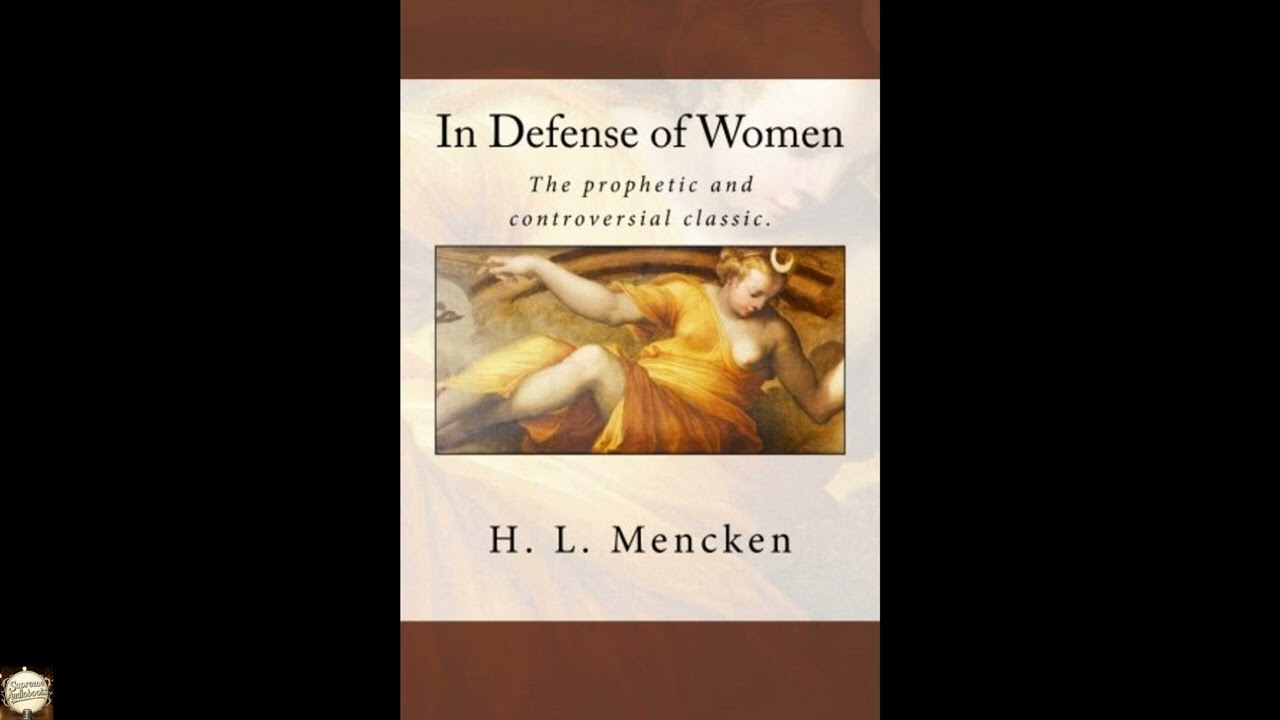
In Defense of Women
H. L. Mencken’s “In Defense of Women” stands as a blistering, often hilarious, and perpetually provocative examination of the age-old battle of the sexes, penned by one of America’s most iconoclastic and influential writers. First published in 1918, this collection of essays is not a polite defense in the modern sense; instead, it is a frontal assault on conventional wisdom, societal pieties, and—most pointedly—the male ego. Why should a listener care about such a document today? Because Mencken, with his characteristic blend of savage wit and unsparing observation, dissects the fundamental power dynamics between men and women in ways that, despite their early 20th-century origins, still sting and enlighten in equal measure. It forces a listener to reconsider deeply ingrained assumptions about intelligence, emotion, strategy, and desire, prompting debates that remain fiercely relevant in our contemporary conversations about gender, equality, and the perpetual enigma of human relationships. Mencken sets his stage by inviting us into his world, a realm where common sense is often inverted and sacred cows are gleefully slaughtered. The book does not follow a linear narrative with traditional characters, but rather presents a relentless progression of arguments, each building upon the last to construct Mencken’s unique, often scandalous, worldview regarding the sexes. His central thesis, paradoxically, posits women as the superior sex—not in terms of physical strength or public influence, but in their raw, pragmatic intelligence and their clear-eyed understanding of life's realities. Men, in Mencken’s estimation, are perpetually blinded by sentimentality, abstract ideals, and a profound, almost tragic, self-deception about their own importance and control. He presents “Woman” as a shrewd, practical strategist, whose seemingly delicate exterior conceals a formidable will and an innate ability to navigate the social landscape to her advantage. "Man," by contrast, appears as a bumbling, easily manipulated creature, perpetually caught in the snares of his own romantic illusions and biological imperatives. Mencken meticulously details how women, through their mastery of appearance, emotion, and subtle manipulation, achieve their desired ends—most notably, securing a partner and establishing a secure domestic sphere—while men are often left chasing phantoms of chivalry and honor. He spares no institution, taking aim at marriage as a largely female invention, designed for the comfort and advancement of women, and at love as a male delusion, easily exploited. The unfolding of Mencken’s thought process is the true arc of the experience, as he moves from broad generalizations to specific, often outrageous, assertions about how men and women perceive each other and the world, all without ever fully revealing his ultimate, nuanced conclusions until the very end of his audacious argument. H. L. Mencken, born Henry Louis Mencken in Baltimore, Maryland, in 1880, carved an indelible niche in American letters as a journalist, essayist, editor, and satirist. From his early days working for the Baltimore Herald and later The Baltimore Sun, Mencken developed a distinctive voice that was both erudite and pugnacious. He rose to national prominence as a literary critic, becoming a powerful force in shaping American modernism. With his editorship of The Smart Set and subsequently The American Mercury, he championed new writers while simultaneously skewering the hypocrisy and provincialism he observed in American life. Throughout his long career, which spanned until his death in 1956, Mencken published numerous collections of essays under the series title Prejudices, which solidified his reputation as a master of polemic and a tireless "debunker" of popular opinion. His monumental work, The American Language, a multi-volume study of American English, remains a landmark achievement in linguistics. Mencken was a fiercely independent intellectual, often associated with the "lost generation" but standing apart in his unique brand of cynical optimism. He championed realism and naturalism in literature, and his trenchant prose and incisive social commentary cemented his place as one of the most significant and controversial American literary figures of the first half of the twentieth century. The essays collected in “In Defense of Women” stand as a prime example of Mencken’s characteristic themes. One central theme is the deconstruction of gender roles and societal expectations. Mencken systematically dismantles traditional notions of chivalry, romance, and domesticity, frequently portraying women as the more practical and intelligent sex, adept at navigating the realities of life, while men are often depicted as foolish idealists. For instance, he argues that women’s perceived weakness is, in fact, their greatest strength, as it allows them to manipulate men into providing for and protecting them. Another dominant theme is satire and social critique. Mencken employs his famously acerbic wit to expose what he considers the absurdities and hypocrisies of American society. He uses humor, often biting and irreverent, to highlight the self-delusion prevalent in both sexes regarding their roles and relationships, particularly lampooning men’s vanity and their often misguided attempts at control within romantic partnerships. Furthermore, the book continuously examines the contrast between pragmatism and idealism. Mencken champions what he views as women’s innate pragmatism—their focus on the tangible and the immediate—over men’s propensity for abstract thought, sentimentality, and grand, often unrealistic, schemes. He asserts that women are far more grounded in reality, making them inherently more intelligent when it comes to the actual business of living. This leads directly to a broader consideration of human nature itself, which underpins all of Mencken’s observations. Beneath the surface of his gender-specific arguments lies a deeper contemplation of universal human failings: vanity, self-deception, the pursuit of power, and the often-irrational drives that govern behavior. He suggests that while gender shapes how these traits manifest, they are fundamental components of the human condition. “In Defense of Women” emerged during a period of profound social and cultural upheaval in the United States, specifically in the years immediately following World War I. The decade of its initial publication, and its subsequent revision in 1922, saw seismic shifts in gender dynamics. The women's suffrage movement was reaching its zenith, culminating in the ratification of the 19th Amendment in 1920, granting women the right to vote. Culturally, the "New Woman" of the Roaring Twenties—the flapper—was challenging Victorian norms of femininity, embracing greater personal freedom, entry into the workforce, and a more outspoken presence in public life. This was also a time when Freudian psychology was gaining traction, introducing new frameworks for understanding human sexuality and subconscious drives. Mencken, with his skeptical and often cynical lens, offered a counter-narrative to both the sentimentalism of the Victorian era and the nascent, sometimes idealized, visions of modern gender relations. His work can be seen as a direct, albeit controversial, response to these changing tides, an attempt to strip away what he considered to be illusions about progress and reveal the raw, unchanging realities of human interaction, as he perceived them, beneath the veneer of societal change. He wrote to provoke, to challenge, and to force his readers to see themselves and their relationships with unflinching honesty. Listening to “In Defense of Women” as an audiobook offers a singular opportunity to fully appreciate Mencken’s unique prose and his sardonic brilliance. The experience hinges on the narrator’s ability to capture the precise tone—the irony, the humor, the underlying seriousness of his arguments. A skilled reader can bring out the rhythm of Mencken’s sentences, allowing his often lengthy, yet perfectly constructed, paragraphs to unfold with clarity and impact. The several-hour run length provides ample time to immerse oneself in his detailed, often winding, but always compelling arguments, making it an ideal companion for commutes or thoughtful reflection. Pay attention to how the voice conveys the playful disdain and the pointed wit, transforming what might otherwise be a dense philosophical treatise into a dynamic intellectual sparring match. The audio format allows the listener to directly engage with Mencken’s forceful personality and to let his challenging, often scandalous, observations about men, women, and the curious dance between them, truly sink in.
Enjoyed In Defense of Women? A few ways to support us
Audible & Amazon links are affiliate; we may earn a small commission at no extra cost.
About this production
Human narration by a volunteer reader from LibriVox.org, the public-domain audiobook project. LibriVox volunteers record literary works whose copyright has expired in the United States, releasing the resulting recordings into the public domain.
In Defense of Women by H. L. Mencken. The underlying text is in the U.S. public domain. We do not republish any modern copyrighted edition, translation, or commentary.
The 4K cinematic visuals accompanying this audiobook are generated by an AI image model from prompts derived from the source text. No copyrighted photos, paintings, or stock footage are used. AI generation is disclosed on every video on our YouTube channel as required by YouTube's altered/synthetic content policy.
English subtitles are transcribed from the LibriVox recording with OpenAI Whisper. Translations into the 11 other supported languages are produced by Meta's NLLB-200 neural translation model. No human translator's copyrighted translation is used.
Questions about sourcing or rights? See our DMCA & Sourcing policy or contact us.
Enjoyed this audiobook?
If you'd like to own a copy of In Defense of Women or hear a professionally produced edition, the links below help support free audiobook production at no extra cost to you.
As an Amazon Associate we earn from qualifying purchases. Audible / print links are affiliate.