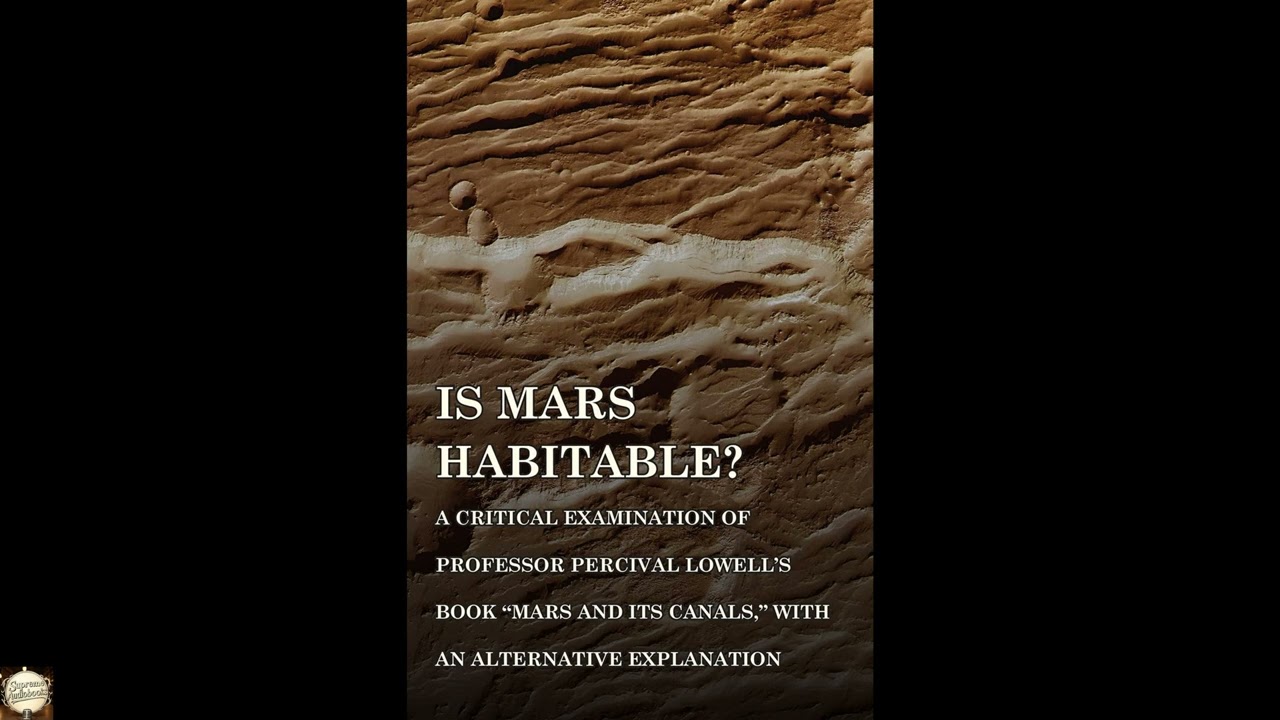
Is Mars Habitable? A Critical Examination of Professor Percival Lowell's Book "Mars
When we gaze at the night sky, we often wonder what lies beyond our world. For centuries, humanity has projected its hopes, fears, and scientific curiosity onto the distant planets, none more so than Mars. In the late nineteenth and early twentieth centuries, a prevailing theory captured the public imagination: Mars was crisscrossed by artificial canals, built by an advanced, dying civilization struggling to survive. This audiobook, Is Mars Habitable? A Critical Examination of Professor Percival Lowell's Book "Mars", offers a potent counter-argument, a meticulously reasoned challenge to the sensational claims that captivated millions. It is more than just a scientific debate; it is a profound testament to the scientific method itself, a reminder of the necessity of skepticism and rigorous evidence in the face of popular enthusiasm, and why such critical thought remains vital even today as we continue to ponder life beyond Earth. The heart of this book lies in its direct engagement with the ideas of Professor Percival Lowell, an influential astronomer and a passionate advocate for the existence of intelligent life on Mars. Lowell, working from his observatory in Flagstaff, Arizona, meticulously mapped what he believed were canals—a vast network of waterways—on the Martian surface. His book, Mars, published in 1895, presented these observations as incontrovertible proof of a sophisticated Martian civilization. The conflict at the core of Is Mars Habitable? unfolds as an intellectual duel, not between individuals, but between two distinct approaches to scientific inquiry. On one side stands Lowell's vivid, detailed, and ultimately speculative interpretation of telescopic observations; on the other, the methodical, skeptical reasoning of this anonymous author. The narrative arc of this critical examination begins by carefully laying out Lowell's principal arguments and the observational evidence he presented. The unknown author then systematically dissects each claim, beginning with the very nature of telescopic observation and the inherent difficulties of perceiving faint, linear features on a distant planetary disk. The author scrutinizes Lowell's methods, questioning the subjective nature of visual sightings, the optical illusions that can create apparent patterns, and the lack of independent verification from other astronomers using different instruments or observation techniques. As the examination progresses, the author introduces alternative, naturalistic explanations for the phenomena Lowell reported, often drawing on principles of optics, atmospheric science, and planetary geology, thereby constructing a powerful case for a Mars shaped by natural processes rather than intelligent design. While the author of Is Mars Habitable? remains anonymous, the work itself speaks volumes about the intellectual climate from which it emerged. This book is a product of an era that witnessed both unprecedented scientific discovery and intense public fascination with the cosmos. It stands as a powerful example of the vital, often anonymous, role played by critics and skeptics in the self-correcting mechanism of science. During the late nineteenth and early twentieth centuries, as astronomy advanced rapidly, the scientific community grappled with how to interpret increasingly detailed observations and how to distinguish genuine discoveries from observational artifacts or wishful thinking. A critical text such as this represents the rigorous internal peer review inherent to scientific progress, where extraordinary claims demand extraordinary evidence, and where even respected figures like Lowell could have their theories robustly challenged. The very existence of this book underscores the importance of open scientific debate and the collective pursuit of truth, pushing against the tide of popular imagination to uphold empirical standards. Several themes resonate throughout Is Mars Habitable?, making it a significant document of its time and ours. Foremost among them is the enduring tension between scientific fact and human imagination. Lowell's theory of Martian canals, born from observations, quickly blossomed into elaborate speculation about an advanced, dying race, influencing popular culture and even inspiring early science fiction. This book serves as a vital corrective, illustrating how rigorous adherence to the scientific method—relying on verifiable data, testable hypotheses, and avoiding anthropocentric bias—is crucial to separating verifiable knowledge from compelling conjecture. For instance, the author methodically addresses the possibility of optical illusions, demonstrating how the human eye and brain, when presented with faint, ambiguous details at the limit of a telescope's resolution, might subconsciously connect disparate points into perceived lines, creating the very "canals" Lowell meticulously mapped. Another significant theme is the very nature of scientific evidence and the critical importance of skepticism. The author's approach is a masterclass in applying systematic doubt to a widely accepted premise. The book dissects Lowell's interpretations, not by dismissing them outright, but by re-examining the foundational observations through different theoretical lenses. For example, the author likely questions whether the observed linear features, if real, are necessarily artificial, proposing geological or atmospheric explanations that require no intelligent agency. This methodical deconstruction of argument, weighing alternative hypotheses, and emphasizing the need for independent confirmation, highlights the ongoing struggle within science to establish consensus based on robust, repeatable evidence, rather than on the authority or charisma of any single proponent. This critical examination emerges from a period of profound scientific and cultural change. The late 1800s and early 1900s were a time of tremendous technological progress, from the advent of electricity and the automobile to increasingly powerful telescopes. This fostered an atmosphere of optimism and a belief in humanity's ability to understand and even conquer new frontiers, including space. News of "canals" on Mars, first reported by Giovanni Schiaparelli in 1877 (though his Italian "canali" simply meant channels, often mistranslated as artificial canals), and then dramatically popularized by Lowell, fit perfectly into this cultural moment. It fueled public imagination, inspiring H.G. Wells's The War of the Worlds and countless other narratives about alien life. Is Mars Habitable? thus represents an important counter-current to this tide of popular excitement, a voice advocating for scientific discipline and caution amidst the widespread fascination with extraterrestrial life. It appeared as a necessary intellectual counterbalance, reminding the scientific community and the public that the pursuit of truth requires more than just compelling narratives; it demands verifiable data and sound reasoning. Listening to Is Mars Habitable? as an audiobook offers a singular opportunity to engage directly with this crucial scientific and historical debate. A skilled narrator, with a voice that balances clarity and an authoritative tone, allows the logical flow of the arguments to unfold with precision, making complex scientific points accessible. The several hours of run time provide ample space for the careful building of the unknown author's case, letting listeners absorb the methodical deconstruction of Lowell's theories step by step. As you listen, pay attention to the exactitude of the language, the way the author systematically addresses each piece of Lowell's evidence, and the careful presentation of alternative explanations. It is an exercise in pure intellectual rigor, offering a window into how scientific consensus is forged and challenged, and how the pursuit of knowledge often means challenging widely held beliefs with unflinching, evidence-based reasoning.
Enjoyed Is Mars Habitable? A Critical Examination of Professor Percival Lowell's Book "Mars? A few ways to support us
Audible & Amazon links are affiliate; we may earn a small commission at no extra cost.
About this production
Human narration by a volunteer reader from LibriVox.org, the public-domain audiobook project. LibriVox volunteers record literary works whose copyright has expired in the United States, releasing the resulting recordings into the public domain.
Is Mars Habitable? A Critical Examination of Professor Percival Lowell's Book "Mars by Alfred Russel Wallace. The underlying text is in the U.S. public domain. We do not republish any modern copyrighted edition, translation, or commentary.
The 4K cinematic visuals accompanying this audiobook are generated by an AI image model from prompts derived from the source text. No copyrighted photos, paintings, or stock footage are used. AI generation is disclosed on every video on our YouTube channel as required by YouTube's altered/synthetic content policy.
English subtitles are transcribed from the LibriVox recording with OpenAI Whisper. Translations into the 11 other supported languages are produced by Meta's NLLB-200 neural translation model. No human translator's copyrighted translation is used.
Questions about sourcing or rights? See our DMCA & Sourcing policy or contact us.
Enjoyed this audiobook?
If you'd like to own a copy of Is Mars Habitable? A Critical Examination of Professor Percival Lowell's Book "Mars or hear a professionally produced edition, the links below help support free audiobook production at no extra cost to you.
As an Amazon Associate we earn from qualifying purchases. Audible / print links are affiliate.