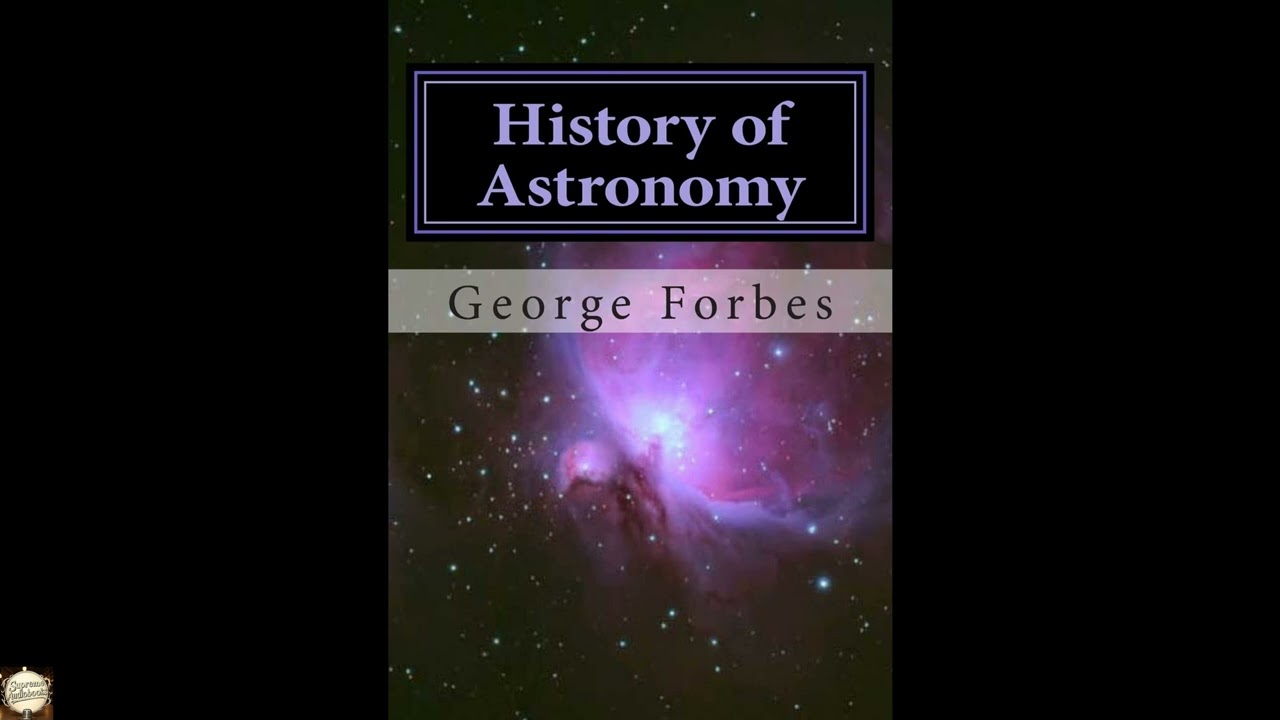
History of Astronomy
From the earliest flickering campfires, humanity has gazed at the night sky, a vast, mysterious canvas prompting wonder and fear. That enduring fascination, that primal urge to map the stars and decipher the celestial ballet, forms the very core of George Forbes's "History of Astronomy." This isn't merely a chronological recounting of facts; it is the grand narrative of human intellect stretching across millennia, a compelling saga of observation, deduction, and relentless curiosity that continues to shape our understanding of existence. For anyone who has ever felt a tremor of awe beneath a canopy of stars, this detailed yet accessible account offers a profound connection to the generations who paved the way for modern science, revealing how we slowly, painstakingly, came to comprehend our cosmic address. George Forbes constructs his historical narrative not as a dry academic chronology, but as an unfolding drama where the stage is the universe itself and the lead players are the keenest minds humanity has produced. The story begins in antiquity, with the foundational concepts laid by thinkers like Aristotle and Ptolemy, who—observing the heavens from a seemingly stationary Earth—forged a compelling, albeit flawed, geocentric model that would dominate Western thought for over a millennium. Listeners will follow the painstaking efforts to map planetary motions, to predict eclipses, and to reconcile observed phenomena with prevailing philosophies, witnessing the gradual accumulation of knowledge that often sparked as much debate as it offered clarity. The central conflict animating Forbes's account is humanity’s protracted struggle to untangle the true mechanics of the cosmos from superstition, philosophical dogma, and the limitations of early instrumentation. The narrative gains momentum with the revolutionary proposals of Nicolaus Copernicus, who dared to place the Sun, not the Earth, at the center of the solar system—a radical idea that ignited a profound intellectual shift. From there, the story charts the meticulous observational work of Tycho Brahe, whose unparalleled precision provided the raw data, and the mathematical genius of Johannes Kepler, who distilled Brahe’s observations into elegant laws of planetary motion, forever altering our understanding of celestial mechanics. Listeners then follow Galileo Galilei’s telescopic observations, which provided startling empirical evidence supporting the Copernican view, often at great personal cost, and finally arrive at Isaac Newton’s monumental synthesis, unifying terrestrial and celestial physics under the universal law of gravitation. This grand arc illustrates a profound intellectual revolution, a progression from Earth-bound assumptions to a universe governed by discoverable laws. The mind behind this expansive history was George Forbes, a Scottish polymath whose life spanned the late nineteenth and early twentieth centuries, a period of immense scientific and technological acceleration. Born in 1849, Forbes exhibited an early brilliance that led him to study at St Andrews and Cambridge, eventually earning a reputation not only as a distinguished astronomer but also as an eminent electrical engineer. He served as Professor of Natural Philosophy at Anderson's University, Glasgow, from 1872 to 1880, where he undoubtedly honed his talent for distilling complex scientific principles into accessible language. Forbes's career was characterized by a rare blend of theoretical inquiry and practical application. His engineering acumen saw him advising on critical projects, including the harnessing of hydroelectric power at Niagara Falls in the 1890s, where his innovative designs left a lasting legacy. Yet, his passion for astronomy remained undimmed. He participated in expeditions to observe the transit of Venus in 1874 and 1882—rare celestial events that inspired the scientific world of the era—and contributed significantly to the understanding of comets and nebulae. This dual expertise in both cutting-edge engineering and observational astronomy provided him with a unique perspective, allowing him to appreciate both the mechanical ingenuity required for astronomical instruments and the profound theoretical leaps that advanced our understanding of the universe. His contributions were recognized through his fellowship in the Royal Society of Edinburgh, cementing his place among the era's leading scientific minds until his passing in 1936. Forbes's "History of Astronomy" articulates several enduring themes that resonate far beyond the realm of science. Foremost among these is the relentless human drive of intellectual curiosity—the innate desire to understand the world around us, regardless of prevailing wisdom. We see this vividly in the tireless observations of Tycho Brahe, who meticulously cataloged stellar and planetary positions for decades without a telescope, simply to gather accurate data, driven by an unyielding desire for precision. This fundamental thirst for knowledge, often requiring immense personal dedication and patience, forms the bedrock of scientific advancement documented throughout the book. Another powerful theme is the challenging of established authority and dogma in the pursuit of empirical truth. The narrative repeatedly shows scientists—from Copernicus cautiously proposing a heliocentric model to Galileo daring to publish observations that contradicted Aristotelian and ecclesiastical teachings—risking reputation and even liberty to follow evidence where it leads. The resistance faced by these figures underscores the difficulty of overturning entrenched beliefs, even in the face of compelling data. Furthermore, the book eloquently demonstrates the incremental nature of scientific progress: how each discovery, no matter how revolutionary, stands on the shoulders of preceding efforts. Kepler’s elliptical orbits, for instance, were not a sudden flash of insight but the culmination of years of wrestling with Brahe’s data, painstakingly rejecting simpler models until the correct, albeit less aesthetically pleasing, solution emerged—a powerful testament to the scientific method’s iterative, self-correcting power. George Forbes published his "History of Astronomy" in 1909, placing it squarely within the active intellectual landscape of the early twentieth century. This was a period characterized by immense scientific optimism, a sense that humanity was rapidly uncovering the fundamental laws governing the universe and technology was transforming daily life. The professionalization of science was well underway, with universities and research institutions playing increasingly central roles in discovery, rather than relying solely on independent gentlemen scholars. It was also an era grappling with the implications of Darwinian evolution, which had fundamentally reshaped biological thought, and the first whispers of revolutionary new physics—relativity and quantum mechanics—were just beginning to challenge Newtonian certainties, although Forbes’s historical survey naturally focuses on the established scientific consensus up to his contemporary period. The book’s emergence at this time reflects a widespread public appetite for knowledge, a desire to understand the scientific and technological advancements that were reshaping the world. Forbes’s clear, engaging prose served to popularize scientific history, making it accessible to a broader audience beyond academic specialists. It provided a grounding in the origins of modern astronomy just as humanity was poised for unprecedented leaps in cosmic exploration, from the development of larger telescopes to the theoretical groundwork that would eventually lead to our understanding of galaxies and the expanding universe. Forbes's history therefore bridges the classical understanding of the cosmos with the burgeoning scientific curiosity of the modern age. Listening to George Forbes’s "History of Astronomy" as an audiobook transforms a detailed intellectual history into a compelling oral tradition. The narrator’s measured pacing allows the listener to absorb the progression of ideas, from ancient cosmology to the profound insights of Newton, without feeling rushed. A clear, articulate voice lends authority and warmth to Forbes’s thoughtful prose, making the often-complex scientific concepts approachable and understandable. This auditory experience creates a unique atmosphere, almost as if one is attending a series of engaging lectures from a seasoned scholar, allowing the grand sweep of human endeavor to unfold naturally across several hours. It’s an ideal listen for quiet reflection, for walks, or for anyone seeking to connect with the deep roots of our cosmic understanding, one discovery at a time, allowing the historical drama of scientific breakthroughs to truly resonate.
Enjoyed History of Astronomy? A few ways to support us
Audible & Amazon links are affiliate; we may earn a small commission at no extra cost.
About this production
Human narration by a volunteer reader from LibriVox.org, the public-domain audiobook project. LibriVox volunteers record literary works whose copyright has expired in the United States, releasing the resulting recordings into the public domain.
History of Astronomy by George Forbes. The underlying text is in the U.S. public domain. We do not republish any modern copyrighted edition, translation, or commentary.
The 4K cinematic visuals accompanying this audiobook are generated by an AI image model from prompts derived from the source text. No copyrighted photos, paintings, or stock footage are used. AI generation is disclosed on every video on our YouTube channel as required by YouTube's altered/synthetic content policy.
English subtitles are transcribed from the LibriVox recording with OpenAI Whisper. Translations into the 11 other supported languages are produced by Meta's NLLB-200 neural translation model. No human translator's copyrighted translation is used.
Questions about sourcing or rights? See our DMCA & Sourcing policy or contact us.
Enjoyed this audiobook?
If you'd like to own a copy of History of Astronomy or hear a professionally produced edition, the links below help support free audiobook production at no extra cost to you.
As an Amazon Associate we earn from qualifying purchases. Audible / print links are affiliate.