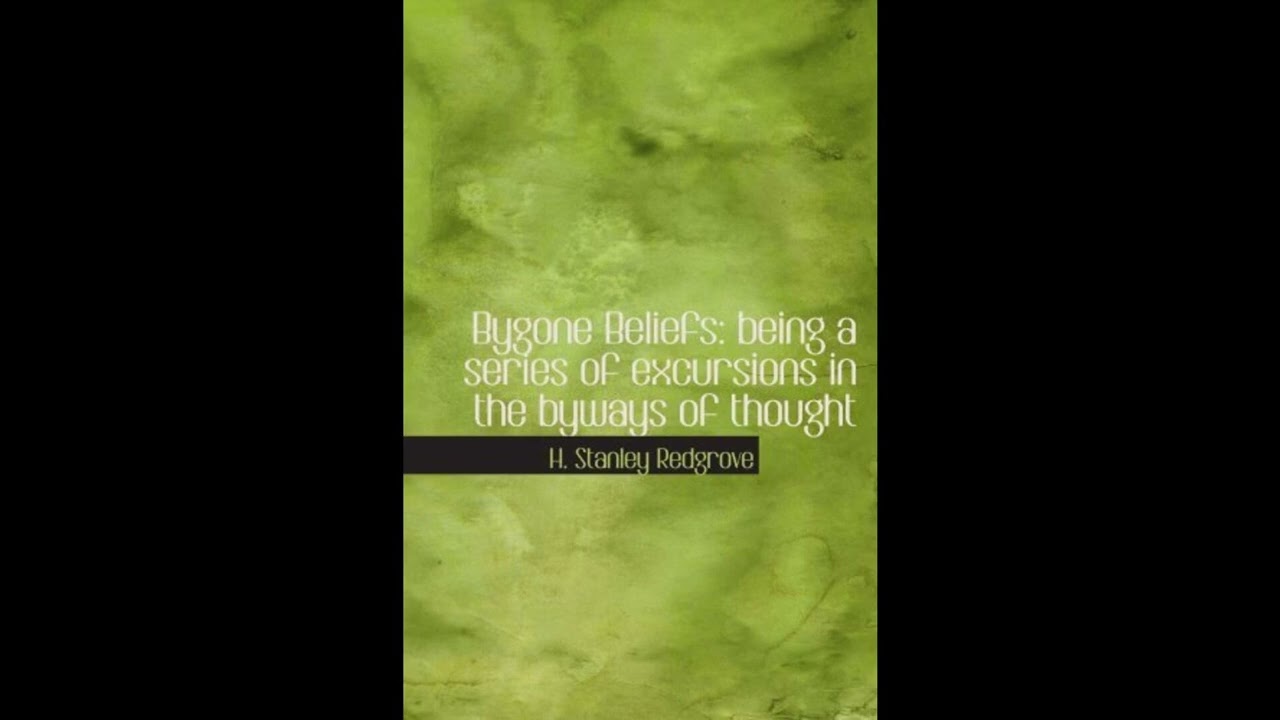
Bygone Beliefs: being a series of excursions in the byways of thought
Step into the fascinating annals of human thought, where the discarded concepts of yesteryear still resonate with quiet wisdom. Bygone Beliefs: being a series of excursions in the byways of thought by H. Stanley invites the curious mind on an extraordinary intellectual passage, not through lands or epochs, but through the very fabric of how humanity has sought to understand its world. This is not merely a history lesson; it is an intimate conversation with the ghosts of ideas, a reminder that what we hold as incontrovertible truth today might well become tomorrow's charming historical curiosity. For anyone who has ever pondered the shifting sands of knowledge, who questions the permanence of their own assumptions, or simply delights in the peculiar and profound ways humans have made sense of existence, this literary offering stands as both a mirror and a window, reflecting our present through the lens of forgotten pasts. H. Stanley's work is structured as an intellectual expedition, a collection of meticulously researched and thoughtfully presented investigations into the curious detours and discarded theories that populate the landscape of human intelligence. Instead of a traditional narrative arc with characters and dramatic turning points, the central "story" here is the unfolding revelation of human ingenuity—and occasional folly—across the centuries. The author acts as a sagacious guide, leading us through discrete "byways" of thought: perhaps a peculiar astronomical theory from the Middle Ages, a now-discredited medical practice from antiquity, a once-revered philosophical doctrine, or a superstition that held sway over entire civilizations. Each "excursion" presents a distinct subject, examining its origins, its proponents, its eventual decline, and its underlying logic, however alien that logic may seem to a modern mind. The intellectual setting of the book spans an immense temporal and cultural breadth, from the earliest recorded ideas to the threshold of what was, at the time of writing, considered contemporary thought. H. Stanley’s remarkable breadth of knowledge allows the listener to witness humanity grappling with universal questions: the nature of the cosmos, the causes of illness, the meaning of life and death, the forces governing nature. While there isn’t a single conflict in the fictional sense, an underlying tension persists throughout: the ongoing struggle between human beings’ desire for certainty and the inexorable march of new discoveries and revised understandings that inevitably render previous "truths" obsolete. The narrative progress, then, is cumulative, building a mosaic of human intellectual endeavor that highlights both our astonishing capacity for reasoning and our persistent vulnerability to error. The author, H. Stanley, remains somewhat a figure of quiet academic renown, whose precise biographical details have receded gracefully into the past, allowing the enduring brilliance of their work to speak for itself. What we perceive of Stanley is primarily through the clear, analytical, and deeply learned voice that pervades these pages. They emerge as an individual of immense erudition, possessing a keen eye for historical detail and a profound sympathy for the often-misunderstood thinkers of bygone eras. Though we lack specific birth and death dates or the minutiae of their personal life, the character of Stanley as a writer is undeniable: a scholar dedicated to illuminating the forgotten corners of intellectual history, driven by an unflagging curiosity about the human mind and its ever-evolving interpretations of reality. Based on the style and subject matter of Bygone Beliefs, one can infer that Stanley was likely a public intellectual of their time, possibly working in the late nineteenth or early twentieth century, a period ripe for such reflective and broadly educational works. They were almost certainly a person well-versed in philosophy, history, and the nascent fields of anthropology and comparative religion. Stanley’s unique contribution lies not just in cataloging these forgotten ideas, but in presenting them with a clarity and fairness that resists condescension, instead seeking to understand the internal consistency and cultural context of even the most outlandish historical concepts. This commitment to intellectual empathy, more than any personal anecdote, defines the lasting legacy of H. Stanley. Among the core ideas Bygone Beliefs enacts, perhaps the most prominent is the ephemerality of truth. H. Stanley consistently demonstrates how concepts once held as immutable fact—such as the geocentric model of the universe or the efficacy of certain antiquated medical remedies—were, in their time, supported by robust logic and observation, only to be supplanted by new paradigms. The book meticulously details how these beliefs, far from being foolish, often represented the most sophisticated thinking available, thereby fostering intellectual humility in the listener. For instance, an extended discussion might center on the nuances of alchemy, not merely as a quest for gold, but as an early form of chemical inquiry intertwined with philosophical and spiritual meaning, revealing the complex layers of an idea before its scientific discrediting. Another central theme is the persistent human quest for meaning and explanation. Whether confronted with the vastness of the cosmos, the unpredictability of nature, or the mysteries of life and death, people throughout history have striven to impose order and construct narratives that make sense of their existence. H. Stanley illustrates this through examinations of origin myths from disparate cultures, or early explanations for meteorological phenomena like thunder and lightning, showcasing humanity's innate drive to comprehend the incomprehensible. This deep dive into past rationales reveals the underlying commonalities of human intellectual impulses, regardless of the era or specific cultural context, underscoring our enduring desire to understand the world and our place within it. The intellectual environment that likely fostered a work like Bygone Beliefs was one of profound change and increasing specialization in academic disciplines. Such a book would find its footing in an era, perhaps around the turn of the 20th century, when scientific advancements were rapidly reshaping understanding of the natural world, leading to a reassessment of older forms of knowledge. The rise of anthropology and comparative studies in religion and mythology would have encouraged a broader, more global perspective on human thought, moving beyond a purely Eurocentric view. It was a time when intellectuals sought to synthesize knowledge from various fields and present it to an educated public, fostering a more critical and informed engagement with history and philosophy. This was a period marked by both great optimism in human progress and a certain nostalgic reflection on the past, creating fertile ground for a work that examines the trajectory of ideas. Such a book emerged as a way to contextualize modern certainties, perhaps to caution against intellectual arrogance, or simply to celebrate the sheer diversity of human mental constructs across the ages. It offered readers a chance to stand back from the immediate concerns of their time and consider the grand sweep of human intellectual endeavor, providing a valuable perspective on the fragile and ever-evolving nature of understanding. Listening to Bygone Beliefs as an audiobook offers an exceptionally rewarding experience, perfectly suited to its reflective content. The "several hours" run time is ideal for focused listening, perhaps during quiet contemplation, or broken into segments that allow the profound ideas to settle and resonate. An intelligent, measured narration is paramount for such material, ensuring that the listener can fully absorb H. Stanley’s meticulous research and thoughtful interpretations. Listen for a voice that embodies both scholarly authority and an inviting sense of curiosity, guiding you smoothly through complex philosophical and historical terrain without ever feeling rushed or overwhelming. The pacing should allow ample space for ideas to sink in, creating an atmosphere akin to an engaging lecture delivered by a wise and amiable professor, where every historical example and intellectual argument contributes to a richer understanding of the human mind.
Enjoyed Bygone Beliefs: being a series of excursions in the byways of thought? A few ways to support us
Audible & Amazon links are affiliate; we may earn a small commission at no extra cost.
About this production
Human narration by a volunteer reader from LibriVox.org, the public-domain audiobook project. LibriVox volunteers record literary works whose copyright has expired in the United States, releasing the resulting recordings into the public domain.
Bygone Beliefs: being a series of excursions in the byways of thought by H. Stanley. The underlying text is in the U.S. public domain. We do not republish any modern copyrighted edition, translation, or commentary.
The 4K cinematic visuals accompanying this audiobook are generated by an AI image model from prompts derived from the source text. No copyrighted photos, paintings, or stock footage are used. AI generation is disclosed on every video on our YouTube channel as required by YouTube's altered/synthetic content policy.
English subtitles are transcribed from the LibriVox recording with OpenAI Whisper. Translations into the 11 other supported languages are produced by Meta's NLLB-200 neural translation model. No human translator's copyrighted translation is used.
Questions about sourcing or rights? See our DMCA & Sourcing policy or contact us.
Enjoyed this audiobook?
If you'd like to own a copy of Bygone Beliefs: being a series of excursions in the byways of thought or hear a professionally produced edition, the links below help support free audiobook production at no extra cost to you.
As an Amazon Associate we earn from qualifying purchases. Audible / print links are affiliate.