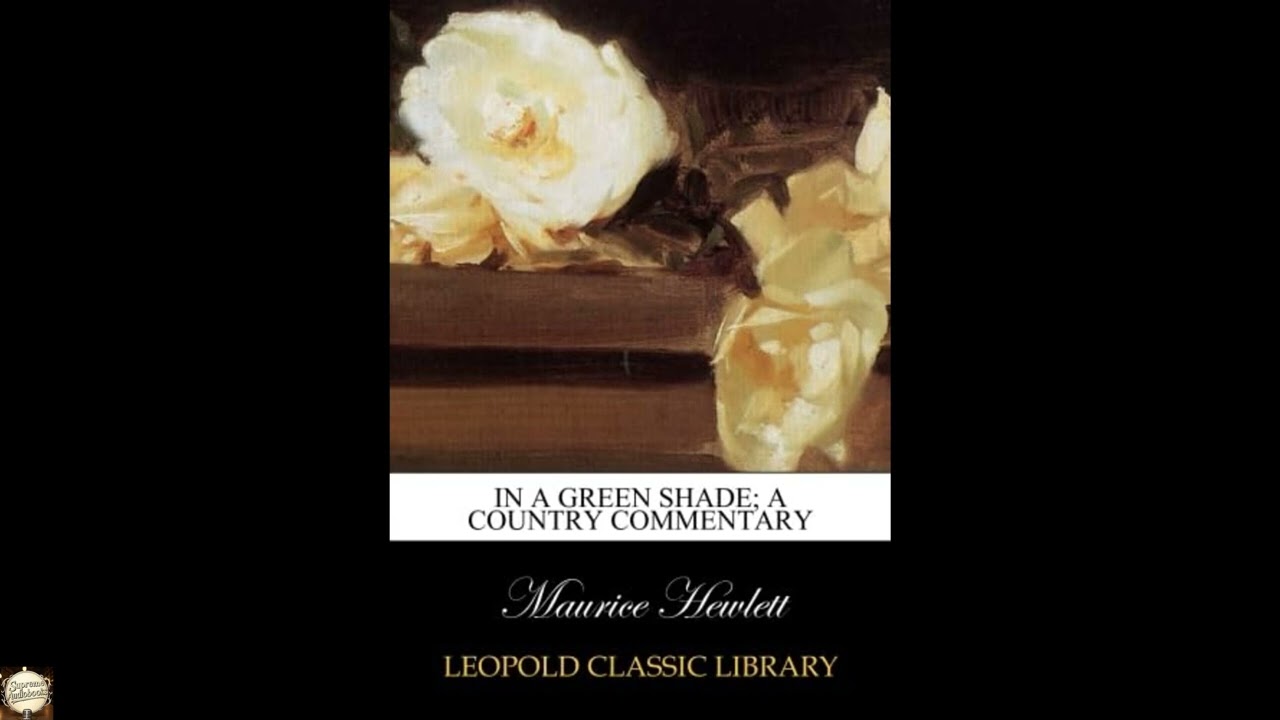
In a green shade; a country commentary
"In a Green Shade; a Country Commentary" invites listeners into a tranquil, contemplative world, offering a quiet antidote to the ceaseless demands of modern life. This collection of essays, penned by the acclaimed Maurice Hewlett, stands as a testament to the enduring peace found in nature and solitary observation. It is more than a book about the countryside; it's an intimate conversation with the landscape, a philosophical rumination on human existence woven into seasonal rhythms. For those yearning to reconnect with the natural world, to find moments of stillness amid the daily rush, or simply to immerse themselves in elegant prose that gently unfolds wisdom, Hewlett's observations resonate with a grace that urges us to pause, listen, and truly see the world around us. The setting for Hewlett’s reflections is primarily the English countryside, brought to life through the author’s keen, discerning gaze. We find ourselves transported to meadows shimmering with dew, ancient woodlands whispering secrets, and country lanes where the scent of hawthorn hangs heavy in the air. The year unfolds season by season, not as a linear narrative, but as a series of exquisitely rendered moments. Hewlett acts as our companion, a sensitive and articulate observer who finds universal truths within the specific details of his rural surroundings. His commentary often begins with a simple observation – the flight of a bird, the changing light on a distant hill, the behavior of a badger at dusk, or the blossoming of a common wildflower. From these starting points, his thoughts meander outward, connecting the particular to the general, the fleeting moment to eternal concepts. There is no conventional conflict or antagonist, but an ongoing engagement with the quiet unfolding of life itself. The trajectory of this commentary is one of deepening appreciation and understanding, as Hewlett grapples with the subtle shifts in nature, the passage of time, and the quiet dignity of the non-human world, all filtered through his educated and poetic sensibility. Listeners will find themselves drawn into a gentle current of thought, where the true resolution lies in the heightened awareness fostered by the author’s example. Maurice Henry Hewlett (1861–1923) pursued a distinguished literary path through late Victorian and early Edwardian England. Born in London, his early life was shaped by a legal education, and he even served for a time at the Record Office. However, the pull of literature proved irresistible, leading him to abandon the law and dedicate himself fully to writing. Initially, Hewlett gained widespread acclaim for his historical romances, works that transported readers to the dramatic courts and battlefields of medieval and Renaissance Europe. Titles like The Forest Lovers, published in 1898, and Richard Yea-and-Nay, from 1900, established his reputation as a master of vivid historical reconstruction and passionate prose. As his career progressed, Hewlett’s interests expanded beyond the purely historical. He began to experiment with different forms, including poetry and, significantly, the personal essay. His move from London to the Wiltshire countryside profoundly influenced this shift, grounding his later writings in the immediacy of his surroundings. This geographical change ignited a deep appreciation for the natural world and rural rhythms, prompting him to document his observations in a more direct, autobiographical style. Hewlett occupies a fascinating position in the English literary canon. He was a transitional figure, bridging the high romanticism of Victorian historical fiction with a burgeoning interest in psychological realism and the emergence of modern nature writing. His essays, particularly those collected in "In a Green Shade," reveal a side of his genius distinct from his historical epics, showcasing a tender, meditative voice and an acute sensitivity to the subtle beauty of the everyday. He stands alongside other notable English essayists and naturalists, contributing a distinctively learned and lyrical voice to the tradition. At its heart, "In a Green Shade" gently illuminates several profound themes. One primary concern is the human connection to nature, depicted through careful, loving observation. Hewlett finds spiritual sustenance in the simplest phenomena, such as tracing the annual return of migrating birds to their nesting grounds, or musing on the stubborn resilience of an ancient oak tree. He shows how tuning into the natural world can provide a framework for understanding our own place within the larger cosmic order, offering solace and perspective. For instance, he might meticulously describe a spider's web glistening with dew, only to ponder the industriousness and artistic instinct inherent in such a humble creature, drawing human parallels. Another recurring theme is the profound value of solitude and introspection. Hewlett's commentary often originates from moments of quiet contemplation, walking alone through fields or sitting silently by a stream. These solitary encounters are not presented as lonely, but rather as opportunities for deep personal discovery and unburdened thought. He demonstrates how stepping away from the clamor of human society allows for a clearer perception of both the outer world and one's inner landscape. His reflections on a sun-drenched afternoon, watching clouds drift, might evolve into a meditation on fleeting beauty and savoring each moment. These essays are, in essence, an argument for the rejuvenating power of quietude and observant living. "In a Green Shade" arrived in the public sphere in 1918, a period of immense upheaval and profound change. Published as the First World War neared its close, it offered a serene retreat in a turbulent era. It provided a much-needed sanctuary for readers amidst profound societal scars, standing as a literary counterpoint to the mechanization and destruction dominating headlines. Culturally, this period also saw a continued blossoming of English nature writing, a tradition that had gained traction throughout the nineteenth century with figures like Gilbert White and Richard Jefferies, and which was then carried forward by contemporaries such as W.H. Hudson and Edward Thomas. This surge of interest was a reaction against rapid industrialization and urbanization that had reshaped Britain. Many writers and thinkers sought to preserve, or at least reflect upon, a vanishing agrarian way of life and the intrinsic value of the English countryside. Hewlett’s contribution aligns perfectly with this movement, offering a learned and deeply felt voice to the chorus of those championing the profound solace and wisdom found beyond the city limits. To experience "In a Green Shade" as an audiobook is to receive these essays in their most natural and resonant form. The gentle, unhurried pace of Hewlett’s prose is perfectly suited to audio, inviting listeners to slow down and absorb his observations without distraction. The narrator’s voice becomes the vessel for Hewlett's reflective wisdom, guiding the listener through descriptive passages that paint vivid pictures of the English landscape – the murmur of a brook, rustling leaves, the call of a distant bird. This format allows the atmospheric qualities of the writing to truly come alive, creating an immersive experience akin to a shared stroll with a thoughtful companion. It's ideal for moments of quiet contemplation, for unwinding after a long day, or for finding pockets of peace during a commute, allowing the beauty of Hewlett's words to wash over you and deepen your appreciation for the world around.
Enjoyed In a green shade; a country commentary? A few ways to support us
Audible & Amazon links are affiliate; we may earn a small commission at no extra cost.
About this production
Human narration by a volunteer reader from LibriVox.org, the public-domain audiobook project. LibriVox volunteers record literary works whose copyright has expired in the United States, releasing the resulting recordings into the public domain.
In a green shade; a country commentary by Maurice Hewlett. The underlying text is in the U.S. public domain. We do not republish any modern copyrighted edition, translation, or commentary.
The 4K cinematic visuals accompanying this audiobook are generated by an AI image model from prompts derived from the source text. No copyrighted photos, paintings, or stock footage are used. AI generation is disclosed on every video on our YouTube channel as required by YouTube's altered/synthetic content policy.
English subtitles are transcribed from the LibriVox recording with OpenAI Whisper. Translations into the 11 other supported languages are produced by Meta's NLLB-200 neural translation model. No human translator's copyrighted translation is used.
Questions about sourcing or rights? See our DMCA & Sourcing policy or contact us.
Enjoyed this audiobook?
If you'd like to own a copy of In a green shade; a country commentary or hear a professionally produced edition, the links below help support free audiobook production at no extra cost to you.
As an Amazon Associate we earn from qualifying purchases. Audible / print links are affiliate.