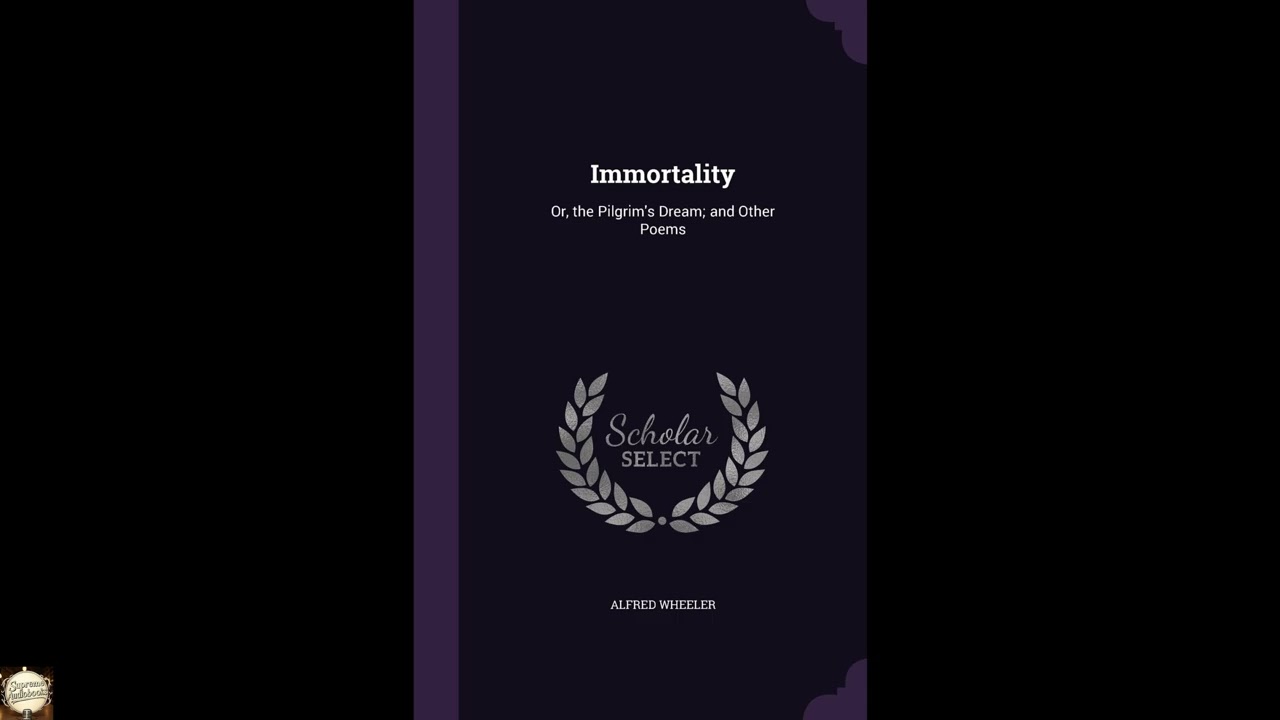
Immortality, Or The Pilgrim's Dream; And Other Poems
Alfred Wheeler's "Immortality, Or The Pilgrim's Dream; And Other Poems" offers a profound invitation to contemplate the enduring questions that define the human condition. At its heart lies a magnificent allegorical poem, a grand meditation on life, death, and the elusive promise of what lies beyond. This collection stands as a testament to the power of verse to grapple with philosophy, faith, and the deepest spiritual longings. For listeners today, the work retains a striking relevance, speaking to our contemporary anxieties about purpose and legacy, urging us to pause amidst the clamor of modern existence and reflect on the truths that truly matter. It is a work for those who seek solace, provocation, or simply a moment of quiet contemplation within the vast landscape of human experience. The central piece, "The Pilgrim's Dream," unfurls as an extended visionary narrative. We are introduced to the Pilgrim, an archetypal figure burdened by the weight of mortality and an insatiable desire for ultimate understanding. The narrative setting is not a fixed geographical location but a shifting, symbolic landscape—a dream world, perhaps, or an internal psychic realm. Within this ethereal domain, the Pilgrim encounters a series of allegorical figures and confronts scenes that represent various facets of human experience: ephemeral beauty, crushing despair, fleeting joys, and the inexorable march of time. The fundamental conflict is internal, a wrestling match between the rational mind’s doubts and the soul’s fervent hope for eternity, a struggle to reconcile the finite nature of human life with the yearning for something limitless. As the dream unfolds, the Pilgrim moves through symbolic valleys of shadow and over mountains of illumination, seeking answers from spectral guides or finding momentary epiphanies in moments of profound natural revelation. The core of the story lies in this searching, the relentless inquiry into the nature of existence itself. The accompanying "Other Poems" in the collection serve to broaden this thematic scope, offering shorter, often lyrical, meditations on love, loss, the passage of seasons, and the quiet dignity of the human spirit. These pieces echo the main poem’s introspective mood, providing different perspectives on the universal themes that preoccupy the human heart, each poem acting as a further facet of the collection’s overarching philosophical and spiritual quest. Alfred Wheeler stands as a voice from an earlier age of letters, a poet whose keen intellect and sensitive spirit found expression in verse that grappled with the profound. While specific biographical markers are often obscured by the passage of time, the character of his work suggests a mind deeply engaged with the philosophical and theological currents of his era. He seems to belong to that tradition of poets who viewed their art as a vehicle for grand contemplation, a means to articulate the ineffable and to provide spiritual guidance through beauty of language. His poetry reflects a sensibility attuned to both the natural world and the inner life, hinting at a background that fostered deep thought and an appreciation for the classical forms of expression. His literary output, centered around this collection, situates him among those who continued to champion serious, contemplative poetry during a period that saw significant shifts in literary tastes. He represents a commitment to the long poem as a serious artistic undertaking, a form capable of sustaining complex arguments and extended metaphors. One can discern in his lines echoes of earlier English poets who used allegory and elevated language to address the most weighty subjects, placing him within a lineage that valued moral and spiritual inquiry above all else. His work, therefore, occupies a distinctive place, upholding a tradition of philosophical poetry even as the literary landscape began to change around him. The collection is deeply structured around several key themes. Foremost among them is the duality of immortality and mortality. The Pilgrim's entire quest is sparked by an awareness of human transience, contrasting the brevity of earthly life with the aspiration for an eternal state. For instance, the dream sequence might present a vision of crumbling ancient ruins, a concrete example of decay, immediately followed by the appearance of a celestial light or an enduring symbol of truth, demonstrating the tension between what perishes and what persists. Another prominent theme is the spiritual quest and the interplay of faith and doubt. The Pilgrim often finds himself at crossroads, grappling with moments of profound skepticism where the answers seem elusive, only to be drawn back by an innate hope or a sudden, revelatory insight into divine order. A scene might depict the Pilgrim in a desolate landscape, questioning the very existence of a guiding hand, before discovering a hidden spring or a guiding star that renews a sense of purpose. Furthermore, the concept of memory and legacy permeates the verse. The poems reflect on what endures of human lives, both personally and collectively, and how past actions or forgotten truths resonate through time. Perhaps the Pilgrim encounters shades of ancestors or glimpses historical events, understanding how individual lives contribute to a larger, ongoing narrative, emphasizing the echoes of the past in the present. Finally, the nature of reality, particularly the distinction between dream and waking life, forms a foundational element. The allegorical dream itself serves as a powerful metaphor for deeper truths that can only be apprehended through intuition or visionary experience, suggesting that the "real" world we perceive may only be one layer of a far more profound existence. A moment where the dream-world logic becomes paradoxically clearer than waking thought can serve to illustrate this theme. This kind of profound philosophical poetry often arises during periods of intense intellectual and societal change, when established certainties are questioned and humanity seeks new anchors for meaning. The concerns addressed by Wheeler's poems—the existence of a soul, the ultimate fate of humanity, the nature of good and evil—were particularly resonant during times when scientific discovery challenged traditional religious dogma, or when rapid industrial and social shifts led to profound existential introspection. It is easy to imagine this work emerging from a cultural moment marked by both significant technological progress and a simultaneous, perhaps melancholic, yearning for spiritual understanding. Such periods often see a resurgence of allegorical and symbolic art, as artists seek to convey complex ideas in ways that transcend direct didacticism, offering comfort and intellectual stimulation without resorting to dogmatic pronouncements. Listening to "Immortality, Or The Pilgrim's Dream; And Other Poems" as an audiobook allows the inherent musicality and rhythm of Wheeler’s verse to fully unfurl. The spoken word adds an essential dimension to poetry, allowing the listener to absorb the nuances of meter, alliteration, and imagery without the visual interferences of text. With several hours of content, this audiobook provides a substantial listening experience, ideal for extended periods of quiet reflection—perhaps during a long walk, a commute, or an evening by the fire. A skilled narrator's pacing can highlight the deliberate grandeur of "The Pilgrim's Dream," giving weight to its philosophical pronouncements, while lending a more tender, intimate voice to the shorter, lyrical pieces. Listen for the subtle shifts in tone, the way the narrator conveys the Pilgrim's struggles and revelations through vocal inflection, and how the carefully chosen words create an atmosphere that is at once dreamlike, contemplative, and deeply moving.
Enjoyed Immortality, Or The Pilgrim's Dream; And Other Poems? A few ways to support us
Audible & Amazon links are affiliate; we may earn a small commission at no extra cost.
About this production
Human narration by a volunteer reader from LibriVox.org, the public-domain audiobook project. LibriVox volunteers record literary works whose copyright has expired in the United States, releasing the resulting recordings into the public domain.
Immortality, Or The Pilgrim's Dream; And Other Poems by Alfred Wheeler. The underlying text is in the U.S. public domain. We do not republish any modern copyrighted edition, translation, or commentary.
The 4K cinematic visuals accompanying this audiobook are generated by an AI image model from prompts derived from the source text. No copyrighted photos, paintings, or stock footage are used. AI generation is disclosed on every video on our YouTube channel as required by YouTube's altered/synthetic content policy.
English subtitles are transcribed from the LibriVox recording with OpenAI Whisper. Translations into the 11 other supported languages are produced by Meta's NLLB-200 neural translation model. No human translator's copyrighted translation is used.
Questions about sourcing or rights? See our DMCA & Sourcing policy or contact us.
Enjoyed this audiobook?
If you'd like to own a copy of Immortality, Or The Pilgrim's Dream; And Other Poems or hear a professionally produced edition, the links below help support free audiobook production at no extra cost to you.
As an Amazon Associate we earn from qualifying purchases. Audible / print links are affiliate.