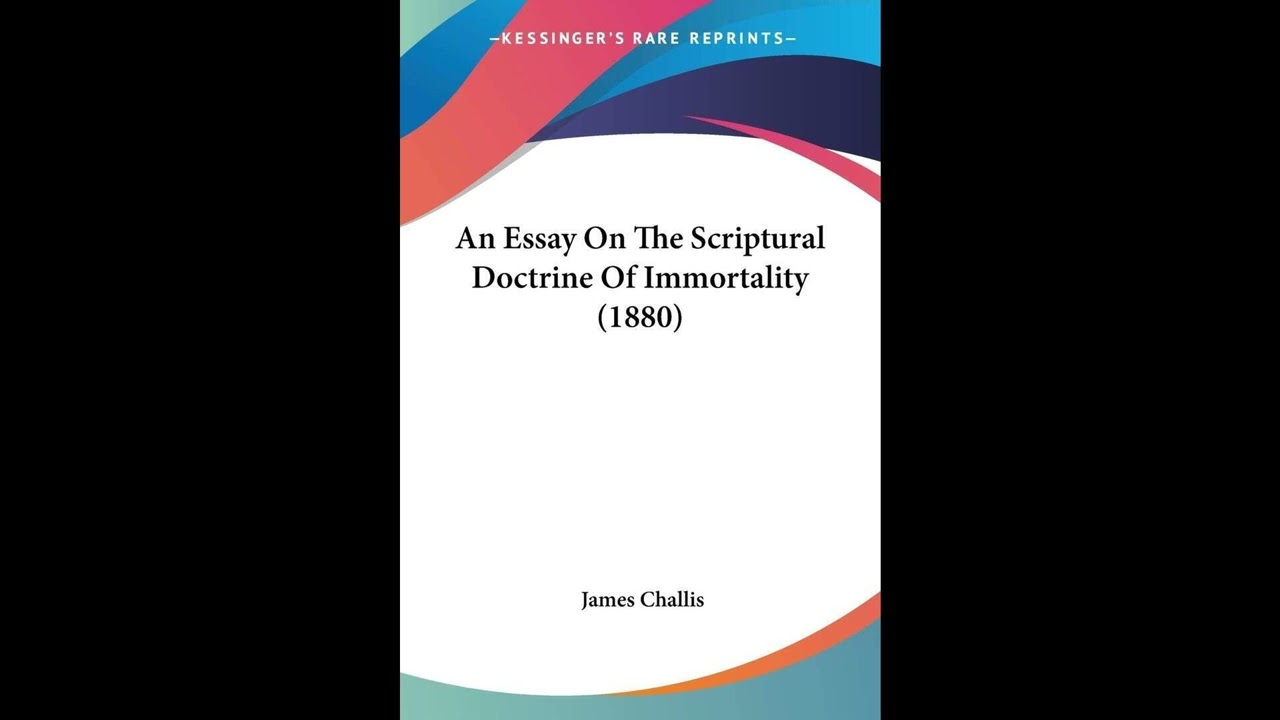
An Essay On The Scriptural Doctrine Of Immortality (1880)
What awaits us beyond this life? It is a question that has haunted humanity for millennia, whispered in ancient texts and debated in every generation. In 1880, as the Victorian age grappled with scientific discovery and shifting spiritual landscapes, James Challis offered his meticulous contribution to this enduring inquiry: An Essay On The Scriptural Doctrine Of Immortality. This profound work is not a fleeting contemplation but a rigorous, systematic examination, a testament to an era when intellectual giants applied their formidable minds to the deepest theological puzzles. Listeners today will find themselves drawn into a conversation that remains strikingly relevant, witnessing a brilliant scholar's earnest pursuit of truth within the very foundations of Christian belief, challenging assumptions and demanding intellectual honesty. This essay sets its intellectual stage in the late nineteenth century, a period where established religious doctrines faced increasing scrutiny from both scientific advancements and emerging biblical scholarship. Challis, a man deeply learned in both the natural sciences and theology, presents himself not as an innovator of new beliefs, but as a scrupulous interpreter committed to understanding what the Holy Scriptures actually teach about the future state of the soul. The central conflict of the essay arises from Challis's assertion that many widely held views on immortality may owe more to later theological developments and philosophical traditions than to the plain words of the Bible itself. He positions the reader as a fellow inquirer, inviting them to lay aside preconceived notions and join him in a careful re-examination. The arc of Challis’s argument unfolds with the precision one might expect from a seasoned academic. He does not begin with an emphatic declaration, but rather with a methodical laying of groundwork, establishing the principles of scriptural interpretation that will guide his investigation. He then moves through a series of specific biblical passages, dissecting verses from both the Old and New Testaments. He weighs different translations, considers the historical and cultural context in which these words were originally penned, and compares various scriptural uses of key terms. His approach is akin to a legal brief, systematically presenting evidence and building a case brick by careful brick, demonstrating how certain interpretations might have deviated from the original intent of the inspired texts. The essay's internal progression is characterized by a patient, step-by-step reasoning. Challis guides the reader through complex theological concepts, questioning traditional readings and offering alternative perspectives rooted firmly in his exegetical process. He considers the implications of different understandings of terms like "soul," "spirit," "death," and "eternal life," revealing the subtleties often overlooked in more casual readings of scripture. Without revealing the precise conclusions of his extensive analysis, it is fair to say that the listener is taken on a challenging yet illuminating intellectual passage, culminating in a carefully reasoned position on what the Bible specifically teaches regarding immortality, free from what Challis perceives as extraneous philosophical overlays. James Challis, born in 1803, was a formidable intellectual figure in Victorian England, perhaps best known for his distinguished scientific career. For forty-three years, from 1836 until his death in 1882, he held the esteemed position of Plumian Professor of Astronomy at Cambridge University. In this role, he made significant contributions to the field, meticulously observing comets and minor planets, and playing a notable, if ultimately frustrating, part in the scientific hunt for the planet Neptune in the mid-19th century. His work was characterized by rigorous methodology, exhaustive data collection, and a deep commitment to empirical evidence. Beyond the observatory, however, Challis possessed a profound and abiding interest in theological matters, particularly in his later years. He was an ordained clergyman in the Church of England, and he increasingly turned his analytical gaze to questions of faith, scripture, and doctrine. His theological writings, including this essay, reveal a mind accustomed to precise thinking and logical argumentation. He brought the same scientific discipline he applied to celestial mechanics to the complex task of biblical interpretation, aiming to understand religious truths with clarity and an unswerving dedication to textual evidence, positioning him as a significant voice within the intersection of Victorian science and religion. One of the principal themes evident throughout Challis’s essay is the primacy of scriptural authority and the necessity of diligent biblical exegesis. Challis passionately argues that understanding the doctrine of immortality requires a return to the foundational texts of Christianity, stripped of centuries of accumulated tradition and philosophical influence. For instance, he might painstakingly examine a particular Greek word in a Pauline epistle, comparing its usage across various contexts to ascertain its most precise meaning, rather than relying on an established English translation that might carry later theological baggage. His work showcases a deep commitment to letting scripture interpret itself, allowing its internal coherence and historical context to shape understanding. Another compelling theme is the application of scientific methodology to theological inquiry. Challis, with his background in astronomy, approaches the Bible with the methodical rigor of a scientist. He treats theological propositions not as matters of unexamined dogma, but as hypotheses to be tested against empirical evidence—in this case, the textual evidence of the Bible. He presents his arguments in a clear, logical sequence, anticipating objections and systematically dismantling alternative interpretations by pointing to specific scriptural inconsistencies or historical developments. This intellectual honesty and systematic argument also reveal a third theme: the courage to challenge long-held traditions in pursuit of what he believed to be fundamental truth. He stands as an example of a scholar willing to question the status quo, even on matters as central as the afterlife, in service of a more accurate scriptural understanding. The late 19th century was an era of extraordinary intellectual and social change, and An Essay On The Scriptural Doctrine Of Immortality emerged directly from this ferment. Charles Darwin's On the Origin of Species, published just two decades prior, had radically reshaped scientific and theological thinking, creating profound challenges to traditional biblical narratives. Concurrent with this, "Higher Criticism" of the Bible—a scholarly approach that applied historical and literary analysis to sacred texts—was gaining traction, prompting many to re-evaluate the Bible's composition and meaning. Amidst these seismic shifts, there was a widespread desire to reconcile faith with reason, to ensure that Christian doctrine could withstand the rigorous demands of modern inquiry. Challis's work can be seen as a direct response to this cultural imperative. It reflects a period when thinkers grappled with the implications of new knowledge, not necessarily to abandon faith, but to refine and purify it, seeking a more robust and intellectually defensible understanding of fundamental truths. His essay contributes to the vibrant intellectual debates of the time, addressing a topic that resonated deeply with the anxieties and hopes of a society navigating rapid progress and profound change. To listen to An Essay On The Scriptural Doctrine Of Immortality as an audiobook is to receive a rare gift: the opportunity to engage with a profound philosophical and theological argument in a sustained, contemplative manner. Challis's prose is careful and precise, unfolding his reasoning with a methodical pace that benefits immensely from skilled narration. The run length of several hours is perfectly suited for allowing the listener to absorb complex arguments, perhaps in segments, reflecting on each point before proceeding. Hearing the carefully constructed sentences, the precise articulation of biblical references, and the unfolding of Challis's logical progression allows for a deeper appreciation of his scholarship than a quick read might provide. The narrator's voice becomes a guide through the labyrinth of scriptural interpretation, conveying the earnestness and intellectual rigor of a scholar dedicated to an enduring human question, making the act of listening itself an act of intellectual discernment.
Enjoyed An Essay On The Scriptural Doctrine Of Immortality (1880)? A few ways to support us
Audible & Amazon links are affiliate; we may earn a small commission at no extra cost.
About this production
Human narration by a volunteer reader from LibriVox.org, the public-domain audiobook project. LibriVox volunteers record literary works whose copyright has expired in the United States, releasing the resulting recordings into the public domain.
An Essay On The Scriptural Doctrine Of Immortality (1880) by James Challis. The underlying text is in the U.S. public domain. We do not republish any modern copyrighted edition, translation, or commentary.
The 4K cinematic visuals accompanying this audiobook are generated by an AI image model from prompts derived from the source text. No copyrighted photos, paintings, or stock footage are used. AI generation is disclosed on every video on our YouTube channel as required by YouTube's altered/synthetic content policy.
English subtitles are transcribed from the LibriVox recording with OpenAI Whisper. Translations into the 11 other supported languages are produced by Meta's NLLB-200 neural translation model. No human translator's copyrighted translation is used.
Questions about sourcing or rights? See our DMCA & Sourcing policy or contact us.
Enjoyed this audiobook?
If you'd like to own a copy of An Essay On The Scriptural Doctrine Of Immortality (1880) or hear a professionally produced edition, the links below help support free audiobook production at no extra cost to you.
As an Amazon Associate we earn from qualifying purchases. Audible / print links are affiliate.