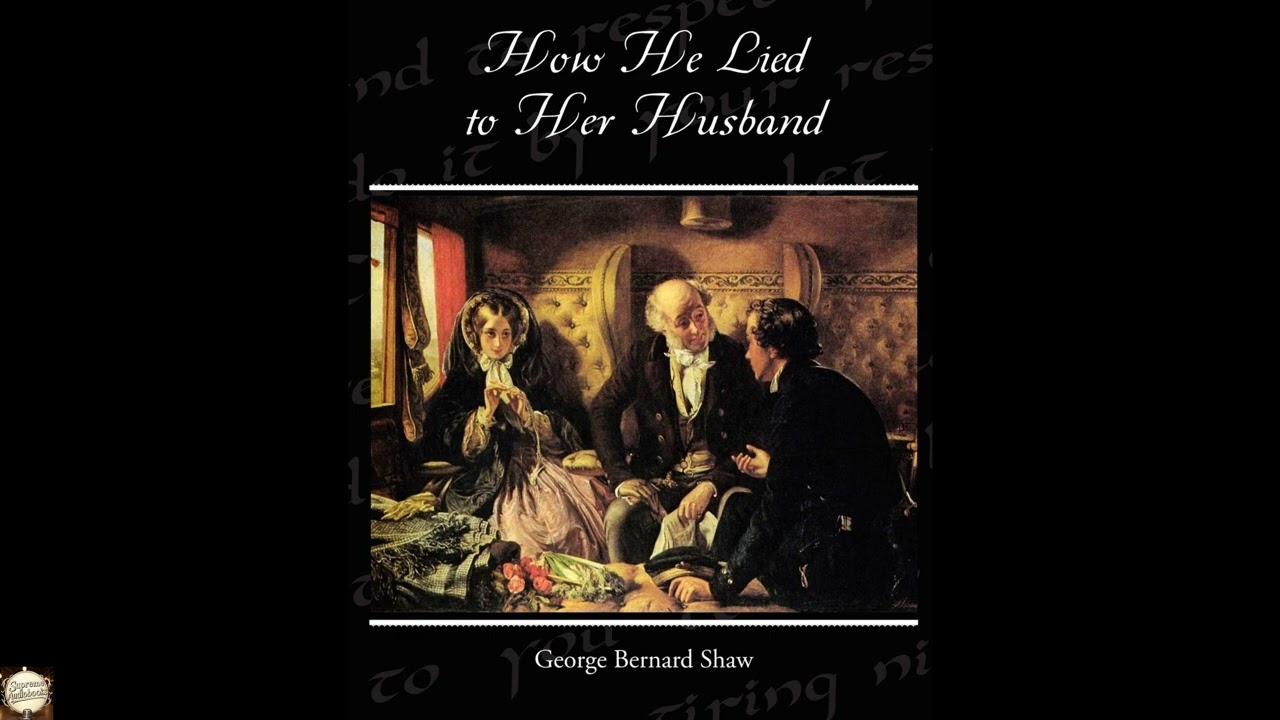
How He Lied to Her Husband
Imagine a London drawing-room, a picture of Edwardian propriety, where a youthful poet’s infatuation for an older, married woman suddenly threatens to upend the careful order of domestic life. Bernard Shaw's one-act comedy, "How He Lied to Her Husband," plunges listeners into just such a precarious scenario, transforming what could be a scandalous revelation into a delightful, incisive examination of vanity, social convention, and the flexible nature of truth. This brief but potent play, first staged in 1904, remains remarkably resonant today, offering a witty lens through which to view our own contemporary concerns about public image, private desires, and the often-absurd lengths people will go to maintain appearances in an age obsessed with authenticity—or the performance of it. The curtain rises on Aurora Bompas, a society lady of considerable charm, in her elegantly appointed home. She is flustered, perhaps even a little flattered, by the predicament facing Henry Apjohn, a young man consumed by a dramatic, poetic adoration for her. Henry has expressed his fervent admiration not just in words, but in a volume of verse, dedicated explicitly to Aurora. His crisis stems from the fact that this volume, a testament to his passionate but ill-advised feelings, has fallen into the hands of Aurora’s husband, Bompas. The central conflict ignites as Henry tries desperately to retrieve the incriminating book, fearing Bompas’s inevitable discovery and the ensuing scandal. What unfolds is a carefully choreographed dance of misdirection and convenient misunderstanding. As Bompas enters, quite innocently, the quick-witted Henry, with Aurora’s nervous complicity, scrambles to invent a plausible, if utterly fictitious, explanation for the book's dedication. The play thrives on the escalating absurdity of their attempts, as each lie requires another, and Bompas, far from being the dim-witted cuckold often found in such farces, turns out to have his own peculiar and unexpected interpretation of the unfolding events. Shaw masterfully uses the confined setting and rapid-fire dialogue to build a comedic tension that keeps the audience guessing how on earth these characters will navigate their way out of this self-made labyrinth, or indeed, if they even want to. The author, George Bernard Shaw, born in Dublin in 1856, moved to London in his early twenties and dedicated himself to a literary career that initially saw him struggling as a novelist and critic. It was in the theatre, however, that his sharp intellect and reformist zeal found their true calling. Shaw became a prolific and celebrated playwright, renowned for his "problem plays" that tackled pressing social issues with a blend of intellectual rigor and sparkling wit. A committed socialist and a prominent member of the Fabian Society, Shaw viewed the stage not merely as a venue for entertainment but as a platform for challenging conventional wisdom and advocating for social change. His groundbreaking plays often subverted popular expectations, using comedy to provoke serious thought about everything from poverty and prostitution to gender roles and political ideologies. Shaw’s influence on twentieth-century drama is immense. He challenged the sentimentalism of Victorian theatre, ushering in an era of more realistic and intellectually stimulating plays. His extensive body of work includes enduring classics such as "Pygmalion," which later became the basis for "My Fair Lady"; "Man and Superman," a sprawling philosophical comedy; and the historical drama "Saint Joan." He received the Nobel Prize in Literature in 1925, cementing his place as one of the most significant figures in English literature, celebrated for his distinctive Shavian wit, his incisive social commentary, and his enduring ability to make audiences laugh while simultaneously questioning their deeply held beliefs. "How He Lied to Her Husband" enacts several key themes with typical Shavian finesse. One central idea is the elasticity of truth and the pervasive role of deception in social interactions. Henry's immediate, instinctual lie to protect himself and Aurora from scandal demonstrates how readily people construct convenient fictions. Even more revealing is Bompas’s ultimate, surprising reaction, which highlights how individuals often interpret events through the lens of their own preconceived notions or desires, rather than objective reality. Another prominent theme is the performance of marriage and the maintenance of social facades. The entire predicament revolves around the characters' desperate attempts to uphold the outward appearance of a respectable marriage, even if it means constructing elaborate fictions. Aurora's vanity, in particular, showcases how personal pride can sometimes outweigh the fear of exposure. Furthermore, the play subtly critiques the nature of artistic inspiration and celebrity worship. Henry's poetic fervor for Aurora borders on a kind of romantic idolization, and Aurora, despite the inconvenience, clearly relishes the idea of being a poet's muse. Shaw highlights the potential for ego and self-delusion in both the artist and the subject, suggesting that artistic devotion can sometimes be a vehicle for personal gratification rather than pure expression. The underlying current of gender roles and societal expectations also runs through the narrative, as the characters navigate the delicate balance of Edwardian propriety, particularly concerning a married woman’s reputation and a young man’s impulsive passion. This particular play emerged during the Edwardian era, a period in Britain (roughly 1901-1910) characterized by a veneer of stability and prosperity, but also by significant social and political ferment beneath the surface. It was a time when established institutions, including marriage and social class, were increasingly being questioned. Shaw, as a prominent intellectual and socialist, was at the forefront of this cultural shift, using his plays to challenge the hypocrisies and rigid conventions of his day. His "problem plays" were a direct response to a society grappling with issues of poverty, women's suffrage, and changing moral landscapes. "How He Lied to Her Husband," with its seemingly lighthearted domestic farce, deftly skewers the era's preoccupation with respectability and the often-absurd lengths to which individuals would go to avoid public embarrassment, making it a perfect snapshot of Edwardian anxieties filtered through Shaw's unique satirical vision. To listen to "How He Lied to Her Husband" as an audiobook is to experience Bernard Shaw's genius for dialogue and character brought to vivid life. The brilliance of Shaw lies in his words—the precise rhythms, the escalating wit, and the distinct voices of his characters. A skilled narration fully realizes the play’s comedic timing, allowing listeners to appreciate the subtle pauses, the hurried exclamations, and the underlying humor that might be missed in a casual reading. Given its relatively concise length—even as part of a collection several hours long—it makes for an ideal listening experience, whether you seek a quick burst of intellectual comedy or a deeper dive into Shaw's theatrical world. The performance invites you to attune your ear to the particular cadences of Edwardian speech and to savor the nuanced portrayals that breathe life into Aurora's vanity, Henry's youthful fervor, and Bompas's surprising interpretations, immersing you directly into the play’s delightful drawing-room intrigue.
Enjoyed How He Lied to Her Husband? A few ways to support us
Audible & Amazon links are affiliate; we may earn a small commission at no extra cost.
About this production
Human narration by a volunteer reader from LibriVox.org, the public-domain audiobook project. LibriVox volunteers record literary works whose copyright has expired in the United States, releasing the resulting recordings into the public domain.
How He Lied to Her Husband by Bernard Shaw. The underlying text is in the U.S. public domain. We do not republish any modern copyrighted edition, translation, or commentary.
The 4K cinematic visuals accompanying this audiobook are generated by an AI image model from prompts derived from the source text. No copyrighted photos, paintings, or stock footage are used. AI generation is disclosed on every video on our YouTube channel as required by YouTube's altered/synthetic content policy.
English subtitles are transcribed from the LibriVox recording with OpenAI Whisper. Translations into the 11 other supported languages are produced by Meta's NLLB-200 neural translation model. No human translator's copyrighted translation is used.
Questions about sourcing or rights? See our DMCA & Sourcing policy or contact us.
Enjoyed this audiobook?
If you'd like to own a copy of How He Lied to Her Husband or hear a professionally produced edition, the links below help support free audiobook production at no extra cost to you.
As an Amazon Associate we earn from qualifying purchases. Audible / print links are affiliate.