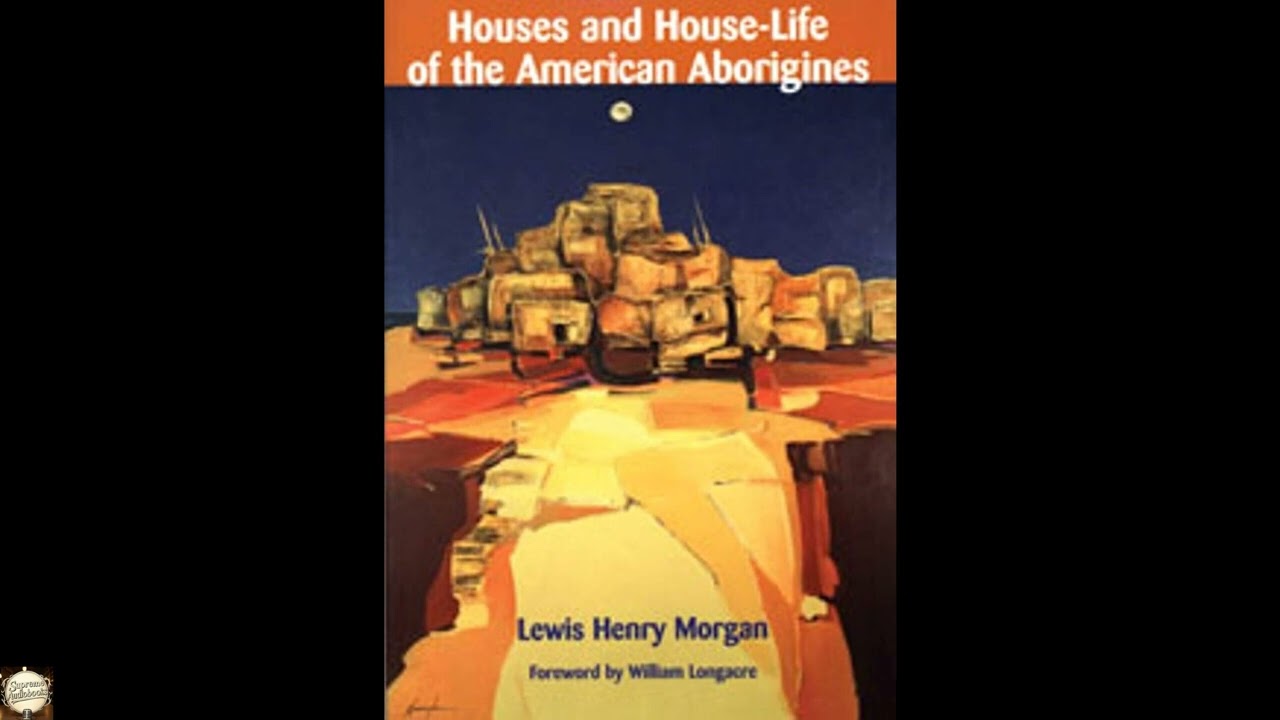
Houses and House-Life of the American Aborigines
Lewis Henry Morgan’s Houses and House-Life of the American Aborigines stands as a pivotal document in the intellectual history of American thought, offering far more than a simple architectural survey. This foundational text invites listeners into the mind of a 19th-century scholar grappling with the complexities of human society, particularly the diverse indigenous cultures of North America. It challenges prevailing notions about what constitutes "civilization" and offers a meticulous, if sometimes flawed by modern standards, examination of how physical dwellings reflect and shape social organization. For the contemporary listener, it provides a crucial lens not only for understanding historical perspectives on Native American life, but also for appreciating the evolution of anthropology itself, allowing us to witness the birth pangs of a systematic approach to cultural study. The book’s intellectual drama unfolds as Morgan, driven by a profound curiosity and an extensive firsthand engagement with Indigenous communities, sets out to prove a revolutionary thesis: that the architectural forms adopted by various North American Aboriginal peoples are direct expressions of their social, economic, and political structures. He begins his detailed analysis with the communal longhouses of the Iroquois, a group with whom he had a deep personal connection and scholarly familiarity. Here, he describes not merely wooden frames and bark coverings, but intricate social units where multiple families shared hearths and resources, illustrating how these structures facilitated a particular form of gentile (kinship-based) organization and communal living. The setting then broadens, moving westward to the impressive, multi-story cliff dwellings and pueblos of the American Southwest, examining how these fixed, defensive structures correlate with more settled agricultural practices and larger, more stratified communities. Morgan’s narrative arc follows his quest to establish universal principles of social development, using housing as a primary form of evidence. He systematically compares and contrasts dwellings from various cultures – from the earth lodges of the Missouri Valley to the plank houses of the Pacific Northwest – showing how each architectural style, whether temporary or permanent, simple or complex, illuminates aspects of a society’s level of technological advancement, its system of property ownership, and its familial arrangements. His focus is on showing how these structures are not random creations but rather logical outcomes of specific stages of human social evolution, leading him to categorize societies along a spectrum from "savagery" to "barbarism" and ultimately to "civilization," a framework he would more fully articulate in later works. The story is one of a scholar building a grand theory, brick by intellectual brick, from observable cultural forms. Lewis Henry Morgan (1818-1881) was a towering figure in the development of American anthropology, though his initial career was in law and politics. Born in Aurora, New York, he maintained a lifelong connection to the Finger Lakes region, which profoundly influenced his academic pursuits. His formative interactions with the Seneca Nation of the Iroquois Confederacy proved to be a turning point, providing him with an unparalleled opportunity for direct observation and deep engagement with an Indigenous culture. This relationship led to his groundbreaking publication League of the Ho-dé-no-sau-nee, or Iroquois (1851), a work that set new standards for ethnographic reporting and established him as a pioneer in the field. Morgan’s work on the Iroquois not only described their political and social organization but also detailed their kinship systems, a study that would later become a cornerstone of his theoretical framework. His subsequent comparative studies, particularly of kinship terms across various cultures, culminated in his most influential theoretical work, Ancient Society (1877). This book formalized his unilineal theory of social evolution, proposing that all societies progress through fixed stages, often using material culture and social organization as indicators. Morgan’s place in the canon is significant; he is often regarded as one of the founders of American anthropology, and his ideas, particularly those related to stages of social development and the evolution of family structures, profoundly influenced thinkers like Karl Marx and Friedrich Engels, who integrated his theories into their own analyses of historical materialism. One of the central themes that runs through Houses and House-Life is the direct relationship between architectural form and social organization. Morgan meticulously illustrates this through his description of the Iroquois longhouse. He details its open interior, shared hearths, and divisions into compartments for individual families, all under a single roof, and then connects this physical layout directly to the Iroquois' communal living, shared property, and the extended family or gentile system that characterized their society. The arrangement of the dwelling, for Morgan, was not arbitrary but a deliberate manifestation of their social principles. Another prominent theme is social evolutionism, the idea that human societies progress through distinct, universal stages. Morgan uses the progression from simpler, temporary dwellings like brush huts to more complex, permanent structures such as Pueblo multi-family dwellings, as evidence for societies advancing from "savagery" to "barbarism." For instance, he links the architectural sophistication and settled nature of Pueblo communities, with their organized defensive structures and agricultural base, to what he considered a higher stage of development than more nomadic groups with simpler shelters. This systematic comparison and classification of dwelling types across diverse cultures is another significant thematic thread, demonstrating his attempt to build a comprehensive, comparative science of society. The mid to late 19th century, when Morgan was conducting his research and publishing these ideas, was a period of intense intellectual ferment and profound societal change in America. The nation was still grappling with the aftermath of the Civil War, and the westward expansion brought increasing contact—and conflict—with Indigenous populations. Culturally, it was an era fascinated by classification and progress, influenced heavily by Darwin's recent theories on biological evolution. This intellectual climate spurred thinkers like Morgan to apply similar evolutionary frameworks to human societies and cultures. The nascent field of anthropology was emerging from earlier forms of amateur ethnography, seeking to establish itself as a rigorous scientific discipline. Morgan’s work emerged precisely from this desire to systematically understand and categorize human social phenomena, offering a "scientific" explanation for cultural differences and historical trajectories, often within the dominant Western paradigm of progress. Listening to Houses and House-Life of the American Aborigines as an audiobook offers a distinctive way to absorb its detailed observations and complex arguments. The narration, ideally delivered with a clear and measured pace, allows the listener to fully appreciate the precise architectural descriptions and the intricate social theories Morgan presents. Given its length of several hours, this is a text well-suited for sustained, focused listening, perhaps during commutes or dedicated study sessions. A skilled narrator will provide an authoritative yet accessible voice, rendering Morgan’s scholarly prose intelligible and engaging. The auditory experience can help to build a clearer mental picture of the various dwellings described, transforming what might otherwise be dense academic text into a more vivid portrayal of Indigenous life and 19th-century scholarship.
Enjoyed Houses and House-Life of the American Aborigines? A few ways to support us
Audible & Amazon links are affiliate; we may earn a small commission at no extra cost.
About this production
Human narration by a volunteer reader from LibriVox.org, the public-domain audiobook project. LibriVox volunteers record literary works whose copyright has expired in the United States, releasing the resulting recordings into the public domain.
Houses and House-Life of the American Aborigines by Lewis Henry Morgan. The underlying text is in the U.S. public domain. We do not republish any modern copyrighted edition, translation, or commentary.
The 4K cinematic visuals accompanying this audiobook are generated by an AI image model from prompts derived from the source text. No copyrighted photos, paintings, or stock footage are used. AI generation is disclosed on every video on our YouTube channel as required by YouTube's altered/synthetic content policy.
English subtitles are transcribed from the LibriVox recording with OpenAI Whisper. Translations into the 11 other supported languages are produced by Meta's NLLB-200 neural translation model. No human translator's copyrighted translation is used.
Questions about sourcing or rights? See our DMCA & Sourcing policy or contact us.
Enjoyed this audiobook?
If you'd like to own a copy of Houses and House-Life of the American Aborigines or hear a professionally produced edition, the links below help support free audiobook production at no extra cost to you.
As an Amazon Associate we earn from qualifying purchases. Audible / print links are affiliate.