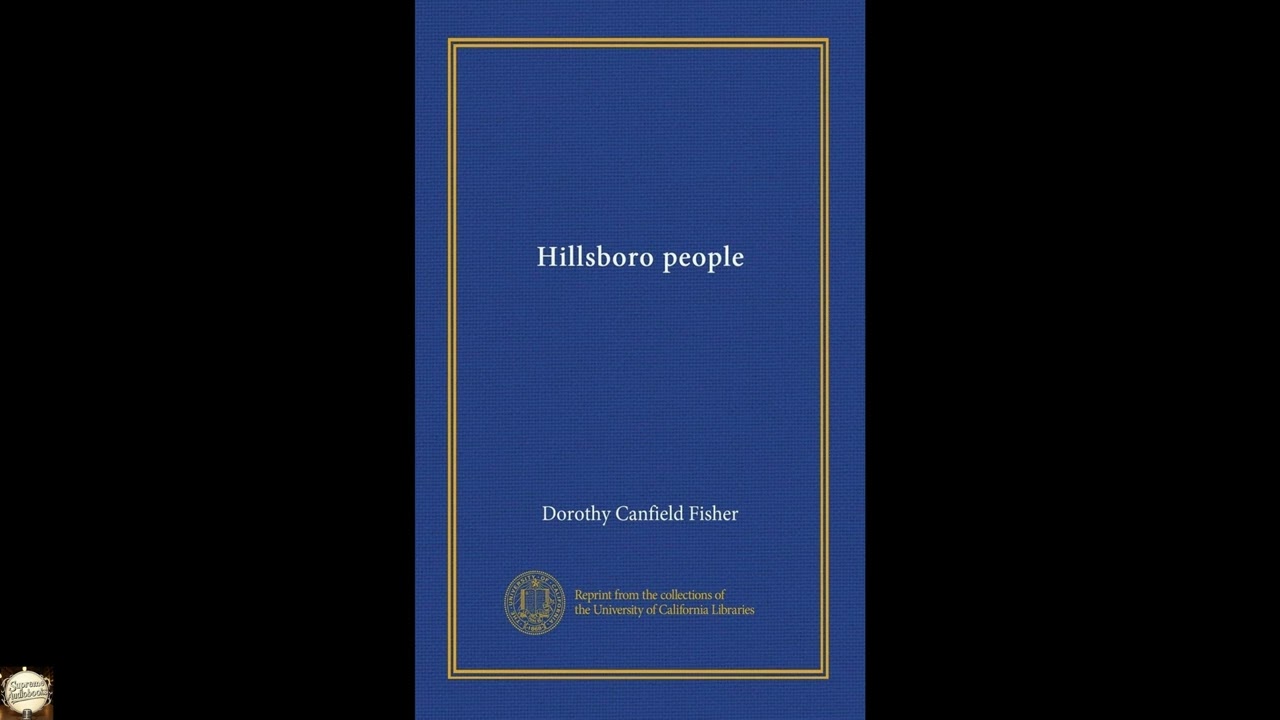
Hillsboro people
Dorothy Canfield Fisher’s collection, Hillsboro People, invites listeners into a world that feels both distant and profoundly familiar: a small, early 20th-century Vermont town where the rhythms of life are dictated by seasons, community, and the enduring human heart. Far from a dusty historical relic, this gathering of interconnected stories remains compelling today because it captures the universal experience of belonging and isolation, the quiet dignity of everyday struggles, and the ways in which a tight-knit community shapes individual destiny. It offers a gentle yet honest portrait of an American past, resonating with anyone who has ever pondered the meaning of home, the complexities of neighborly bonds, or the search for personal fulfillment amidst collective expectations. The stories unfold in the fictional village of Hillsboro, a place nestled in the green mountains of Vermont, where life moves at a deliberate pace. Rather than following a single grand narrative, the collection introduces us to a diverse array of characters—farmers, schoolteachers, storekeepers, housewives, and the town's elder statesmen—whose lives intersect and intertwine. We meet individuals like Mrs. Purdy, whose quiet resilience anchors her family through hardship, or the determined young woman who dreams of a life beyond the village boundaries, only to discover the unexpected pull of home. Each story functions as a window into a particular corner of Hillsboro, revealing the small triumphs and sorrows that collectively form the fabric of the community. Listeners witness the quiet dramas of daily existence: the anxieties over a meager harvest, the gossip that ripples through town after a scandalous event, the tender affections that bloom between young lovers, and the deep-seated loyalties that bind families across generations. There is no overarching plot in the conventional sense; instead, the book paints a cumulative portrait of Hillsboro itself, a character forged from the shared experiences of its inhabitants. The narrative arc is found in the recurring appearances of certain figures, allowing us to observe their growth, their disappointments, and their moments of profound insight, all against the unchanging backdrop of the Vermont landscape and the gradual march of time. The author behind this empathetic rendering of rural life was Dorothy Canfield Fisher, born in Kansas in 1879, a daughter of an Ohio State University professor and an artist. Her childhood was marked by travel and exposure to intellectual circles, yet it was her adult life spent largely in Arlington, Vermont, that profoundly shaped her literary voice. Fisher earned a Ph.D. in Romance Languages from Columbia University, a testament to her academic rigor, but her heart remained connected to the American landscape and its people. She was a prolific writer, known for her novels, short stories, and children's literature, including the beloved Understood Betsy, The Brimming Cup, and Seasoned Timber. Beyond her literary achievements, Fisher was a dedicated educational reformer and an outspoken activist. She championed the Montessori method of education, actively participated in the women's suffrage movement, and advocated for the League of Nations, reflecting her progressive ideals. Her writing often mirrored these concerns, portraying strong, intelligent women grappling with societal constraints and seeking meaningful lives. Fisher’s place in the American literary canon is significant; she stands as a bridge between 19th-century regionalism and 20th-century social realism, celebrated for her precise observation of character and her ability to imbue ordinary lives with profound meaning and psychological depth. She passed away in 1958, leaving behind a body of work that continues to speak to the enduring spirit of American life. Hillsboro People enacts several core themes with thoughtful clarity. One prominent theme is the interplay between community and individuality. The close-knit nature of Hillsboro provides an undeniable network of support—neighbors helping neighbors during illness or economic hardship, the shared joy of a town celebration. Yet, this same closeness can also present a challenge to personal freedom, as expectations and judgments from the community can weigh heavily on those who dare to deviate. One story, for instance, quietly illustrates how a young woman’s unconventional choices are met with a mixture of quiet disapproval and grudging respect, forcing her to find her own path while still existing within the town's embrace. Another powerful theme is resilience in the face of hardship. Life in Hillsboro is not romanticized; it often involves arduous labor, unforgiving weather, and unexpected tragedy. Characters frequently confront loss—a failed crop, the death of a loved one, the struggle against encroaching poverty. Through these trials, Fisher consistently highlights an underlying strength, an almost stoic determination to persevere. We see this in the quiet resolve of a farmer who rebuilds after a devastating fire, or the fortitude of a widow who finds new purpose in caring for her extended family, showcasing a deep wellspring of human endurance. These specific vignettes emphasize the quiet courage required to simply keep going, day after day, year after year. When Hillsboro People was published in 1915, the world was on the cusp of seismic change. World War I had just erupted in Europe, though the United States had not yet entered the conflict, leaving a sense of burgeoning global unrest beneath the surface of American tranquility. Domestically, the Progressive Era was in full swing, marked by widespread social reform movements, including the vigorous push for women’s suffrage, a cause Dorothy Canfield Fisher actively supported. While industrialization and urbanization were rapidly transforming the nation, much of America, particularly in rural areas like Vermont, still operated under older agrarian rhythms. Literarily, Fisher's work emerged during a fertile period for American realism. Writers were increasingly turning away from the sentimentalism of the Victorian era, seeking to portray American life and character with greater authenticity and psychological nuance. Authors like Willa Cather, Zona Gale, and Sherwood Anderson were beginning to shape a new landscape of American fiction, focusing on regional particularities and the inner lives of ordinary people. Fisher’s contribution to this movement was her particular gift for capturing the specific textures of rural New England life, portraying its inhabitants with an unsentimental eye that nevertheless conveyed deep affection and understanding, thereby securing her place among the important realist voices of her time. Listening to Hillsboro People as an audiobook offers a unique opportunity to truly settle into the contemplative pace of its narratives. The run length, spread over several hours, is perfectly suited for savoring each distinct story, whether during a long drive or as a companion to quiet mornings. A skilled narrator can bring out the gentle humor and the understated pathos woven throughout the text, allowing listeners to fully appreciate the distinctive voices of the Hillsboro residents—from the wry observations of the oldest inhabitants to the earnest hopes of the younger generation. The spoken word enhances the atmosphere, making the listener a welcomed guest in this carefully observed community, giving texture to the creak of a farmhouse door, the rustle of autumn leaves, or the quiet cadence of a neighborly conversation. It allows the subtle shifts in mood, the pauses for reflection, and the wisdom embedded in simple dialogue to fully resonate, creating an immersive experience that deepens one’s appreciation for these enduring stories of human connection.
Enjoyed Hillsboro people? A few ways to support us
Audible & Amazon links are affiliate; we may earn a small commission at no extra cost.
About this production
Human narration by a volunteer reader from LibriVox.org, the public-domain audiobook project. LibriVox volunteers record literary works whose copyright has expired in the United States, releasing the resulting recordings into the public domain.
Hillsboro people by Dorothy Canfield Fisher. The underlying text is in the U.S. public domain. We do not republish any modern copyrighted edition, translation, or commentary.
The 4K cinematic visuals accompanying this audiobook are generated by an AI image model from prompts derived from the source text. No copyrighted photos, paintings, or stock footage are used. AI generation is disclosed on every video on our YouTube channel as required by YouTube's altered/synthetic content policy.
English subtitles are transcribed from the LibriVox recording with OpenAI Whisper. Translations into the 11 other supported languages are produced by Meta's NLLB-200 neural translation model. No human translator's copyrighted translation is used.
Questions about sourcing or rights? See our DMCA & Sourcing policy or contact us.
Enjoyed this audiobook?
If you'd like to own a copy of Hillsboro people or hear a professionally produced edition, the links below help support free audiobook production at no extra cost to you.
As an Amazon Associate we earn from qualifying purchases. Audible / print links are affiliate.