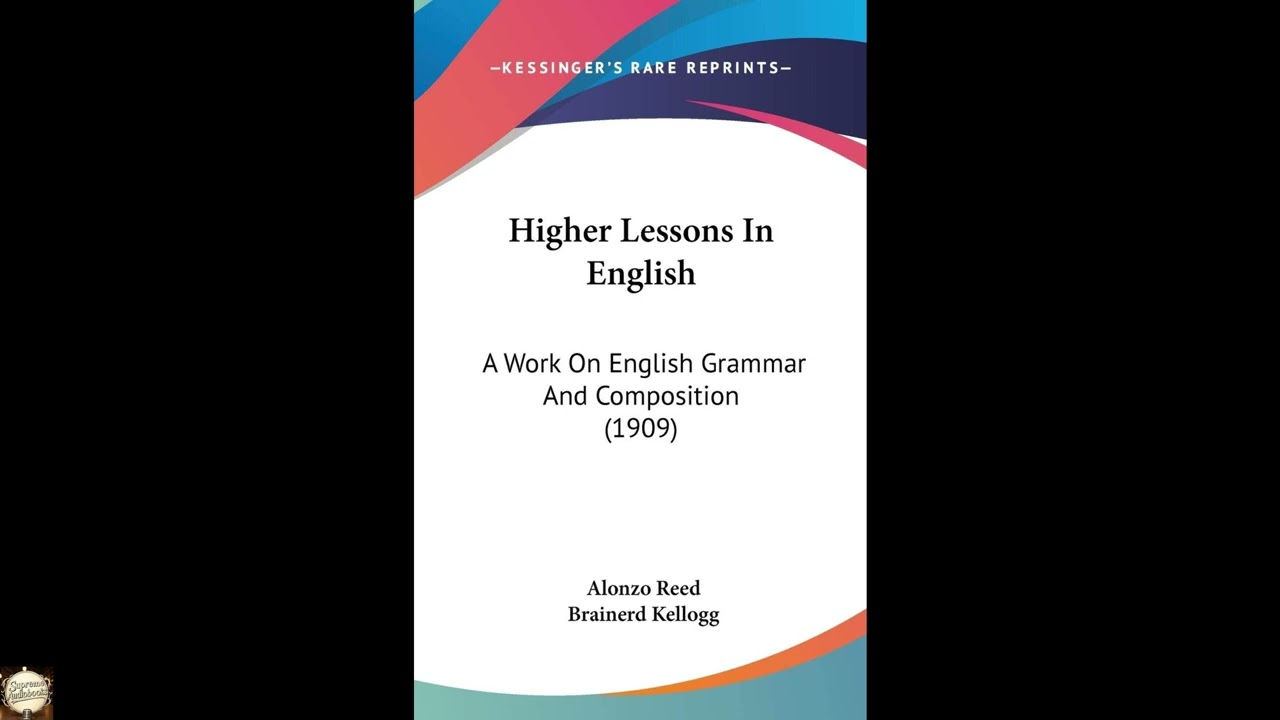
Higher Lessons In English: A Work On English Grammar And Composition (1909)
Long before the internet offered instant answers to every grammatical query, when the structure of the English language was taught with meticulous care in classrooms across the nation, works like Higher Lessons In English: A Work On English Grammar And Composition served as indispensable guides. Published in 1909, this volume by Alon represents more than just a dusty curriculum artifact; it is a meticulously crafted pedagogical tool designed to instill a profound understanding of language in its students. For listeners today, it offers a fascinating portal into the minds that shaped our linguistic heritage, a chance to rediscover the foundational principles many of us learned, or perhaps never fully grasped, and to appreciate the rigorous intellectual effort once dedicated to mastering the art of clear, effective communication. It’s a compelling look at the very framework of thought and expression as understood at the dawn of the twentieth century, providing context for the linguistic habits and expectations that still subtly influence how we speak and write today. The "story" of Higher Lessons In English unfolds not through characters and events in the traditional sense, but through the intellectual progression of the student, guided by Alon's structured methodology. The setting is the idealized classroom of the early 1900s, a mental space where precise rules and logical construction reign supreme. The primary "character" is the diligent learner, eager to navigate the often-perplexing landscape of English grammar and composition. Alon, the authorial voice, functions as the ever-present, patient instructor, laying out concepts with methodical clarity and providing a steady hand through complex syntax and elusive distinctions. The central conflict lies in the inherent challenge of taming the English language—a tongue notorious for its irregularities and vast vocabulary—into a predictable, effective system for expression. It is a struggle between confusion and comprehension, between imprecise thought and articulate statement. The arc of this educational narrative begins with foundational building blocks, examining the core parts of speech—nouns, verbs, adjectives—not merely as labels but as active components functioning within the greater linguistic machine. As the student progresses, Alon systematically introduces more elaborate structures: the construction of sentences, the nuances of punctuation, the art of paragraph development, and ultimately, the principles of cohesive composition. Each lesson builds upon the last, much like a meticulous architect adding layer upon layer to a grand design, until the student gains a comprehensive understanding of how words combine to form meaning, how sentences convey ideas, and how paragraphs articulate arguments. The journey culminates in the ability to construct well-reasoned, grammatically sound prose, a skill highly valued in a society increasingly reliant on written communication for commerce, education, and civic engagement. The name "Alon" for this seminal work on English grammar is not associated with a widely recognized literary figure or a specific biographical history, a common occurrence for many educational texts of the period, which were often products of committees, editorial teams, or educators who prioritized pedagogy over personal acclaim. Rather, the impact of such works stemmed from their utility and the clarity of their instruction. Higher Lessons In English likely emerged from a collective effort or the distillation of best practices within the educational establishments of the time, striving to standardize the teaching of language across a diverse and rapidly expanding nation. The emphasis was on a systematic approach, presenting grammar not as a collection of arbitrary rules, but as a logical system underpinning effective communication. These kinds of instructional materials formed the backbone of curricula in public and private schools, shaping generations of speakers and writers and reflecting the earnest desire to cultivate a literate and articulate citizenry. Several themes resonate throughout Alon's Higher Lessons In English, even in its didactic form. Foremost among these is clarity and precision in communication. The book consistently emphasizes that the proper use of grammar and composition is not an academic exercise for its own sake, but a vital tool for ensuring that one's thoughts are conveyed without ambiguity. For instance, sections on pronoun agreement or the correct placement of modifiers directly address how misplaced words can distort meaning, illustrating with concrete examples the subtle ways in which an ill-formed sentence can lead to misunderstanding. Another powerful theme is the idea of order and structure as inherent to effective expression. Alon meticulously breaks down the English language into its constituent parts—words, phrases, clauses, sentences, paragraphs—demonstrating how each element fits into a larger, logical framework. The rigorous analysis of sentence diagramming, for example, visually represents this commitment to structural integrity, showing how even complex ideas can be organized into an understandable linguistic form. Further, the work champions the theme of self-improvement and mastery through diligent study. The very title, "Higher Lessons," suggests a progressive climb toward advanced understanding, implying that linguistic proficiency is a skill to be honed and perfected. The numerous exercises and composition prompts within the text serve as practical applications of this theme, encouraging students to actively engage with the material and see tangible growth in their writing abilities. Finally, one can discern the theme of the enduring nature of foundational principles amidst linguistic evolution. While language is constantly shifting, Alon’s text posits that certain core grammatical truths remain constant, providing a stable anchor for clear expression. This dedication to fundamental principles ensures the book’s continued relevance, even as slang and new forms of communication emerge. The period surrounding the publication of Higher Lessons In English in 1909 was a dynamic time in American history, characterized by rapid industrialization, significant waves of immigration, and a burgeoning public education system. Culturally, there was a strong societal emphasis on standardization and the cultivation of a common American identity, with language playing a crucial role in this process. Politically, the Progressive Era was gaining momentum, pushing for reforms in education, public health, and social welfare, all of which relied on clear communication and an educated populace. In the literary world, realism and naturalism were prominent, demanding precise observation and accurate depiction, thereby reinforcing the value of clear and concise writing. This work emerged precisely because of these converging forces: the need to teach a diverse population a standardized English, the belief that proper language use was key to social mobility and civic participation, and a pedagogical philosophy that valued systematic instruction. It was a time when the "rules" of English were seen not as restrictive, but as empowering, offering a pathway to articulate thought and effective action in a rapidly changing world. Listening to Higher Lessons In English as an audiobook transforms what might appear to be a dry academic text into an engaging auditory experience. The narrator’s clear, measured voice becomes that of the patient teacher, guiding you through each explanation, each definition, and each illustrative example. The multi-hour length allows for a gradual absorption of complex ideas, perfect for attentive listening during a commute, while performing household tasks, or as a dedicated study aid. You can pause, rewind, and relisten to particular sections—perhaps the intricate explanations of verb moods or the finer points of comma usage—allowing the rhythm of the language itself to aid in comprehension. The pacing is deliberately unhurried, reflecting the careful pedagogy of the era, giving the listener ample time to process new information. It is an opportunity to immerse oneself in the disciplined atmosphere of early twentieth-century learning, hearing the very cadences and structures that generations used to master the formidable yet beautiful English language.
Enjoyed Higher Lessons In English: A Work On English Grammar And Composition (1909)? A few ways to support us
Audible & Amazon links are affiliate; we may earn a small commission at no extra cost.
About this production
Human narration by a volunteer reader from LibriVox.org, the public-domain audiobook project. LibriVox volunteers record literary works whose copyright has expired in the United States, releasing the resulting recordings into the public domain.
Higher Lessons In English: A Work On English Grammar And Composition (1909) by Alon. The underlying text is in the U.S. public domain. We do not republish any modern copyrighted edition, translation, or commentary.
The 4K cinematic visuals accompanying this audiobook are generated by an AI image model from prompts derived from the source text. No copyrighted photos, paintings, or stock footage are used. AI generation is disclosed on every video on our YouTube channel as required by YouTube's altered/synthetic content policy.
English subtitles are transcribed from the LibriVox recording with OpenAI Whisper. Translations into the 11 other supported languages are produced by Meta's NLLB-200 neural translation model. No human translator's copyrighted translation is used.
Questions about sourcing or rights? See our DMCA & Sourcing policy or contact us.
Enjoyed this audiobook?
If you'd like to own a copy of Higher Lessons In English: A Work On English Grammar And Composition (1909) or hear a professionally produced edition, the links below help support free audiobook production at no extra cost to you.
As an Amazon Associate we earn from qualifying purchases. Audible / print links are affiliate.
More Audiobooks
A Book of English Prose - Part II, Arranged for Secondary and High Schools
English-Bisaya Grammar, In Twenty Eight Lessons
Lectures on the English Poets: Delivered at the Surrey Institution
An English Garner - Critical Essays & Literary Fragments