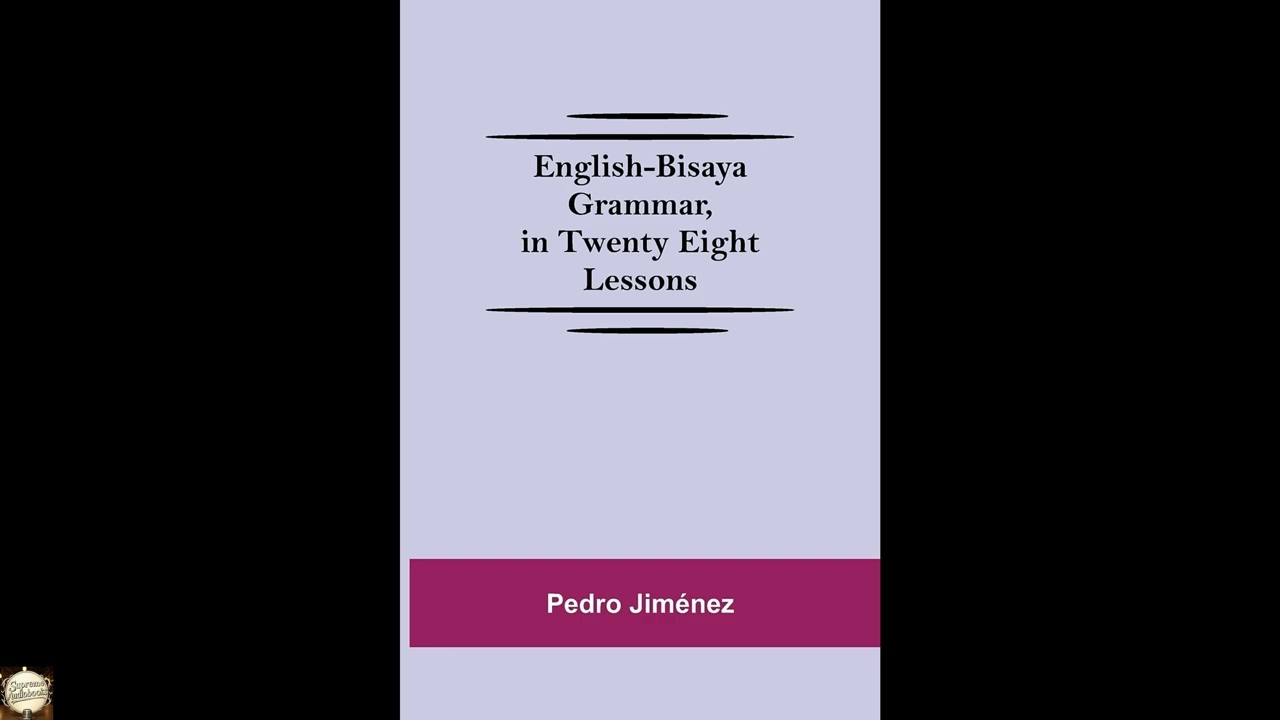
English-Bisaya Grammar, In Twenty Eight Lessons
"English-Bisaya Grammar, In Twenty Eight Lessons" by Pedro Jiménez is far more than a mere instructional text; it stands as a cultural artifact, a linguistic bridge, and a poignant echo from a pivotal era. This volume, meticulously structured and thoughtfully presented, offers modern listeners a unique opportunity to connect with the foundational elements of two distinct linguistic traditions: the global reach of English and the rich, expressive character of Bisaya, a major language of the central and southern Philippines. For anyone interested in the mechanics of language, the history of cross-cultural communication, or the subtle ways in which grammar shapes thought and identity, this foundational text provides not only practical linguistic insight but also a vivid snapshot of the persistent human drive to understand and connect across divides. It speaks to the enduring relevance of linguistic fluency in an ever-interconnected world. The "story" within "English-Bisaya Grammar" unfolds not through characters and traditional narrative arcs, but through the methodical progression of its twenty-eight carefully curated lessons, each a step forward in an intellectual quest. The setting is a conceptual space where two languages meet and merge, reflecting the actual linguistic encounter that defined much of the Philippines' modern history. The central "character" is the diligent student, implicitly guided by Jiménez's clear voice, striving to master the intricacies of both tongues. Listeners are introduced to the fundamental building blocks of Bisaya grammar, presented in clear comparison to English structures. This begins with basic phonology and simple sentence construction, establishing a bedrock understanding from which more complex concepts can spring. As the lessons progress, the scope widens. Listeners will find themselves moving from the identification of nouns and verbs to the nuances of tense and aspect, from simple affirmative statements to the construction of interrogatives and commands. The underlying "conflict" is the inherent challenge of internalizing new grammatical rules and lexical systems, particularly when those systems originate from vastly different linguistic families. Jiménez addresses this by systematically breaking down seemingly complex structures into manageable components, providing numerous examples that illustrate usage in everyday contexts. This gradual ascent through the layers of grammar creates a compelling intellectual arc, inviting the listener to witness the elegant logic inherent in both languages while bridging the gaps between them. The narrative momentum builds through the accumulation of knowledge, as each lesson integrates and expands upon previous concepts. Listeners will hear the subtle distinctions in Bisaya particle usage, the intricacies of verb conjugation, and the polite forms of address—all presented with a clarity designed to illuminate rather than confuse. Jiménez’s approach systematically builds a scaffolding for comprehension, allowing the learner to progressively construct an understanding of how to articulate thoughts and questions in Bisaya and how to translate the complexities of English into its counterpart. The concluding lessons promise not a dramatic climax, but the satisfaction of increased fluency, preparing the diligent student for genuine communication and a deeper appreciation of Bisaya expression. The journey itself is the reward, culminating in a firm grasp of practical grammar without revealing specific advanced insights of the final lessons. Pedro Jiménez, the visionary behind this enduring linguistic guide, remains a figure whose true biographical contours are etched more in his enduring work than in extensive historical records. Born likely in the late 19th or very early 20th century, Jiménez dedicated his life to education and cross-cultural understanding within the Philippine archipelago. Though specific dates of his birth and passing are not widely circulated, his contribution points to a period when formalizing indigenous languages for instruction and cultural exchange was of paramount importance. He was likely an educator, perhaps a scholar or a colonial administrator with a profound respect for local tongues, who recognized the urgent need for accessible resources to bridge the burgeoning influence of English with the deeply rooted Bisaya language. Jiménez's commitment extended beyond mere translation; he sought to illuminate the underlying logical structures of Bisaya for English speakers, and vice-versa, making the daunting task of language acquisition approachable. While "English-Bisaya Grammar" is his most celebrated and widely recognized publication, historical mentions suggest he may have also contributed to other educational materials, possibly a Bisaya-English dictionary or a collection of folk tales transcribed for academic study. His approach placed him firmly within a movement of pioneering linguists and ethnographers who, in the wake of shifting colonial powers, endeavored to document and standardize the languages of the Philippines, ensuring their preservation and promoting their use in a rapidly changing world. His place in the canon is not that of a novelist or a poet, but that of a foundational figure in Philippine linguistics and pedagogy. Jiménez’s work represents a vital cornerstone in the intellectual history of the Visayas region, serving as a testament to the effort to maintain linguistic identity amidst external pressures while simultaneously facilitating communication with the broader world. His lasting legacy lies in providing a clear, systematic pathway for generations of learners, affirming the inherent value and complexity of Bisaya and making it accessible to those who sought to connect with its speakers. He truly established a pedagogical benchmark for comparative grammar. "English-Bisaya Grammar" enacts several profound themes through its very structure and purpose. Foremost among these is language as a bridge and a barrier. The initial lessons, for instance, often highlight phonetic differences—the subtle sounds in Bisaya that do not have direct English equivalents—demonstrating how pronunciation itself can be an initial hurdle to understanding. Yet, by painstakingly providing phonetic guides and comparative examples, Jiménez immediately shows how those barriers can be systematically overcome, building a bridge of comprehension syllable by syllable. The constant juxtaposition of grammatical rules from both languages concretely illustrates how two disparate systems can be mapped onto each other, transforming linguistic difference from an obstacle into a pathway for connection. Another prominent theme is cultural exchange and identity. The grammar lessons are not merely abstract rules; they often incorporate everyday phrases and expressions that reflect social customs and cultural nuances. For example, the chapter on pronouns and terms of address indirectly illuminates the hierarchical and deferential aspects of Bisaya culture, contrasting with the more egalitarian English system. Furthermore, the systematic process of learning and education itself forms a central thematic thread. Jiménez's pedagogical approach—moving from simple to complex, reinforcing concepts through repetition and contextual examples—serves as an ongoing demonstration of effective learning strategies. The very act of engaging with the twenty-eight lessons becomes a journey into the nature of knowledge acquisition, proving that systematic effort can indeed lead to profound understanding. This grammar emerged during a period of profound transition and transformation in the Philippines, likely in the early to mid-20th century, a time when the archipelago was navigating the complexities of its identity following centuries of Spanish rule and the ascendance of American influence. English was rapidly becoming the language of administration, higher education, and burgeoning commerce, creating an urgent need for resources that could facilitate its adoption among the diverse linguistic groups of the islands. Simultaneously, there was a growing recognition of the importance of preserving and understanding indigenous languages like Bisaya, which served as the bedrock of local culture and communication for millions. In this cultural and political milieu, works like Jiménez’s "English-Bisaya Grammar" played a dual role. They were instrumental in equipping Bisaya speakers with the tools to master English, thereby accessing new educational and economic opportunities within the American colonial framework or the nascent Philippine Republic. Crucially, they also served as a means for non-Bisaya speakers, including American administrators, educators, and even other Filipinos, to gain an appreciation for and proficiency in a vital regional language. The existence of such a meticulous grammar underscores the dynamic linguistic landscape of the era, where adaptation and preservation coexisted, and where language was seen as both a tool for modernization and a repository of cultural heritage. Listening to "English-Bisaya Grammar, In Twenty Eight Lessons" as an audiobook offers an immersive and uniquely beneficial experience that transcends the limitations of a printed page. The narration provides immediate and accurate phonetic pronunciation of Bisaya words and phrases, a crucial element for any language learner that is often difficult to convey purely through text. The run length, spread over several hours, allows for a flexible listening schedule, perfect for focused study sessions or for absorbing the linguistic rhythms during a commute or while engaging in other activities. Listen for the careful distinction in the narrator's voice as they transition between English explanations and Bisaya examples, emphasizing the subtle phonetic differences and intonations. This auditory presentation brings the grammar to life, making the often-abstract rules of syntax and morphology concrete and audible, allowing the listener to grasp the cadences and musicality of both languages as they are systematically compared and clarified. It transforms a potentially daunting subject into an engaging and accessible educational encounter.
Enjoyed English-Bisaya Grammar, In Twenty Eight Lessons? A few ways to support us
Audible & Amazon links are affiliate; we may earn a small commission at no extra cost.
About this production
Human narration by a volunteer reader from LibriVox.org, the public-domain audiobook project. LibriVox volunteers record literary works whose copyright has expired in the United States, releasing the resulting recordings into the public domain.
English-Bisaya Grammar, In Twenty Eight Lessons by Pedro Jiménez. The underlying text is in the U.S. public domain. We do not republish any modern copyrighted edition, translation, or commentary.
The 4K cinematic visuals accompanying this audiobook are generated by an AI image model from prompts derived from the source text. No copyrighted photos, paintings, or stock footage are used. AI generation is disclosed on every video on our YouTube channel as required by YouTube's altered/synthetic content policy.
English subtitles are transcribed from the LibriVox recording with OpenAI Whisper. Translations into the 11 other supported languages are produced by Meta's NLLB-200 neural translation model. No human translator's copyrighted translation is used.
Questions about sourcing or rights? See our DMCA & Sourcing policy or contact us.
View 10 famous quotes from this book →
Enjoyed this audiobook?
If you'd like to own a copy of English-Bisaya Grammar, In Twenty Eight Lessons or hear a professionally produced edition, the links below help support free audiobook production at no extra cost to you.
As an Amazon Associate we earn from qualifying purchases. Audible / print links are affiliate.