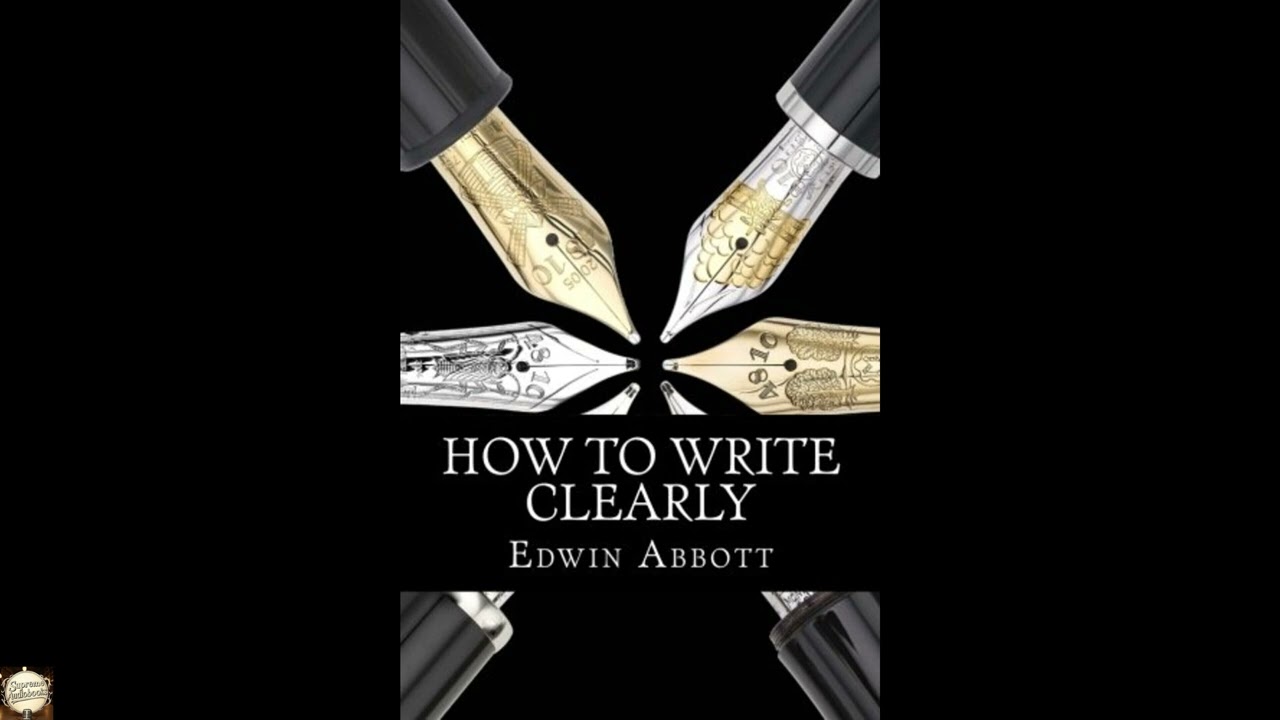
How to Write Clearly: Rules and Exercises on English Composition
In an age awash with information, where brevity often battles with clarity and the clamor of the digital world can obscure true understanding, the foundational principles of effective communication remain as vital as ever. Edwin Abbott's How to Write Clearly: Rules and Exercises on English Composition emerges not merely as a relic of a bygone educational system, but as a surprisingly fresh and essential guide for anyone who seeks to express themselves with precision and impact. This isn't just a dusty grammar book; it’s a manual for shaping thought itself, a testament to the idea that clear writing is a reflection of clear thinking. It offers a structured approach to mastering the English language, ensuring that your words serve your ideas rather than clouding them, making it an invaluable resource for students, professionals, and indeed, anyone striving for better self-expression in the modern world. The work invites the listener into a methodical curriculum designed to demystify the art of composition. From the outset, Abbott positions himself as a patient and logical instructor, guiding the aspiring writer through a series of observations and practical exercises. The "plot," if one can speak of such in a didactic text, is the systematic development of the student's own linguistic faculties. The central conflict lies in overcoming the common pitfalls of vagueness, redundancy, and logical inconsistency that often plague written expression. Abbott establishes fundamental rules concerning sentence structure, the precise use of words, and the coherent organization of paragraphs. He doesn't merely state these rules but illustrates them with pointed examples of both good and bad writing, often drawn from common errors he observed in his own teaching practice. As the book progresses, the scope widens from the minute details of word choice to the broader architecture of an essay or argument. The listener is led through concepts of conciseness, the avoidance of ambiguity, and the power of direct statement. Abbott's methodology encourages an active engagement, posing problems for the listener to consider and resolve, thereby internalizing the principles rather than simply memorizing them. The narrative arc traces a progression from elementary grammatical constructs to the nuanced crafting of persuasive and lucid prose, building confidence and capability with each carefully explained lesson. It’s a pedagogical journey where the listener is the main character, and the transformation is their growing command over the written word, empowered to articulate complex ideas with simplicity and force. Edwin Abbott Abbott, born in London in 1838, was a figure of considerable intellectual breadth and influence in Victorian England. A brilliant scholar, he attended St John's College, Cambridge, where he excelled in Classics and Mathematics. His career was primarily dedicated to education, most notably as the headmaster of the City of London School from 1865 until his retirement in 1889. During his tenure, he significantly modernized the school's curriculum, placing a new emphasis on science and mathematics alongside traditional subjects. This blend of classical rigor and forward-thinking pedagogy characterized much of his work. Beyond his educational leadership, Abbott was a prolific author whose literary output spanned diverse fields. He is perhaps best known for his satirical and philosophical novella, Flatland: A Romance of Many Dimensions, published in 1884, which remains a cornerstone of early science fiction and an insightful social commentary. He also made significant contributions to Shakespearean scholarship, particularly with A Shakespearian Grammar (1870), which became a standard reference work for understanding the linguistic nuances of Elizabethan English. Abbott's theological writings, including Philo Christus and The Kernel and the Husk, further showcase his profound intellectual curiosity and his engagement with critical religious thought during a period of intense theological debate. His place in the literary canon is secured not just by one famous work, but by a consistent thread of intellectual inquiry and a commitment to clarity in all his endeavors. At its core, How to Write Clearly enacts several crucial themes. The most evident is the pursuit of precision in language. Abbott repeatedly demonstrates how a slight shift in word choice or sentence structure can dramatically alter meaning, or even render a passage nonsensical. For instance, he might take an example sentence like "The report was finished by the committee in the morning," and show how its ambiguity (was the report finished by the committee or about the committee?) can be resolved by rewording it to "The committee finished the report in the morning." This isn's merely stylistic; it is about ensuring that the writer's exact intent reaches the reader. Another key theme is logical coherence. Abbott emphasizes that clear writing is inseparable from clear thinking. He guides the listener on how to structure arguments so that each point flows naturally from the last, creating an unbreakable chain of reasoning. He might illustrate this by presenting a jumbled paragraph and then methodically rearranging its sentences to reveal a logical progression that was previously hidden. A third pervasive theme is the power of simplicity and directness. In an era often associated with florid prose, Abbott advocates for an economy of words, urging writers to avoid unnecessary circumlocution and grandiose expressions. He demonstrates that a straightforward sentence often carries more weight and authority than one laden with qualifiers or excessive clauses. This connects to a fourth theme: respect for the reader. Abbott’s rules are ultimately geared toward making writing accessible and understandable, showing consideration for the person on the receiving end of the communication. He implicitly argues that obscure writing is a disservice, preventing ideas from being shared effectively and hindering mutual understanding. When How to Write Clearly was first published in 1872, Victorian England was a society undergoing rapid transformation. The industrial revolution had reshaped urban landscapes, expanding literacy rates meant a growing readership, and the burgeoning scientific and administrative sectors demanded a new emphasis on factual, precise communication. Education itself was a battleground, with reformers like Abbott striving to move beyond rote learning towards more analytical and practical skills. In the literary world, while the great narrative novelists of the era often employed rich, complex prose, there was also a counter-current, a growing appreciation for the clarity and logical force exemplified by essayists and critics. Abbott’s work emerged from this confluence—a recognition that systematic training in English composition was vital for a populace increasingly engaged with written materials, whether in newspapers, government documents, or scientific treatises. It was a practical response to a pressing need to equip individuals with the tools to navigate and contribute to a more complex, information-driven society. To engage with How to Write Clearly as an audiobook is to invite a patient, learned guide directly into your listening space. The instructional nature of the text lends itself beautifully to an auditory format, where the narrator’s voice can adopt a measured, authoritative, yet encouraging tone. One can appreciate the careful pacing as each rule is introduced, explained, and then exemplified, allowing ample time for the concepts to settle. The "several hours" run length makes it ideal for integrating into a daily routine—perhaps a chapter or two during a commute, or while performing other tasks—transforming passive listening into an active learning experience. Listen for the subtle shifts in the narrator's voice when illustrating a common error versus presenting the correct solution, or the deliberate pauses that give weight to a crucial principle. It’s an opportunity to absorb the lessons of clear communication not just intellectually, but through the very sound and rhythm of spoken language itself, a testament to the enduring power of well-chosen words.
Enjoyed How to Write Clearly: Rules and Exercises on English Composition? A few ways to support us
Audible & Amazon links are affiliate; we may earn a small commission at no extra cost.
About this production
Human narration by a volunteer reader from LibriVox.org, the public-domain audiobook project. LibriVox volunteers record literary works whose copyright has expired in the United States, releasing the resulting recordings into the public domain.
How to Write Clearly: Rules and Exercises on English Composition by Edwin Abbott. The underlying text is in the U.S. public domain. We do not republish any modern copyrighted edition, translation, or commentary.
The 4K cinematic visuals accompanying this audiobook are generated by an AI image model from prompts derived from the source text. No copyrighted photos, paintings, or stock footage are used. AI generation is disclosed on every video on our YouTube channel as required by YouTube's altered/synthetic content policy.
English subtitles are transcribed from the LibriVox recording with OpenAI Whisper. Translations into the 11 other supported languages are produced by Meta's NLLB-200 neural translation model. No human translator's copyrighted translation is used.
Questions about sourcing or rights? See our DMCA & Sourcing policy or contact us.
Enjoyed this audiobook?
If you'd like to own a copy of How to Write Clearly: Rules and Exercises on English Composition or hear a professionally produced edition, the links below help support free audiobook production at no extra cost to you.
As an Amazon Associate we earn from qualifying purchases. Audible / print links are affiliate.
More Audiobooks
On the Art of Writing: Lectures delivered in the University of Cambridge
Plain English: A Gateway to Effective Communication By Marian Wharton
Magazine, or Animadversions on the English Spelling (1703) (Classic Books)
Composition Rhetoric