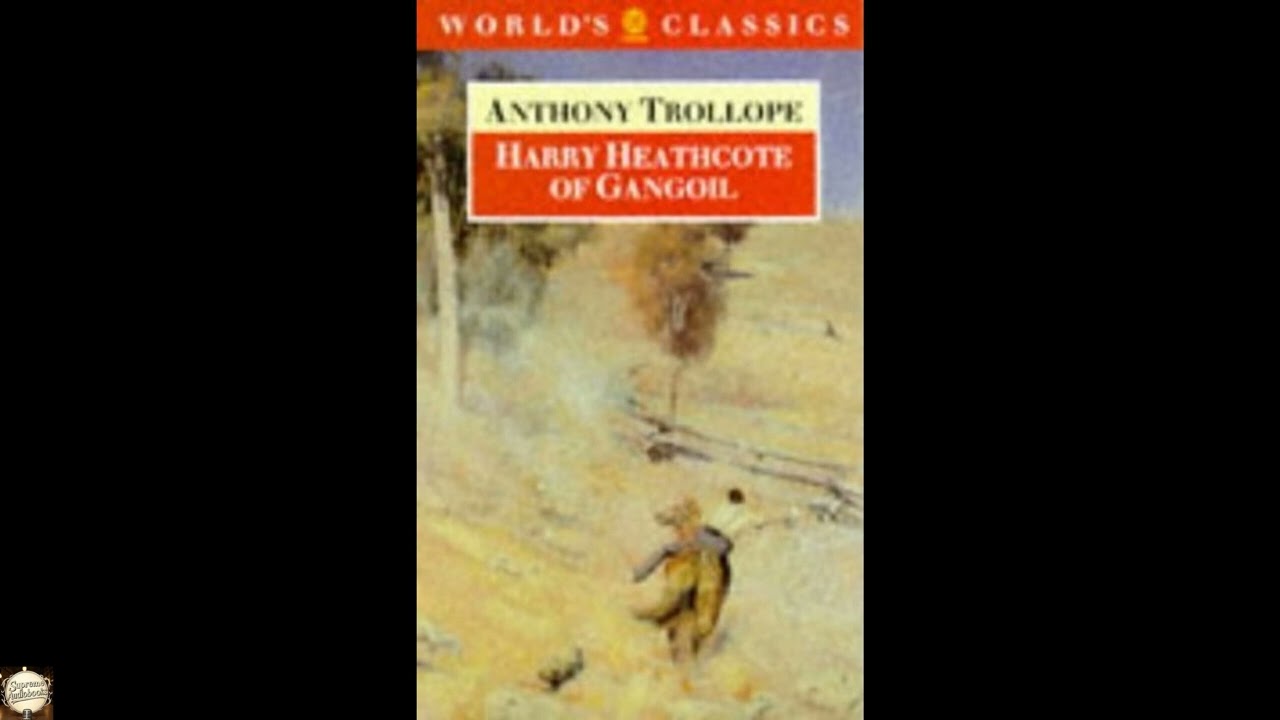
Harry Heathcote of Gangoil: A Tale of Australian Bushlife
Anthony Trollope, an author often synonymous with the drawing-rooms and political machinations of Victorian England, offers listeners a surprising and vivid departure in Harry Heathcote of Gangoil: A Tale of Australian Bushlife. This compact novel transports us not to Barsetshire or the Houses of Parliament, but to the harsh, sprawling, and often unforgiving landscape of colonial Australia. Far from the gentle satire of clerical life or the intricate dance of political ambition, this story plunges into a different kind of struggle: the raw fight for survival and property against both human antagonism and the brutal forces of nature. Why should a listener care about this particular Trollope today? Because it showcases the author's remarkable versatility and keen observation, proving that his genius for character and social dynamics was not confined by geography. It presents a gripping, action-oriented narrative that still resonates with its exploration of land ownership, community friction, and the relentless courage required to carve out a life on a dangerous frontier. Our story introduces Harry Heathcote, a young, earnest, and somewhat impetuous squatter who owns the vast Gangoil station in the remote Australian bush. Harry has poured his life and energy into making Gangoil a success, a monumental task in a land prone to devastating droughts and catastrophic fires. He lives with his resilient wife, Mary, and their small community of stockmen and household staff, forming a microcosm of English settlement in a wild, untamed land. The central conflict arises from Harry's constant vigilance against the threat of fire—a threat made even more perilous by the arrival of "free-selectors" on land adjacent to his own. These free-selectors, led by the resentful and suspicious Brown family, represent a different class and a competing vision for the land, creating a powder keg of social tension and petty grievances that quickly escalate. Harry's determination to protect his property, especially from deliberate arson, leads him into direct confrontation with these neighbors. The escalating friction pits Harry’s sense of justice and order against the envy and lawlessness he perceives in some of the selectors. As the dry season progresses and the danger of fire looms larger, suspicion turns to outright accusation, and Harry finds himself isolated, relying on his own courage and the loyalty of a few trusted hands. The arrival of a neighboring landowner, Giles Medlicot, a man of different temperament and background, further complicates the social dynamics, adding elements of potential romance and rivalry to the already charged atmosphere. The tale unfolds as a tense cat-and-mouse game, with Harry constantly on guard against the hidden dangers that lurk in the expansive, sun-baked landscape. Anthony Trollope, born in 1815, carved out a unique place in the pantheon of Victorian literature, a prolific writer whose output often surprised those who knew him only as a steady, methodical civil servant. His early life was marked by considerable hardship; he suffered through a difficult childhood, struggling at various public schools, including Winchester and Harrow. This period of personal humiliation and poverty deeply influenced his later sensitivity to social status and character psychology. He joined the Post Office in 1834, where he worked for 33 years, eventually becoming an inspector who travelled widely, designing and implementing the famous pillar box system for mail collection. It was during his extensive travels for the Post Office that he found time and inspiration to write, often completing substantial portions of novels on trains or ships. His literary career truly took off in his forties, beginning with The Warden (1855), the first of his beloved Barsetshire Chronicles, which famously brought to life the fictional county of Barsetshire and its ecclesiastical inhabitants. He followed this with other enduring works like Barchester Towers and the Palliser novels, a series that chronicled the lives of the British aristocracy and politicians. Trollope was a realist, known for his keen observation of social customs, human foibles, and the subtle interplay of power and morality in Victorian society. He was a master of psychological realism, creating characters whose inner lives and motivations felt profoundly authentic. Harry Heathcote of Gangoil, however, stands as a testament to his adaptability, written after he himself toured Australia between 1871 and 1872, demonstrating his ability to transplant his signature concerns to an entirely new and challenging environment, far from the familiar comforts of English country estates or London clubs. The novel enacts several compelling themes that resonate beyond its specific setting. One dominant theme is the stark, often brutal, power of man versus nature. The Australian bush itself is a character in Harry Heathcote, relentless and indifferent to human endeavor. Harry's entire existence is overshadowed by the ever-present threat of fire, which in the scorching dry season, can engulf everything he has built. We see this vividly in the desperate and methodical attempts to create firebreaks, the weary vigilance of Harry and his men, and the terrifying descriptions of the approaching flames, which threaten to wipe out not just property, but lives. This theme underscores the precariousness of life on the frontier, where human ingenuity and courage are constantly tested by a formidable environment. Another central theme is that of colonialism and property rights, particularly the friction between established landowners and new settlers. Harry Heathcote, as a squatter, holds vast tracts of land under lease, representing an earlier wave of colonial expansion. The free-selectors, however, represent a more democratic, often less privileged, wave of settlement, legally entitled to carve out smaller farms from the bush. The animosity between Harry and the Browns exemplifies this societal tension. Harry views them with suspicion, seeing them as interlopers who threaten his domain and embody a different, less orderly way of life, while the Browns resent Harry's wealth and authority. This dynamic highlights the complex social stratification and competing claims that shaped colonial societies, where the struggle for land was often a struggle for status and survival. Harry Heathcote of Gangoil was published in 1874, reflecting Trollope's own recent travels and observations in Australia. This period saw the British Empire at its zenith, with Australia still very much a burgeoning colonial outpost, a vast continent being settled by waves of immigrants. While the initial gold rushes had peaked, the push for land settlement and agricultural expansion was intense, leading to significant social and political tensions. The conflict between "squatters" (those who held large pastoral leases) and "free-selectors" (smaller farmers who could purchase land from the government) was a major political and economic issue in Australian colonies during the mid-to-late 19th century. This novel, therefore, emerged directly from a critical moment in Australia's development, offering a timely and insightful glimpse into these very real struggles for land, resources, and social standing on a distant frontier. Trollope, ever the social commentator, meticulously captured these dynamics, even in a setting far removed from his usual London drawing-rooms. To experience Harry Heathcote of Gangoil as an audiobook is to gain a deeper appreciation for the immediate tension and vivid descriptions of this unusual Trollope novel. The narrative, with its focus on action, suspense, and the palpable threat of bushfire, comes alive through a skilled narrator's voice, allowing listeners to feel the heat, hear the crackle of dry brush, and sense the isolation of the Gangoil station. The relatively concise run length makes it an ideal listen for those seeking a self-contained story that can be absorbed over a few focused sessions or enjoyed in shorter bursts. Listeners can savor the narrator’s portrayal of Harry's earnest, sometimes hot-headed, determination, Mary's quiet strength, and the distinct, often gruff, voices of the station hands and their adversaries. The conversational yet precise prose that is a hallmark of Trollope's writing translates beautifully to the spoken word, enhancing the atmosphere of both daily life and escalating peril in the unforgiving Australian wilderness.
Enjoyed Harry Heathcote of Gangoil: A Tale of Australian Bushlife? A few ways to support us
Audible & Amazon links are affiliate; we may earn a small commission at no extra cost.
About this production
Human narration by a volunteer reader from LibriVox.org, the public-domain audiobook project. LibriVox volunteers record literary works whose copyright has expired in the United States, releasing the resulting recordings into the public domain.
Harry Heathcote of Gangoil: A Tale of Australian Bushlife by Anthony Trollope. The underlying text is in the U.S. public domain. We do not republish any modern copyrighted edition, translation, or commentary.
The 4K cinematic visuals accompanying this audiobook are generated by an AI image model from prompts derived from the source text. No copyrighted photos, paintings, or stock footage are used. AI generation is disclosed on every video on our YouTube channel as required by YouTube's altered/synthetic content policy.
English subtitles are transcribed from the LibriVox recording with OpenAI Whisper. Translations into the 11 other supported languages are produced by Meta's NLLB-200 neural translation model. No human translator's copyrighted translation is used.
Questions about sourcing or rights? See our DMCA & Sourcing policy or contact us.
Enjoyed this audiobook?
If you'd like to own a copy of Harry Heathcote of Gangoil: A Tale of Australian Bushlife or hear a professionally produced edition, the links below help support free audiobook production at no extra cost to you.
As an Amazon Associate we earn from qualifying purchases. Audible / print links are affiliate.