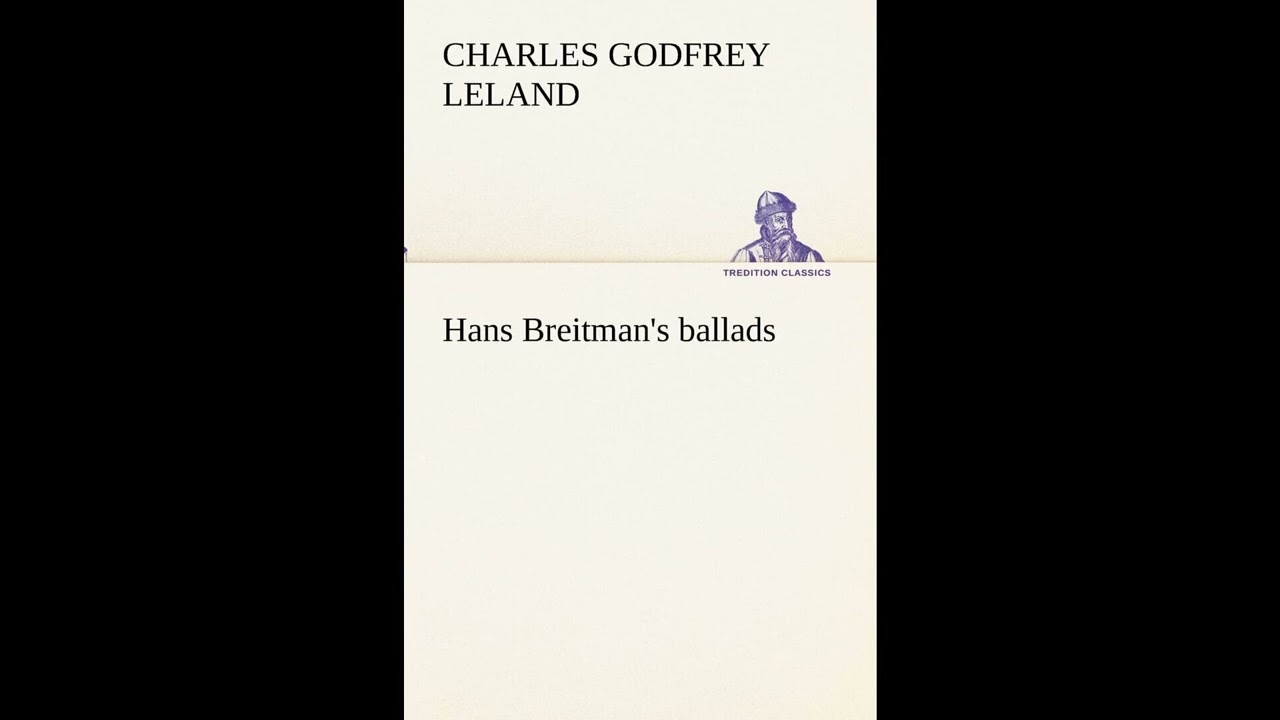
Hans Breitman's ballads
Imagine a world teetering between the raw frontiers of post-Civil War America and the lofty, often absurd, pronouncements of German philosophy. This is the stage upon which Hans Breitman, the unforgettable creation of Professor Charles Godfrey Leland, stumbles and philosophizes his way through a collection of ballads that are as uproarious as they are insightful. Far from a mere literary curiosity, "Hans Breitman's Ballads" stands as a vital and hilarious record of American identity in flux, a celebration of linguistic play, and a keen-edged satire that still resonates with anyone who has grappled with cultural clashes, the pursuit of fortune, or the simple folly of human nature. This is not just old poetry; it’s a living testament to a moment when a nation was finding its voice, often through the very specific, and highly comedic, inflections of its newest arrivals. Hans Breitman is less a fixed character in a sequential narrative than a recurring spirit, a persona who appears across a series of independent ballads, each offering a snapshot of his picaresque existence. We meet Breitman, a German-American adventurer, philosopher, and self-proclaimed connoisseur of life, as he navigates the tumultuous landscape of the American West and other peculiar settings. His adventures often revolve around a quest for "der 'breet'" – a term that could mean anything from booty and plunder to a good time or profound truth, usually involving copious amounts of beer and good company. From his comical, often inebriated, exploits during the American Civil War, where he finds himself more interested in appropriating abandoned goods than fighting battles, to his later wanderings as a philosophical vagabond, Breitman's life is a constant, bewildering pursuit of something just beyond his grasp. The settings for these ballads are as varied as Breitman's escapades: smoky saloons, battlefields strewn with abandoned provisions, Shaker communities he attempts to infiltrate for their "breet," and philosophical debates held in the most unlikely of places. His central conflict, if one can call it that, lies in his persistent attempts to apply a somewhat muddled, half-understood German intellectualism – drawing from Fichte, Schelling, and Hegel – to the very un-philosophical realities of American life. He is a man perpetually out of place, armed with a powerful thirst and an even more powerful, if misguided, intellect, always chasing a phantom of prosperity or enlightenment, and usually falling short in the most entertaining ways imaginable. His story arc is not one of linear progression, but rather a spiraling dance of misadventure, punctuated by moments of accidental wisdom and profound, if drunken, pronouncements. The author behind this iconic character was Charles Godfrey Leland, born in Philadelphia in 1824. A true polymath, Leland's life was as rich and varied as his literary output. After graduating from Princeton, he pursued further studies in Germany at Heidelberg and Munich, immersing himself in European culture and languages – an experience that profoundly shaped his understanding of German identity and humor, eventually leading to the creation of Breitman. He even participated in the 1848 revolution in France, fighting alongside revolutionaries, before returning to the United States. Leland’s professional career was equally diverse, encompassing law, journalism, and ethnography. He edited various publications, including the "Continental Monthly" and the early American humor magazine "Vanity Fair," where many of the Breitman ballads first appeared, instantly garnering immense popularity. Leland’s wide-ranging interests extended far beyond humorous poetry. He became a significant folklorist, dedicating much of his later life to the study of Romani culture, language, and folklore, producing works like "The English Gypsies and Their Language." His inquiries into obscure folk traditions also led him to publish "Aradia, or the Gospel of the Witches," a controversial but influential work on Italian witchcraft. This blend of academic rigor, journalistic wit, and an almost insatiable curiosity about the hidden corners of human culture firmly places Leland as a unique figure in American letters, capable of both lighthearted satire and serious anthropological investigation, making his legacy far more expansive than just his most famous creation. "Hans Breitman's Ballads" brilliantly enacts several profound themes, all delivered with a disarming comedic touch. One prominent theme is the immigrant experience and the complexities of assimilation. Breitman's heavily accented English, infused with German syntax and vocabulary ("Wat is de 'breet' of dis here fighting?"), highlights the linguistic and cultural friction of new arrivals in America. His attempts to interpret American pragmatism through a German philosophical lens offer a humorous, yet poignant, look at the struggle to reconcile Old World heritage with New World realities. Consider, for instance, his attempts to justify his looting during the war by quoting philosophers, a direct collision of high theory and low practice. Another core theme is the satire of American society and frontier life in the immediate post-Civil War era. Leland uses Breitman's wide-eyed, often naive, perspective to lampoon the pervasive get-rich-quick schemes, political corruption, and rough-and-tumble morality of the time. The ballads often show Breitman chasing ill-gotten gains or getting entangled in local politics, reflecting a nascent nation grappling with its own identity and often falling short of its ideals. His pursuit of the "breet" can be seen as a commentary on the materialistic drive of the expanding nation, often at the expense of genuine ethical considerations. The period in which "Hans Breitman's Ballads" first appeared, roughly the late 1860s and early 1870s, was a time of immense social and political upheaval in America. The nation was still reeling from the aftermath of the Civil War, struggling through Reconstruction, and witnessing unprecedented waves of immigration, particularly from Germany. This era saw rapid industrialization, westward expansion, and the rise of a distinct American popular culture that often embraced humor as both an escape and a means of social commentary. Leland's work emerged from this confluence, offering a voice to the experiences of German immigrants and providing a much-needed comedic outlet for a nation in transition, directly addressing the cultural anxieties and opportunities of the time. The widespread popularity of the ballads reflected a hunger for literature that spoke to the immediate experience of a changing America, a demand for homegrown humor that could both entertain and gently critique. Leland’s use of dialect poetry, though sometimes controversial, was part of a broader literary movement towards realism and regionalism, seeking to capture the authentic voices and peculiar characteristics of America's diverse populace. By giving voice to Hans Breitman, a character both foreign and familiar, Leland tapped into a collective understanding of what it meant to be American in an increasingly diverse and often chaotic nation, making his work a cultural touchstone of the period. Listening to "Hans Breitman's Ballads" as an audiobook is, in many ways, the truest way to experience this work. The very essence of these pieces lies in their phonetic humor and the unique cadence of Breitman's broken English, which truly comes alive when spoken aloud. A skilled narrator can perfectly capture the distinct "Pennsylvania Dutch" or German-American dialect, allowing the listener to fully appreciate the clever wordplay, the subtle mispronunciations, and the clashing German syntax that form the backbone of the comedy. Over several hours of listening, one can become intimately acquainted with Breitman's voice, his philosophical ramblings, and his often-bemused outlook on the world. Pay close attention to the narrator's pacing, especially in the longer, more lyrical passages, and listen for how the voice actor differentiates Breitman's boisterous declarations from his more melancholic moments, bringing to life the unforgettable spirit of this uniquely American figure.
Enjoyed Hans Breitman's ballads? A few ways to support us
Audible & Amazon links are affiliate; we may earn a small commission at no extra cost.
About this production
Human narration by a volunteer reader from LibriVox.org, the public-domain audiobook project. LibriVox volunteers record literary works whose copyright has expired in the United States, releasing the resulting recordings into the public domain.
Hans Breitman's ballads by Professor Charles Godfrey Leland. The underlying text is in the U.S. public domain. We do not republish any modern copyrighted edition, translation, or commentary.
The 4K cinematic visuals accompanying this audiobook are generated by an AI image model from prompts derived from the source text. No copyrighted photos, paintings, or stock footage are used. AI generation is disclosed on every video on our YouTube channel as required by YouTube's altered/synthetic content policy.
English subtitles are transcribed from the LibriVox recording with OpenAI Whisper. Translations into the 11 other supported languages are produced by Meta's NLLB-200 neural translation model. No human translator's copyrighted translation is used.
Questions about sourcing or rights? See our DMCA & Sourcing policy or contact us.
Enjoyed this audiobook?
If you'd like to own a copy of Hans Breitman's ballads or hear a professionally produced edition, the links below help support free audiobook production at no extra cost to you.
As an Amazon Associate we earn from qualifying purchases. Audible / print links are affiliate.