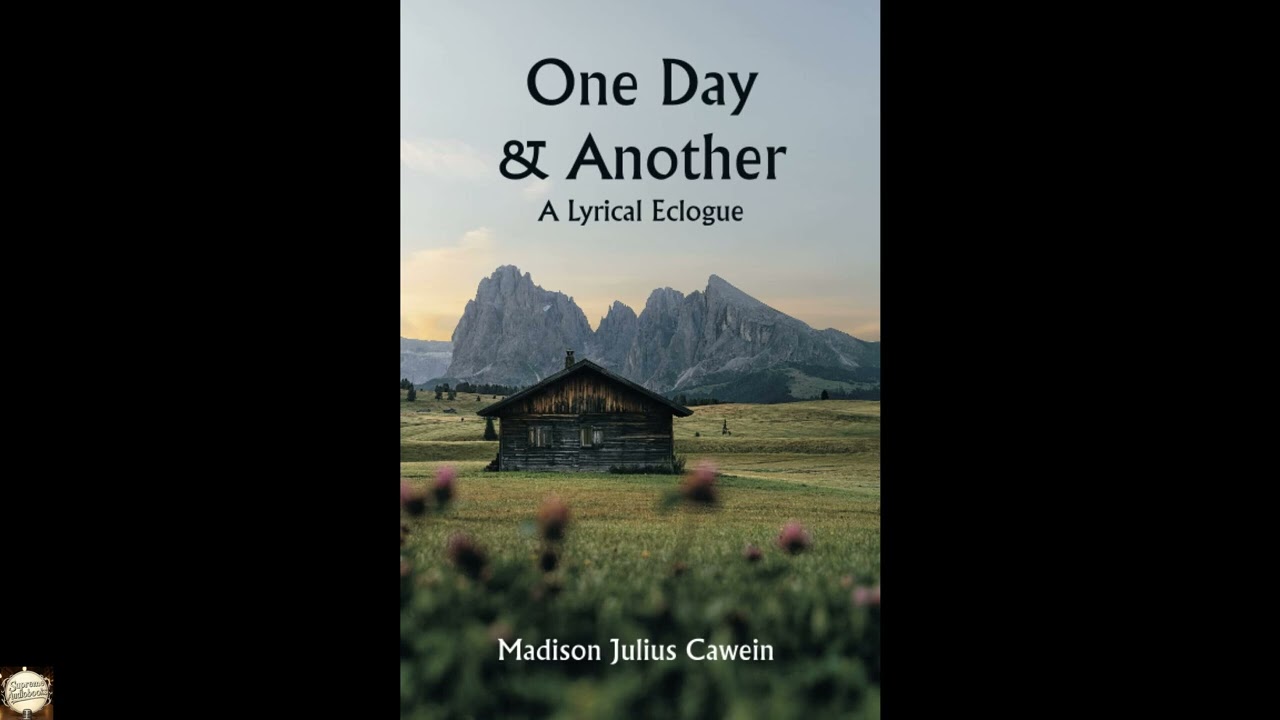
One Day & Another; A Lyrical Eclogue
Step into a verdant landscape sculpted by words, a place where the murmur of a stream speaks volumes and the rustle of leaves whispers forgotten truths. Madison Julius Cawein’s One Day & Another; A Lyrical Eclogue arrives as a resonant echo from a bygone era, yet its poetic vision offers a profound counterpoint to the hurried rhythms of our present world. This is not a grand epic or a sweeping narrative, but an intimate communion with nature, a carefully wrought poetic meditation that invites listeners to slow down, to observe, and to rediscover the profound beauty in the fleeting moments of existence. In an age saturated with digital noise, Cawein’s work presents a serene, meticulously detailed escape, a chance to reconnect with the enduring cycles of the natural world and the reflective spirit of the human heart. The setting for this lyrical work is unmistakably the American South, likely Cawein's native Kentucky, painted with an artist's precision. We are immersed in a pastoral scene, where sunlight filters through ancient trees, a winding creek flows over smooth stones, and the air is thick with the scent of wildflowers and damp earth. While One Day & Another does not present a conventional cast of characters or a dramatic story arc, its structure suggests a dialogue, or perhaps a series of interwoven monologues, from a speaker deeply attuned to the rhythms of the land. The central "protagonist" is arguably the natural world itself—the rising and setting sun, the changing seasons, the flora and fauna observed with keen, almost reverent attention. The eclogue unfolds across a span of time suggested by its title, perhaps tracing the progression of a single day from dawn to dusk, or subtly hinting at the larger cycle of a year. The "conflict," if one can call it that in such a contemplative piece, resides in the interplay between human consciousness and the indifferent beauty of the environment. The speaker grapples with the fleeting nature of beauty, the solace found in solitude, and the subtle melancholy that often accompanies profound appreciation of the world's impermanence. The overarching arc is one of deepening perception, as the poet’s gaze moves from broad observation to minute detail, drawing connections between the macrocosm of the landscape and the microcosm of human emotion, without ever revealing a sudden, climactic resolution. Madison Julius Cawein (1865-1914) was a prolific American poet hailing from Louisville, Kentucky, often celebrated in his time as "the Keats of Kentucky" for his sensuous descriptions and commitment to natural beauty. Born shortly after the close of the Civil War, Cawein devoted his life to poetry, producing over thirty volumes during his relatively brief lifespan. Largely self-taught, he immersed himself in the classical Romantic traditions, drawing inspiration from English poets like John Keats, Percy Bysshe Shelley, and Alfred, Lord Tennyson, while grounding his verse firmly in the distinct landscapes of his Southern home. His early life was marked by financial struggles, yet he relentlessly pursued his literary vocation, finding a dedicated audience in both America and England. Cawein's early work, such as Blooms of the Berry (1887) and The Garden of Dreams (1896), established his reputation as a master of descriptive verse and a champion of the natural world. He was a keen observer, cataloging the specific plants, birds, and atmospheric conditions of the South with a remarkable botanical and zoological precision. His poetry is characterized by a rich lexicon, a love for mythological allusions, and an unwavering commitment to musicality and traditional poetic forms. Though his popularity waned somewhat after his death with the ascendance of Modernism, Cawein remains a significant, if often overlooked, figure in American letters, representing a bridge between the genteel tradition of the nineteenth century and the early stirrings of twentieth-century poetry. Among the central themes woven into One Day & Another is nature as a source of spiritual and aesthetic solace. Cawein renders detailed scenes—a "silver stream" reflecting the sky, the "whispering wind" through sycamore leaves—not merely as picturesque backdrops, but as entities imbued with a living spirit, offering comfort and wisdom. The poem’s careful descriptions of the Kentucky woods or a summer meadow serve as a testament to the restorative power of the wild, suggesting that communion with the earth provides a sanctuary from the complexities of human existence. Another prominent theme is the ephemeral nature of beauty and the passage of time. The very title, One Day & Another, underscores this, as the poet meticulously captures moments of exquisite loveliness—a dawn breaking, a flower blooming—only to implicitly acknowledge their fleeting quality. This creates a gentle melancholy, a wistful awareness that all beauty, like the day itself, eventually fades, yet leaves an indelible impression. Cawein also consistently presents a fusion of the mythic and the mundane, elevating common natural elements into figures of classical or local folklore. A sun-dappled glade might subtly evoke a fae realm, or a gnarled tree could hold the spirit of an ancient Dryad. This approach infuses the landscape with a sense of wonder and enchantment, revealing the poet's reverence for the animistic qualities of the natural world. Furthermore, the eclogue quietly celebrates the contemplative life, portraying an intellectual and emotional engagement with the environment that prioritizes observation and introspection over action or material pursuit. It is a work that champions the act of simply being within nature, reflecting upon its cycles and secrets, and finding profound meaning in quiet contemplation. Published in 1901, One Day & Another emerged at a fascinating crossroads in American history and literature. The turn of the twentieth century was a period of immense change, marked by rapid industrialization, burgeoning urbanization, and the closing of the American frontier. Many people were experiencing a profound disconnect from the natural world, and in response, there was a cultural yearning for simpler, more pastoral ideals. Literary trends were shifting as well; while Cawein continued to write in the Romantic tradition, the seeds of Modernism, with its emphasis on realism, skepticism, and formal experimentation, were beginning to sprout. Cawein's dedication to lyrical beauty and traditional forms placed him somewhat apart from these emerging movements, yet it also made his work a poignant expression of a vanishing sensibility. He offered a beautiful, articulate counter-narrative to the relentless march of progress, reminding his readers of the enduring value of nature, poetry, and reflective thought in an increasingly industrialized and complex society. His work served as an eloquent plea for the preservation of beauty and the spiritual connection to the land that many felt was being lost. Listening to One Day & Another as an audiobook transforms the text into an immersive sonic experience, allowing the inherent musicality of Cawein's verse to fully resonate. The "several hours" run time offers ample opportunity for deep listening, ideal for an extended session of focused appreciation or as a companion during walks in nature. A skilled narrator brings Cawein's meticulous descriptions to life, guiding listeners through the precise imagery—the scent of honeysuckle, the sight of a kingfisher, the feel of moss underfoot—with a pacing that mirrors the reflective nature of the poem. Pay close attention to the narrator's interpretation of Cawein's rhythm and meter, which often evoke the very sounds and movements of the natural world he describes. The voice and tone are crucial here, conveying the poet's blend of reverence, melancholy, and wonder. This is an auditory invitation to pause, breathe, and find beauty in the quiet unfolding of a day, allowing the rich atmosphere of the poem to wash over you, much like a gentle breeze through the Kentucky woods.
Enjoyed One Day & Another; A Lyrical Eclogue? A few ways to support us
Audible & Amazon links are affiliate; we may earn a small commission at no extra cost.
About this production
Human narration by a volunteer reader from LibriVox.org, the public-domain audiobook project. LibriVox volunteers record literary works whose copyright has expired in the United States, releasing the resulting recordings into the public domain.
One Day & Another; A Lyrical Eclogue by Madison Julius Cawein. The underlying text is in the U.S. public domain. We do not republish any modern copyrighted edition, translation, or commentary.
The 4K cinematic visuals accompanying this audiobook are generated by an AI image model from prompts derived from the source text. No copyrighted photos, paintings, or stock footage are used. AI generation is disclosed on every video on our YouTube channel as required by YouTube's altered/synthetic content policy.
English subtitles are transcribed from the LibriVox recording with OpenAI Whisper. Translations into the 11 other supported languages are produced by Meta's NLLB-200 neural translation model. No human translator's copyrighted translation is used.
Questions about sourcing or rights? See our DMCA & Sourcing policy or contact us.
Enjoyed this audiobook?
If you'd like to own a copy of One Day & Another; A Lyrical Eclogue or hear a professionally produced edition, the links below help support free audiobook production at no extra cost to you.
As an Amazon Associate we earn from qualifying purchases. Audible / print links are affiliate.