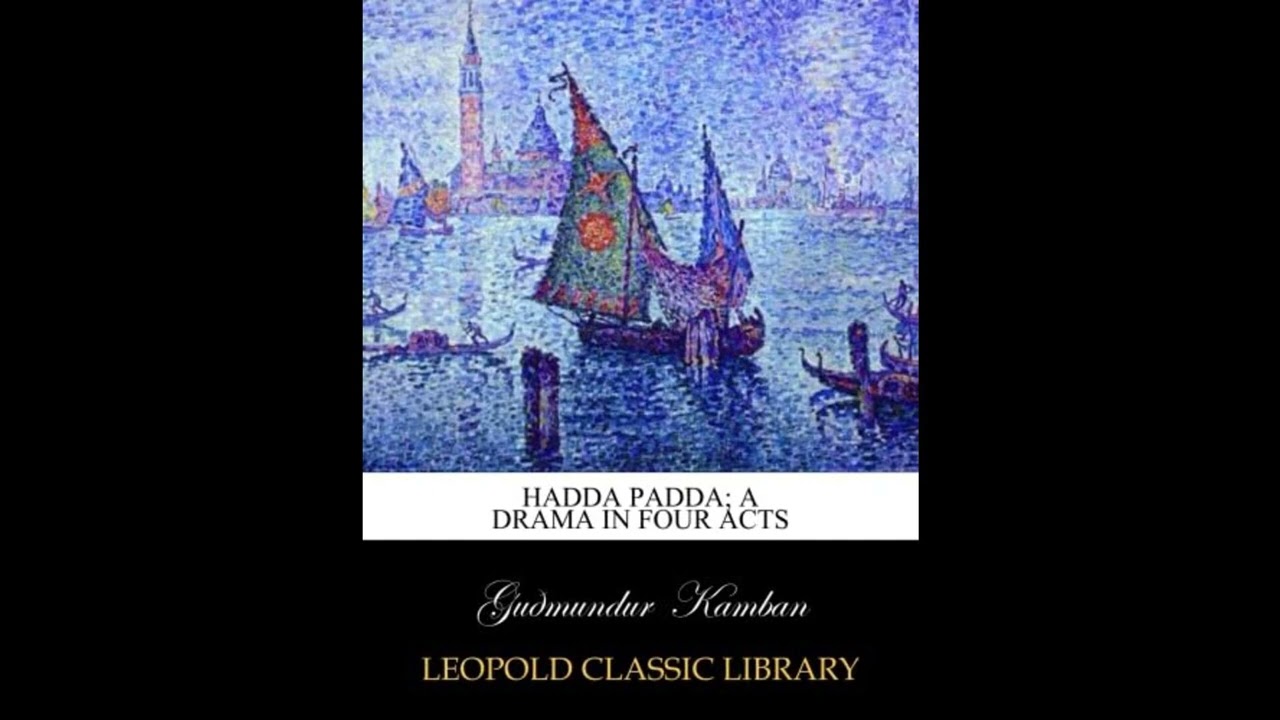
Hadda Padda; a drama in four acts
"Hadda Padda; a drama in four acts" by Guðmundur Kamban is a searing theatrical work that plunges into the fierce heart of individual defiance against the unyielding forces of nature and community. Set against the stark, beautiful backdrop of early twentieth-century Iceland, this powerful play asks whether passion can truly thrive when hemmed in by tradition, the judgment of a small world, and the harsh realities of survival. It’s a drama that resonates profoundly with anyone who has ever felt the pull between their innermost desires and the expectations of the world around them, making its intense emotional conflicts feel as immediate and pressing today as when it first stirred audiences. The story unfolds in a remote Icelandic fishing village, a place where life is dictated by the relentless rhythm of the sea and the deeply ingrained customs passed down through generations. At its center is Hadda Padda, a young woman whose spirit is as untamed and elemental as the landscape itself. Unwilling to be confined by the traditional roles expected of her, Hadda Padda finds herself drawn to Brandur, a hardworking fisherman whose quiet strength matches her own fiery independence. Their connection quickly blossoms into a powerful, unconventional love that challenges the strict social fabric of the community. However, their bond is a source of discomfort and condemnation for the villagers, particularly from the influential family of Jónas, a respected elder who has his own designs for Hadda Padda's future. As whispers and judgments grow, the couple faces increasing pressure to conform, or risk ostracization. A series of escalating events – a treacherous storm at sea, a public confrontation during a community gathering, and the revelation of a long-held secret – force Hadda Padda and Brandur to confront the true cost of their love. The play expertly builds tension through its vivid portrayal of human struggle, showing how personal desires clash with communal well-being and the ancient, unforgiving forces of the land and sea. Guðmundur Kamban, the visionary Icelandic playwright behind "Hadda Padda," was a singular voice in Nordic literature. Born in 1888 in a small fishing community, Kamban's early life steeped him in the sagas and folk tales of his homeland, even as his subsequent studies in Copenhagen exposed him to the cutting edge of European theatrical thought. This dual heritage formed the foundation of his unique dramatic style, which fused the epic scope of Icelandic storytelling with the psychological realism and intense character development favored by continental dramatists. Kamban was not merely a chronicler; he was a provocateur, consistently challenging societal norms and exploring the often-painful struggle for individual freedom in his works. His career was marked by both critical acclaim and controversy. After achieving considerable success with "Hadda Padda" in 1917, he became a celebrated figure in Scandinavia and Germany, known for his stark, unvarnished portrayals of human passion and conflict. Other notable works include the historical novel "The Virgin of Skálholt" and the play "We Murderers," both of which further solidified his reputation for tackling profound ethical dilemmas. Kamban spent much of his adult life abroad, observing the tumultuous changes sweeping through Europe, yet his gaze remained firmly fixed on the human condition, often refracted through the lens of his Icelandic heritage. He tragically passed away in 1945, leaving behind a legacy of powerful, thought-provoking dramas that continue to resonate for their unflinching honesty. "Hadda Padda" stands as a testament to Kamban's thematic brilliance, articulating several core ideas with compelling clarity. Primarily, it dissects the enduring conflict between individual autonomy and communal expectation. We witness Hadda Padda's fierce resistance to arranged marriages and traditional gender roles, her refusal to be molded into what society deems acceptable. In one memorable scene, she confronts Jónas not with defiance, but with a quiet, unyielding self-possession that underscores her independent spirit, demonstrating the immense personal cost of choosing one's own path. The play also foregrounds the immense, indifferent power of nature, particularly the relentless Icelandic sea, which acts as both provider and destroyer, shaping the characters' destinies and testing their resilience. Another significant theme is the legacy of the past – how ancient grudges, family honor, and long-held secrets can profoundly influence present-day choices and relationships. The weight of tradition often stifles personal happiness, creating a suffocating atmosphere from which the protagonists desperately seek escape. Finally, the drama deeply examines the nature of love and sacrifice. Hadda Padda and Brandur's love is not a romanticized idyll, but a gritty, often painful commitment that demands immense personal sacrifice and forces them to confront the very limits of their devotion in the face of overwhelming odds. Their emotional struggle paints a stark picture of love's true, demanding power. Kamban's "Hadda Padda" emerged at a pivotal moment in Icelandic history and European literature. In the early twentieth century, Iceland was experiencing a strong surge of national identity, seeking to define itself apart from centuries of Danish rule. This cultural awakening fostered a renewed interest in Icelandic sagas and folklore, but also a burgeoning engagement with modern European artistic movements. Kamban's drama perfectly captured this tension—rooting its story firmly in the unique character and landscape of Iceland, while employing the psychological realism and social critique gaining traction in Scandinavian and German theatre. The play arrived as societies across Europe were grappling with changing roles for women and increasing questioning of traditional social structures, making its themes of individual freedom and societal pressure remarkably current. To experience "Hadda Padda" as an audiobook is to immerse oneself directly into the heart of its dramatic power. A skilled narrator breathes life into Kamban's potent dialogue, capturing the stark beauty of the setting and the raw emotion of its characters. The spoken word allows the listener to fully appreciate the rhythm and cadence of the exchanges between Hadda Padda and Brandur, feeling the weight of their unspoken desires and the intensity of their arguments. Over several hours of listening, the listener is transported, feeling the bite of the Icelandic wind, hearing the roar of the sea, and witnessing the profound human drama unfold through a performance that brings out every nuance of this compelling classic.
Enjoyed Hadda Padda; a drama in four acts? A few ways to support us
Audible & Amazon links are affiliate; we may earn a small commission at no extra cost.
About this production
Human narration by a volunteer reader from LibriVox.org, the public-domain audiobook project. LibriVox volunteers record literary works whose copyright has expired in the United States, releasing the resulting recordings into the public domain.
Hadda Padda; a drama in four acts by Guðmundur Kamban. The underlying text is in the U.S. public domain. We do not republish any modern copyrighted edition, translation, or commentary.
The 4K cinematic visuals accompanying this audiobook are generated by an AI image model from prompts derived from the source text. No copyrighted photos, paintings, or stock footage are used. AI generation is disclosed on every video on our YouTube channel as required by YouTube's altered/synthetic content policy.
English subtitles are transcribed from the LibriVox recording with OpenAI Whisper. Translations into the 11 other supported languages are produced by Meta's NLLB-200 neural translation model. No human translator's copyrighted translation is used.
Questions about sourcing or rights? See our DMCA & Sourcing policy or contact us.
Enjoyed this audiobook?
If you'd like to own a copy of Hadda Padda; a drama in four acts or hear a professionally produced edition, the links below help support free audiobook production at no extra cost to you.
As an Amazon Associate we earn from qualifying purchases. Audible / print links are affiliate.