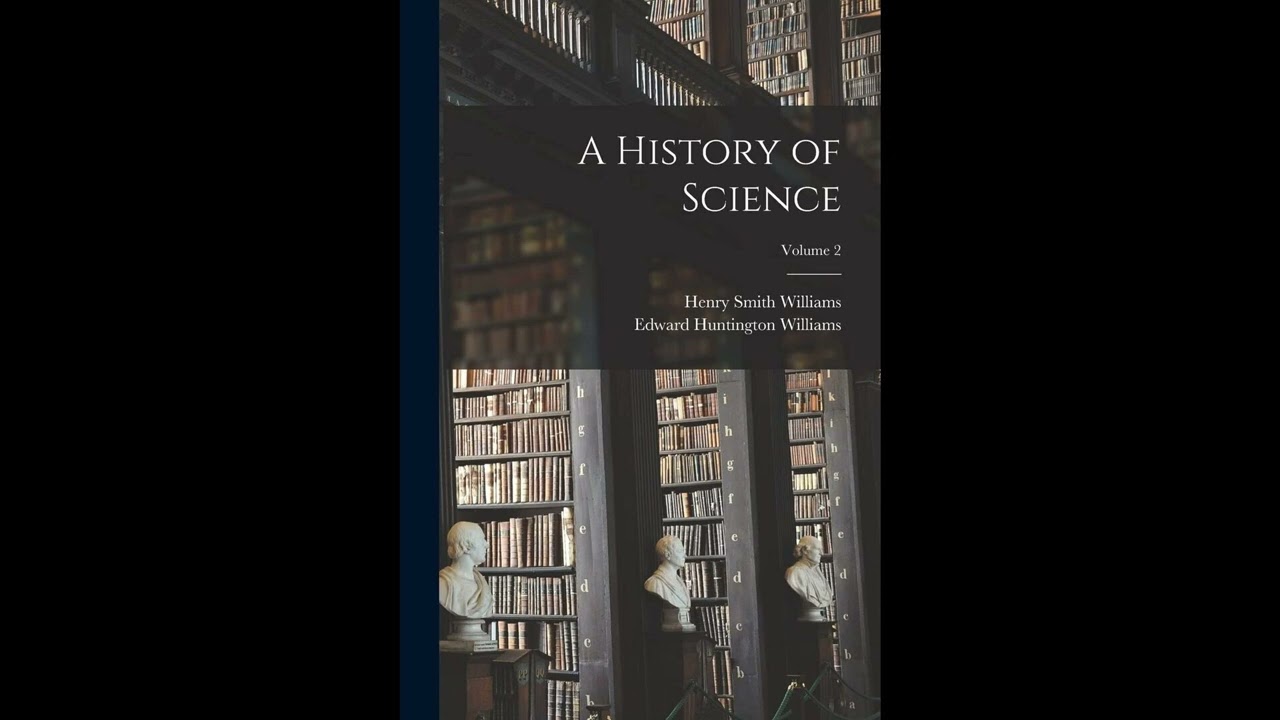
A History of Science; Volume 2
"A History of Science; Volume 2" by Henry Smith Williams offers more than a simple chronicle of discovery; it presents a monumental intellectual adventure, tracing humanity's relentless pursuit of understanding the natural world. This volume, a segment of a broader, foundational survey, invites listeners to witness the dramatic shifts in scientific thought that have shaped our modern age. It is a work that resonates today by demonstrating that current scientific debates and breakthroughs are merely the latest chapters in an ongoing, centuries-long story of inquiry, challenge, and revision. By revealing the often-arduous paths forged by past thinkers, the audiobook encourages a deeper appreciation for the scientific method itself and the cumulative efforts that underpin our present knowledge base. This particular volume lifts the curtain on an era of profound intellectual awakening, moving from the foundational shifts that questioned long-held dogmas to the methodical establishment of disciplines we recognize today. The story begins where ancient and medieval contributions left off, perhaps with the Copernican revolution—a radical re-envisioning of the cosmos that placed the sun, not Earth, at the center. Figures like Nicolaus Copernicus, Johannes Kepler, and Galileo Galilei emerge as central characters, their observational genius and mathematical rigor challenging the very structure of the universe as understood for millennia. This early section details the intense intellectual conflict between traditional authority and empirical evidence, showing how brave individuals risked scorn, and worse, to advance new truths. As the narrative progresses, it introduces listeners to the towering intellect of Isaac Newton, whose laws of motion and universal gravitation provided a comprehensive framework for understanding the physical world, tying together celestial mechanics with terrestrial phenomena. The text illuminates the shift from philosophical speculation to systematic experimentation, as exemplified by Robert Boyle's work in chemistry and Antonie van Leeuwenhoek's pioneering microscopy. The story unfolds as a grand succession of insights, each building upon the last, culminating in the late eighteenth and nineteenth centuries with the formulation of atomic theory by John Dalton, the unraveling of electricity and magnetism by Michael Faraday and James Clerk Maxwell, and the revolutionary insights into life's diversity put forth by Charles Darwin. The narrative arc showcases the profound courage required to question convention and the methodical patience needed to test hypotheses against the raw data of observation. Henry Smith Williams, the author, was born in 1863 and lived until 1943, an American physician by training who became a prolific writer and editor specializing in popular science and history. His life's work demonstrated a remarkable dedication to making complex scientific and historical subjects accessible to the general public. Williams held a medical degree from Yale University but ultimately dedicated himself to literary pursuits, seeing immense value in educating a broad audience about the world's great intellectual achievements. Beyond "A History of Science," Williams authored many other notable works, including "The Story of Nineteenth-Century Science" and "The Science of Happiness," underscoring his wide-ranging intellectual curiosity. He was not merely a chronicler but an interpreter, often distilling vast amounts of information into clear, engaging prose. His position in the literary canon resides firmly in the tradition of science popularizers, a vital role that bridges the gap between specialized academic research and public understanding. Williams's ability to synthesize information and present it lucidly ensured his books reached a wide readership at a time when scientific progress was accelerating rapidly and capturing public imagination. One of the central themes running through "A History of Science; Volume 2" is the evolution of the scientific method itself. Listeners witness how early, less systematic observations gradually give way to rigorous experimentation, hypothesis testing, and mathematical modeling. For instance, the transition from alchemical pursuits to the quantitative analysis of chemistry, epitomized by Lavoisier's work on combustion and conservation of mass, clearly demonstrates this methodological shift. Another potent theme is the interconnectedness of scientific disciplines. Discoveries in astronomy spurred advancements in optics and mechanics; developments in chemistry illuminated biological processes; and mathematical innovations provided the language for all scientific descriptions. The book illustrates how progress in one field often created the tools or conceptual frameworks necessary for breakthroughs in another, showing that science is not a collection of isolated silos but a dynamic, interdependent network of inquiry. A third significant theme is the human element of scientific endeavor—the ambition, rivalry, collaboration, and occasional resistance to new ideas that characterize the lives of great scientists. The text showcases figures like Galileo, who faced intense opposition for his heliocentric views, highlighting the struggle between established dogma and emerging evidence. Williams adeptly portrays the personalities behind the discoveries, reminding us that science is ultimately a human enterprise, driven by curiosity, dedication, and often, profound personal sacrifice. Published in 1904, "A History of Science" emerged during a period of immense change and optimism at the turn of the twentieth century. The Industrial Revolution had profoundly reshaped society, and technological advancements were transforming daily life with unprecedented speed. This era, often called the Progressive Era in America, saw a surge in public education and a growing belief in the power of knowledge to improve human conditions. Williams's work capitalized on a widespread public fascination with science and its practical applications, offering a grand narrative that made sense of the dizzying pace of progress. Culturally and politically, the time was ripe for such a comprehensive work. There was a desire to understand the foundations of this rapidly changing world, and popular science books played a crucial role in disseminating knowledge beyond university walls. Williams's multi-volume history provided context for the scientific breakthroughs that were making headlines—from new insights in physics and chemistry to Darwinian evolution—situating them within a coherent, accessible historical framework. His ability to distill complex ideas into understandable prose made the book a vital resource for a curious public eager to comprehend the forces shaping their future. Listening to "A History of Science; Volume 2" as an audiobook transforms it from a historical text into an immersive oral tradition. The narrator's voice becomes crucial, guiding the listener through complex theories and intricate historical timelines with clarity and measured pacing. It allows for the absorption of dense material without the visual demands of reading, making it ideal for learning during commutes, while exercising, or during quiet moments of reflection. The "several hours" runtime ensures a substantial, sustained engagement with the material, enabling the grand narrative of scientific progress to unfold gradually. A skilled narration brings the personalities of the scientific pioneers to life, making their struggles and triumphs more immediate and engaging, allowing the listener to truly connect with the dramatic human story behind the facts and figures.
Enjoyed A History of Science; Volume 2? A few ways to support us
Audible & Amazon links are affiliate; we may earn a small commission at no extra cost.
About this production
Human narration by a volunteer reader from LibriVox.org, the public-domain audiobook project. LibriVox volunteers record literary works whose copyright has expired in the United States, releasing the resulting recordings into the public domain.
A History of Science; Volume 2 by Henry Smith Williams. The underlying text is in the U.S. public domain. We do not republish any modern copyrighted edition, translation, or commentary.
The 4K cinematic visuals accompanying this audiobook are generated by an AI image model from prompts derived from the source text. No copyrighted photos, paintings, or stock footage are used. AI generation is disclosed on every video on our YouTube channel as required by YouTube's altered/synthetic content policy.
English subtitles are transcribed from the LibriVox recording with OpenAI Whisper. Translations into the 11 other supported languages are produced by Meta's NLLB-200 neural translation model. No human translator's copyrighted translation is used.
Questions about sourcing or rights? See our DMCA & Sourcing policy or contact us.
Enjoyed this audiobook?
If you'd like to own a copy of A History of Science; Volume 2 or hear a professionally produced edition, the links below help support free audiobook production at no extra cost to you.
As an Amazon Associate we earn from qualifying purchases. Audible / print links are affiliate.