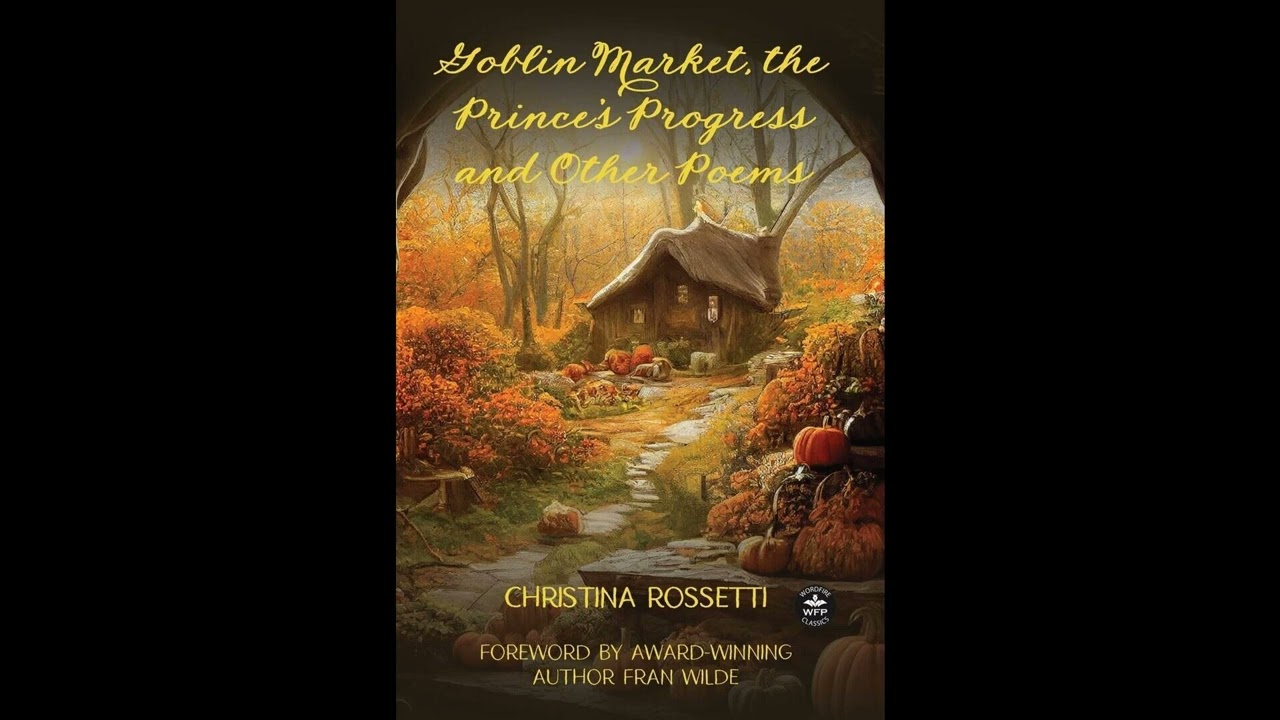
Goblin Market, The Prince's Progress and Other Poems
Step into a world where everyday domesticity meets the chilling allure of the supernatural, where sisterly love contends with forbidden desires, and where the most enchanting melodies hide the darkest dangers. Christina Rossetti's "Goblin Market, The Prince's Progress and Other Poems" stands as a shimmering jewel in the crown of Victorian literature, a collection that, while celebrated for its titular narrative poem, offers so much more than mere verse. This is poetry that casts a spell, drawing listeners into its vibrant, sometimes unsettling, realms, all while probing deeply into questions of innocence, temptation, and the profound bonds of human connection. Its central narratives, particularly "Goblin Market," resonate powerfully even today, speaking to the anxieties of autonomy, the price of conformity, and the enduring strength found in empathy and self-sacrifice. At the heart of the collection, and arguably Rossetti's most famous creation, lies "Goblin Market," a fantastical narrative poem that unfolds in a dreamlike, vaguely pastoral English setting, yet one perpetually on the brink of a more sinister, magical dimension. We are introduced to two sisters, Laura and Lizzie, who live a simple, wholesome life, always heeding the warnings of their elders regarding the insidious goblin men who frequent a nearby glade. These grotesque, animalistic merchants appear at twilight, crying out their wares of "fruit forbidden," enticing passersby with luscious, exotic produce unlike anything found in the mortal world. Though Lizzie cautions her sister, Laura cannot resist the goblins' enchanting cries and their seemingly irresistible fruits. Laura, drawn by curiosity and a longing for the forbidden, approaches the goblin men, despite Lizzie's desperate pleas. Unable to afford their bounty, she offers a lock of her golden hair and a tear from her eye in exchange for a taste of their magical fruit. She devours the delicious, intoxicating plums, peaches, and grapes, finding them sweeter than honey, and returns home to Lizzie, consumed by the experience. However, her indulgence quickly turns to torment; the next day, the goblins' cries are silent to her ears, and she begins to wither, her golden hair turning gray, her vitality draining away. Lizzie, witnessing her sister's decline and fearing for her life, resolves to face the goblin men herself, intent on procuring the magical fruit to save Laura, whatever the personal cost. Her bravery and unwavering love set the stage for a dramatic confrontation, where the forces of pure, selfless affection collide with the sinister, predatory nature of the market vendors. Christina Rossetti, born in London in 1830, hailed from a family steeped in artistic and intellectual pursuits. Her father, Gabriele Rossetti, was an exiled Italian poet and scholar, and her siblings included the renowned painter and poet Dante Gabriel Rossetti, a founding member of the Pre-Raphaelite Brotherhood, as well as Maria Francesca and William Michael, both writers and critics in their own right. This stimulating domestic environment nurtured Christina's poetic talent from a young age, though her path was distinct from her brothers. Deeply devout, she remained a lifelong Anglican, her faith often serving as a guiding force and a wellspring of inspiration for her verse. Though she never formally joined the Pre-Raphaelite Brotherhood, her poetry consistently reflected many of its core tenets: a focus on intense sensory detail, vivid natural imagery, an affinity for medievalism, and a yearning for artistic purity and truth in an age perceived as overly materialistic. Her life was marked by a quiet reclusiveness, punctuated by engagements—two of which she broke off, one due to religious differences—and a devotion to charity and her church. Beyond "Goblin Market" and "The Prince's Progress," Rossetti penned many celebrated poems, including the poignant "Remember," the allegorical "Up-Hill," and the joyous "A Birthday," along with a collection of nursery rhymes, "Sing-Song." She established herself as one of the most significant and unique voices of the Victorian era, a poet whose lyrical skill and profound emotional depth secured her enduring place in the literary canon. The poems in this collection, especially "Goblin Market," brilliantly manifest several enduring themes, making them subjects of ongoing study and admiration. A central concern is the nature of temptation and its consequences, balanced against the redemptive power of selfless love. Laura's consumption of the goblin fruit serves as a clear allegory for succumbing to forbidden desires—whether interpreted as sexual, aesthetic, or spiritual—and the subsequent illness she experiences illustrates the destructive toll such indulgence can take. Conversely, Lizzie's courageous defiance of the goblins and her willingness to face danger for her sister exemplify the profound healing and salvific potential of genuine affection and sacrifice. The narrative suggests that while individual weakness can lead to ruin, the strength found in solidarity and altruism offers a path to restoration. Another powerful theme is the enduring strength of sisterhood and female solidarity in the face of external threats and societal pressures. The bond between Laura and Lizzie is not merely incidental; it forms the very backbone of the story, serving as the sole force capable of overcoming the goblins' malevolent influence. In a time when women were often depicted as passive or solely defined by their relationships with men, Rossetti presents a narrative where female agency and mutual support drive the entire plot and bring about salvation. Lizzie's active, heroic intervention challenges conventional portrayals, asserting that women possess both the strength to resist and the compassion to rescue. The poem further subtly addresses Victorian anxieties around female sexuality and the perilous social fate of "fallen" women, using the fantastical encounter with the goblin men as a metaphor for the real-world dangers and judgments faced by women who strayed from prescribed norms. Christina Rossetti wrote and published this collection in the mid-19th century, a period often defined by the reign of Queen Victoria and significant shifts across British society. Culturally, the Victorian era was marked by strict moral codes, particularly concerning female conduct and sexuality. The concept of the "fallen woman"—a woman who had engaged in premarital sex or prostitution—was a pervasive social anxiety, often leading to ostracization and ruin. Religious revivalism ran alongside burgeoning scientific discoveries that challenged traditional faith, creating a complex spiritual landscape. This was also a time of renewed interest in folklore, fairy tales, and myth, though these narratives were often imbued with moralistic undertones. Literarily, the period saw the flourishing of the novel, but also a vibrant poetic scene, with poets wrestling with themes of doubt, faith, progress, and tradition. The Pre-Raphaelite Brotherhood, founded in 1848 by Rossetti's brother Dante Gabriel along with John Everett Millais and William Holman Hunt, reacted against the perceived artificiality of academic art. They advocated for a return to the naturalism, intense detail, vibrant colors, and narrative clarity of early Renaissance art, coupled with an appreciation for medieval romance and symbolism. Christina Rossetti’s "Goblin Market," published in 1862, embodies many of these Pre-Raphaelite aesthetics: its vivid, almost painterly descriptions, its blend of the natural with the supernatural, its allegorical depth, and its focus on intense emotional and moral dramas. The poem emerged from a cultural milieu ripe for exploring temptation, redemption, and the unique challenges faced by women, offering a nuanced and imaginative commentary on these enduring Victorian concerns. Listening to "Goblin Market, The Prince's Progress and Other Poems" as an audiobook offers an unparalleled way to appreciate the genius of Christina Rossetti. Poetry, by its very nature, is meant to be heard, and Rossetti's verse, with its intricate rhythms, alliteration, assonance, and internal rhymes, truly comes alive through spoken word. The run length of several hours allows for a deep, extended immersion into Rossetti's lyrical world, moving beyond the well-known title poem to discover the rich variety and profound emotional resonance of her other works. A skilled narrator brings out the subtle shifts in tone—from the playful cries of the goblins to Lizzie's determined resolve, from Laura's initial delight to her subsequent despair—guiding the listener through the text's complex emotional landscape. Listen for the narrator's interpretation of character, the pacing that builds suspense in the narrative poems, and the vocal nuances that highlight Rossetti's stunning imagery and the profound musicality inherent in her lines. The atmospheric quality that a carefully modulated voice adds to the fantastical and often unsettling elements truly elevates the experience, allowing Rossetti's stories and insights to settle deeply into the imagination.
Enjoyed Goblin Market, The Prince's Progress and Other Poems? A few ways to support us
Audible & Amazon links are affiliate; we may earn a small commission at no extra cost.
About this production
Human narration by a volunteer reader from LibriVox.org, the public-domain audiobook project. LibriVox volunteers record literary works whose copyright has expired in the United States, releasing the resulting recordings into the public domain.
Goblin Market, The Prince's Progress and Other Poems by Christina Rossetti. The underlying text is in the U.S. public domain. We do not republish any modern copyrighted edition, translation, or commentary.
The 4K cinematic visuals accompanying this audiobook are generated by an AI image model from prompts derived from the source text. No copyrighted photos, paintings, or stock footage are used. AI generation is disclosed on every video on our YouTube channel as required by YouTube's altered/synthetic content policy.
English subtitles are transcribed from the LibriVox recording with OpenAI Whisper. Translations into the 11 other supported languages are produced by Meta's NLLB-200 neural translation model. No human translator's copyrighted translation is used.
Questions about sourcing or rights? See our DMCA & Sourcing policy or contact us.
View 10 famous quotes from this book →
Enjoyed this audiobook?
If you'd like to own a copy of Goblin Market, The Prince's Progress and Other Poems or hear a professionally produced edition, the links below help support free audiobook production at no extra cost to you.
As an Amazon Associate we earn from qualifying purchases. Audible / print links are affiliate.