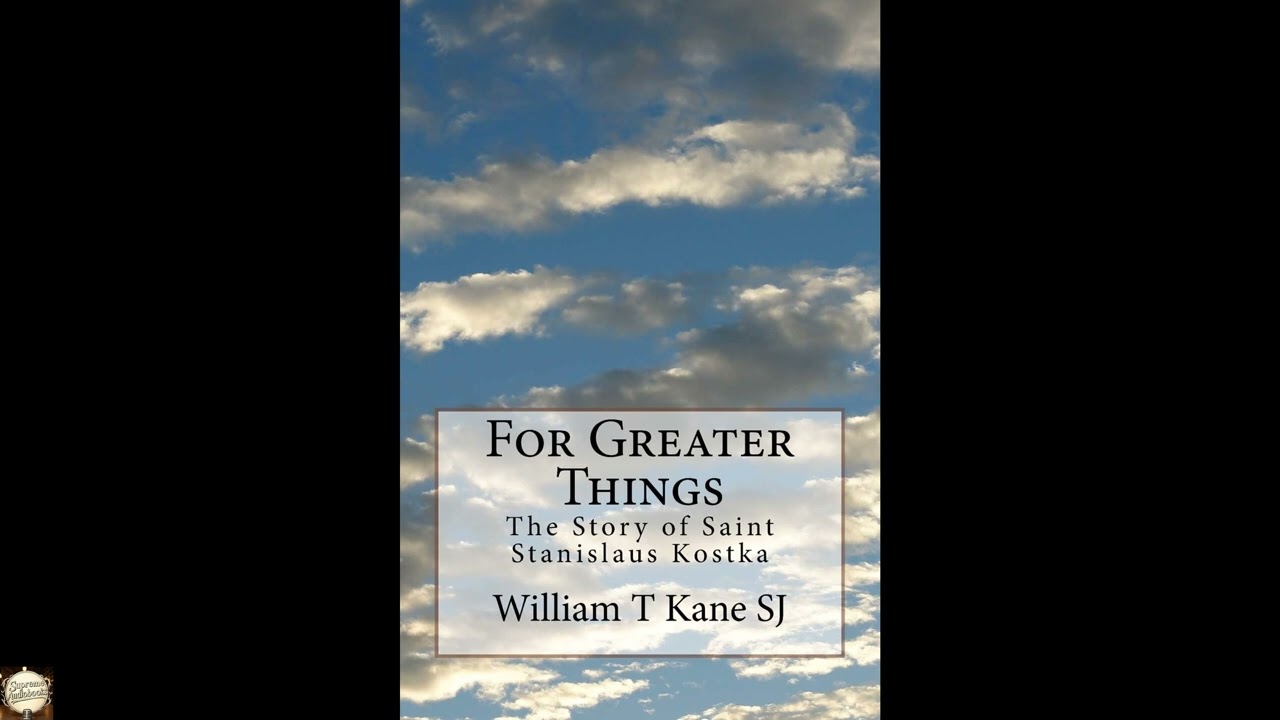
For Greater Things: The Story of Saint Stanislaus Kostka
Step into the 16th century with "For Greater Things: The Story of Saint Stanislaus Kostka" by William T Kane SJ, a remarkable biographical narrative that transcends its historical setting to speak to the enduring human pursuit of purpose and meaning. This is more than a mere account of a young man's life; it is a testament to the power of conviction, the struggle between familial expectation and personal calling, and the extraordinary courage required to follow an inner voice against overwhelming opposition. In an age where many seek to define their own path and find authentic happiness, Stanislaus Kostka's story, as recounted by Kane, offers a profoundly inspiring look at what it means to commit fully to an ideal, reminding us that true greatness often lies not in worldly acclaim, but in unwavering fidelity to one's deepest beliefs. The story opens in 16th-century Poland, introducing Stanislaus Kostka as a scion of nobility, destined for a life of privilege and political influence. We meet him as a young student, sent with his elder brother, Paul, and their private tutor, John Bilinski, to Vienna for studies at the Jesuit college. From the outset, a stark contrast emerges between the two brothers: Paul, boisterous and worldly, reveling in the social scene, and Stanislaus, intensely devout, quiet, and increasingly drawn to a spiritual life. This divergence sets the stage for the central conflict. Stanislaus soon discerns a powerful calling to join the Society of Jesus, a nascent and dynamic religious order, but his aspirations clash violently with his family's ambitions. His father, a powerful senator, expects him to secure the family's legacy through a strategic marriage and political career, viewing his son's spiritual inclination as a foolish, youthful distraction, or worse, an affront to their noble name. The narrative intensifies as Stanislaus, despite his delicate health and gentle nature, exhibits an iron will in pursuing his vocation. He faces not only his father's stern disapproval conveyed through letters but also the constant harassment and even physical abuse from his brother Paul, who attempts to coerce him back to a conventional life. His tutor, Bilinski, while initially sympathetic, eventually succumbs to the pressure from the family, leaving Stanislaus feeling increasingly isolated. Driven by an unshakeable inner certainty, Stanislaus makes the momentous decision to flee Vienna. With virtually no resources and knowing he faces severe repercussions, he sets out on foot, traveling through perilous territories, all to reach a Jesuit novitiate that will accept him. This arduous and solitary journey across central Europe, seeking refuge and guidance from various Jesuit houses, becomes a powerful symbol of his dedication, culminating in his eventual acceptance into the novitiate in Rome under the patronage of figures like Saint Peter Canisius and Saint Francis Borgia. The book details his initial experiences within the order, highlighting his humility, piety, and extraordinary spiritual fervor, promising a life of profound service before reaching a poignant conclusion that solidifies his place in spiritual history. William T Kane, a distinguished American Jesuit priest, educator, and author, brings Stanislaus Kostka’s story to life with both historical rigor and literary grace. Born in 1881, Kane dedicated his life to scholarship and the formation of young minds within the Jesuit tradition. He served as a professor of English at prominent institutions such as Boston College and later Fordham University, where he left an indelible mark on his students. His academic background instilled in him a deep appreciation for language and narrative, evident in the measured yet evocative prose of "For Greater Things." Kane's body of work primarily focused on hagiography—the writing of saints' lives—and on figures central to the history of his order, such as his notable biography of Saint Francis Xavier. He understood that these lives were not merely historical records but powerful narratives capable of inspiring faith and virtue. Kane's writings often sought to render the lives of saints accessible and compelling to a modern audience, stripping away layers of pious hyperbole to reveal the human core of their sanctity. He aimed to present these individuals not as distant, unapproachable figures, but as people who graved with genuine struggles, faced real decisions, and found profound meaning in their commitment to a higher calling. His literary approach to hagiography positioned him within a broader early 20th-century movement that sought to revitalize Catholic literature by combining rigorous scholarship with artistic merit. Kane passed away in 1934, leaving behind a legacy of works that continue to educate and inspire, securing his place as an important chronicler of Catholic spiritual heritage. At its core, "For Greater Things" eloquently articulates several profound themes, chief among them the concept of vocation and the compelling nature of a divine calling. Stanislaus’s unwavering conviction, despite immense pressure from his family and the physical hardships of his flight, vividly illustrates a young man entirely consumed by a spiritual imperative. His steadfast refusal to compromise on his desire to join the Jesuits, even when it meant defying powerful social conventions and parental authority, is a powerful demonstration of fidelity to an inner spiritual compass. This is concretely shown in the repeated, fervent declarations to his tutor and brother that he must pursue this path, regardless of the consequences, and his resolute walking out of Vienna to find a novitiate that would accept him. Another significant theme is the tension between filial duty and personal conviction. Stanislaus finds himself torn between the expectations of his noble family—particularly his father's designs for his future—and his own deeply held spiritual aspirations. The conflict is dramatized through his father’s letters, full of disappointed demands, and the physical aggression from his brother Paul, who sees Stanislaus’s piety as an embarrassment. The book also highlights perseverance and the overcoming of adversity. Stanislaus’s fragile health, the dangers of his clandestine journey across Europe, and the constant threat of being forcibly returned home all serve to emphasize his extraordinary mental and spiritual fortitude. His quiet endurance and persistent efforts to achieve his goal, whether walking hundreds of miles or patiently awaiting acceptance, exemplify a profound resilience rooted in faith. When William T Kane wrote "For Greater Things" in the early 20th century, the cultural and intellectual landscape was undergoing significant shifts. The turn of the century saw rapid industrialization, scientific advancements challenging traditional worldviews, and the emergence of new social theories. In the United States and Europe, while some segments of society moved towards secularism, there was also a notable Catholic literary revival. Authors, many of them converts or deeply committed individuals, sought to counter prevailing materialist philosophies by producing works that articulated spiritual truths and celebrated the lives of saints and religious figures with renewed vigor and literary sophistication. Kane's work emerged during this period, addressing an audience that was increasingly seeking narratives of moral courage and spiritual authenticity in a rapidly changing world. It offered a model of youthful dedication and heroic faith that resonated with those grappling with modernity, aiming to inspire a new generation with the enduring power of a life lived for spiritual ideals. Listening to "For Greater Things" as an audiobook offers an immersive and intimate experience, transforming a historical account into a living narrative. The audiobook's run length, spanning several hours, makes it an ideal companion for reflective periods, whether during a quiet evening, a long commute, or while engaged in other tasks. A skilled narrator can bring out the distinct voices of the characters—Stanislaus’s quiet, determined resolve, Paul’s youthful bluster and frustration, the cautious concern of Bilinski, and the authoritative yet compassionate tones of the Jesuit superiors. The pacing of the narration can effectively build the tension of Stanislaus’s clandestine escape, emphasize the arduous nature of his physical journey, and allow listeners to absorb the profound spiritual insights. The subtle shifts in voice and atmosphere can transport the listener to the dusty roads of 16th-century Europe, the cloistered halls of the Jesuit colleges, and the inner sanctum of a soul striving for holiness, making the historical narrative feel immediate and deeply personal.
Enjoyed For Greater Things: The Story of Saint Stanislaus Kostka? A few ways to support us
Audible & Amazon links are affiliate; we may earn a small commission at no extra cost.
About this production
Human narration by a volunteer reader from LibriVox.org, the public-domain audiobook project. LibriVox volunteers record literary works whose copyright has expired in the United States, releasing the resulting recordings into the public domain.
For Greater Things: The Story of Saint Stanislaus Kostka by William T Kane SJ. The underlying text is in the U.S. public domain. We do not republish any modern copyrighted edition, translation, or commentary.
The 4K cinematic visuals accompanying this audiobook are generated by an AI image model from prompts derived from the source text. No copyrighted photos, paintings, or stock footage are used. AI generation is disclosed on every video on our YouTube channel as required by YouTube's altered/synthetic content policy.
English subtitles are transcribed from the LibriVox recording with OpenAI Whisper. Translations into the 11 other supported languages are produced by Meta's NLLB-200 neural translation model. No human translator's copyrighted translation is used.
Questions about sourcing or rights? See our DMCA & Sourcing policy or contact us.
Enjoyed this audiobook?
If you'd like to own a copy of For Greater Things: The Story of Saint Stanislaus Kostka or hear a professionally produced edition, the links below help support free audiobook production at no extra cost to you.
As an Amazon Associate we earn from qualifying purchases. Audible / print links are affiliate.