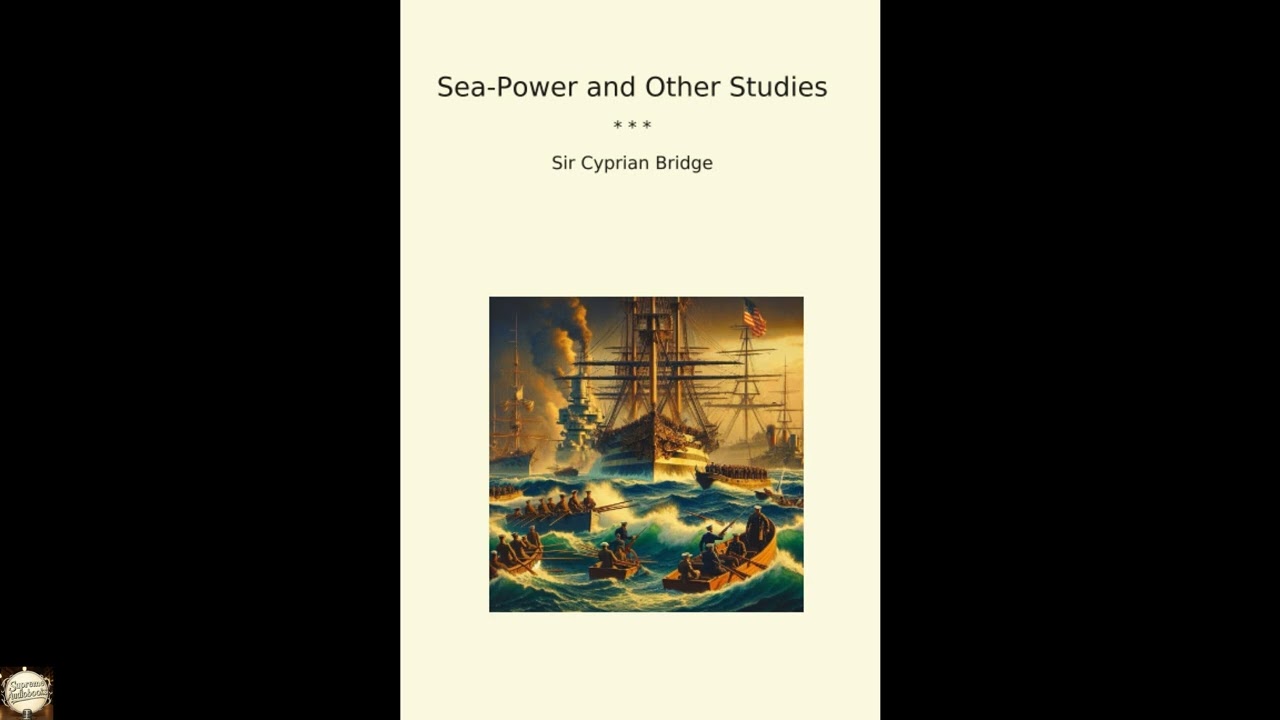
Sea-Power and Other Studies (Classic Books)
Step into a world where the oceans are battlegrounds and the command of the waves dictates the fate of nations. Sir Cyprian Bridge's "Sea-Power and Other Studies" offers a collection of profound insights into the timeless principles of naval strategy and the critical role maritime strength has played across history. Far from a dusty historical tome, this volume resonates with striking relevance even today, as global powers continue to vie for influence and secure vital trade routes. It’s a book that invites listeners to reconsider the very foundations of international power, understanding how the ebb and flow of naval supremacy has shaped—and continues to shape—the world we inhabit. The studies within this volume do not unfold as a single continuous narrative, but rather as a series of meticulously argued intellectual engagements, each building upon a core understanding of strategic thought. Sir Cyprian leads us through an expansive consideration of naval history and theory. He introduces us to the foundational concepts of sea power, examining how command of the sea translates into political and economic advantage. The central intellectual conflict often arises from the challenges of applying abstract strategic principles to the messy realities of war and statecraft, whether discussing fleet dispositions in ancient conflicts or the implications of new ship designs in his own era. We see historical commanders, national leaders, and even the very spirit of innovation acting as key players in these strategic debates. Sir Cyprian masterfully constructs an arc of understanding, moving from broad theoretical discussions to specific historical case studies. He dissects pivotal naval engagements, not merely as battles, but as demonstrations of strategic success or failure. From the sailing ships of the Napoleonic Wars to the steel behemoths emerging in the early 20th century, he traces the evolution of maritime warfare, showing how technology, geography, and human leadership constantly intersect. The listener is guided through an intellectual argument that systematically dismantles assumptions, builds new frameworks for analysis, and ultimately reveals the enduring logic beneath the surface of seemingly disparate historical events. Sir Cyprian Arthur George Bridge, born in 1841, dedicated his life to the Royal Navy and the study of naval strategy. His distinguished career spanned decades, seeing him rise through the ranks to become an Admiral. He joined the navy in 1854, serving during the Crimean War and later on various stations around the globe, gaining firsthand experience in an era of rapid technological change and imperial expansion. His commands included HMS Espiegle, HMS Resolution, and he eventually became Commander-in-Chief of the Australia Station, then the China Station, retiring in 1904. Bridge was not merely a practitioner but a keen observer and a deep thinker, recognized for his intellectual contributions to naval doctrine. Beyond "Sea-Power and Other Studies," Sir Cyprian also authored "The Art of Naval Warfare" and contributed significantly to naval journals and publications of his time. He was a contemporary of other influential naval theorists like Alfred Thayer Mahan, and while often compared to Mahan, Bridge offered distinct perspectives, frequently emphasizing the practical application of strategy and the human element in naval command. His writings secured his place as a significant voice in the development of modern naval thought, bridging the gap between historical precedent and the demands of future conflict. He passed away in 1924, leaving behind a legacy of strategic insight that continued to influence naval thinking for generations. A prominent theme running through "Sea-Power and Other Studies" is the critical importance of naval readiness and the foresight required to maintain maritime dominance. Bridge illustrates this repeatedly, showing how nations that neglected their navies often paid a heavy price in geopolitical standing or wartime defeat. For instance, he might scrutinize the strategic missteps of a particular European power in the 17th century, where a failure to invest adequately in shipbuilding or sailor training directly led to the loss of colonial possessions or key trade routes. This constant linkage between national policy and naval capability underscores the book’s central argument about the non-negotiable nature of sea power. Another significant theme is the dynamic relationship between technology and strategy. Bridge lived through an extraordinary period of naval innovation, witnessing the transition from sail to steam, and from wooden hulls to ironclads and then dreadnoughts. He demonstrates how each technological leap—from improved gunnery to torpedoes—demanded a rethinking of tactical formations, ship design, and overall strategic objectives. He might analyze how the advent of the armored battleship, for example, rendered older fleet compositions obsolete and forced navies worldwide into an expensive arms race, fundamentally altering the calculus of global power projection. When "Sea-Power and Other Studies" was published in 1910, the world stood on the precipice of momentous change. The preceding decades had seen an unprecedented naval arms race, particularly between Great Britain and Imperial Germany, fueled by colonial ambitions and a rapidly shifting balance of power in Europe. The launch of HMS Dreadnought in 1906 had revolutionized naval design, rendering all previous battleships obsolete overnight and escalating tensions. It was an era of intense geopolitical rivalry, burgeoning industrial might, and deep anxieties about the future of international relations. Bridge's work emerged from this crucible, offering a timely and critical examination of the very forces that would soon erupt into the First World War, providing essential context for the strategic decisions that defined the early 20th century. Listening to "Sea-Power and Other Studies" as an audiobook allows for a deeply immersive intellectual experience. The length, spanning several hours, is ideal for extended listening sessions, whether during a long drive or as a companion to focused study. A skilled narrator can bring Sir Cyprian's clear, authoritative prose to life, ensuring that even complex strategic arguments are presented with precision and clarity. The pacing of the narration should reflect the logical progression of Bridge’s arguments, allowing listeners time to absorb historical examples and theoretical discussions. A well-modulated voice can accentuate the weight of historical consequence and the urgency of strategic foresight, transforming what could be dense material into an engaging and enlightening auditory exploration of naval thought.
Enjoyed Sea-Power and Other Studies (Classic Books)? A few ways to support us
Audible & Amazon links are affiliate; we may earn a small commission at no extra cost.
About this production
Human narration by a volunteer reader from LibriVox.org, the public-domain audiobook project. LibriVox volunteers record literary works whose copyright has expired in the United States, releasing the resulting recordings into the public domain.
Sea-Power and Other Studies (Classic Books) by Sir Cyprian Bridge. The underlying text is in the U.S. public domain. We do not republish any modern copyrighted edition, translation, or commentary.
The 4K cinematic visuals accompanying this audiobook are generated by an AI image model from prompts derived from the source text. No copyrighted photos, paintings, or stock footage are used. AI generation is disclosed on every video on our YouTube channel as required by YouTube's altered/synthetic content policy.
English subtitles are transcribed from the LibriVox recording with OpenAI Whisper. Translations into the 11 other supported languages are produced by Meta's NLLB-200 neural translation model. No human translator's copyrighted translation is used.
Questions about sourcing or rights? See our DMCA & Sourcing policy or contact us.
Enjoyed this audiobook?
If you'd like to own a copy of Sea-Power and Other Studies (Classic Books) or hear a professionally produced edition, the links below help support free audiobook production at no extra cost to you.
As an Amazon Associate we earn from qualifying purchases. Audible / print links are affiliate.