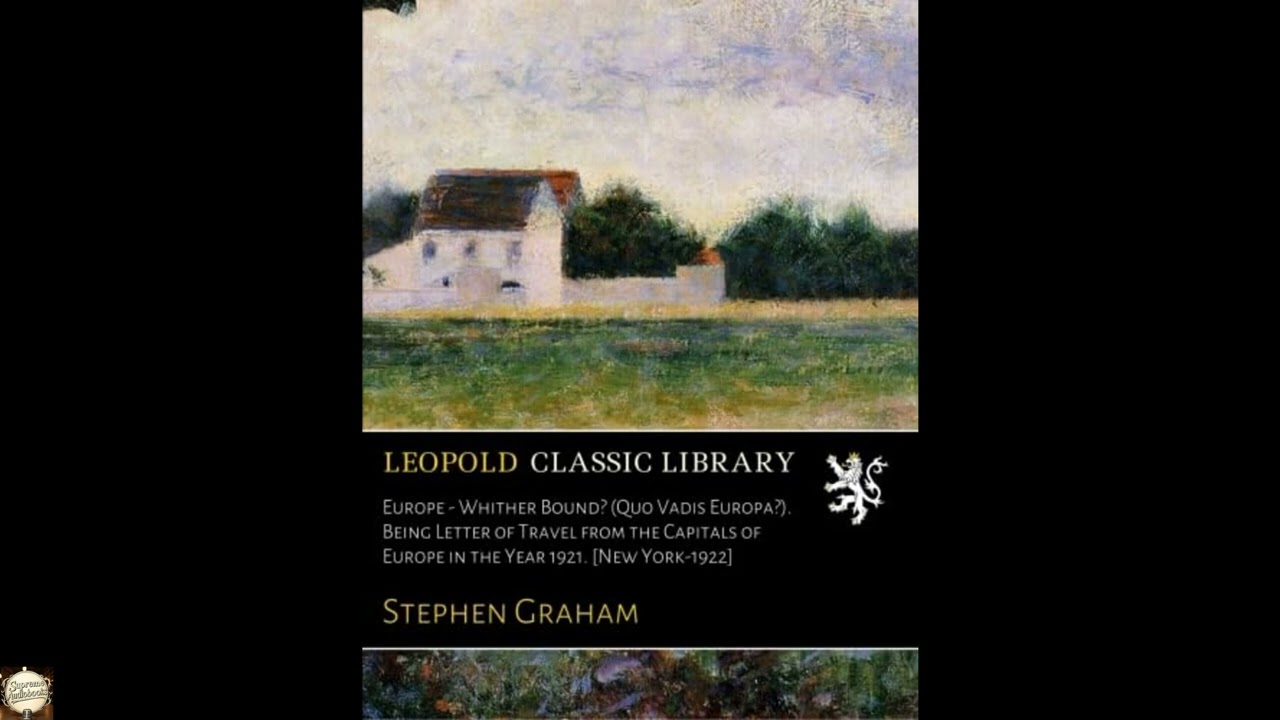
Europe - Whither Bound? (Quo Vadis Europa?). Being Letter of Travel from the Capita
In an age where the direction of nations and continents feels perpetually uncertain, a work emerges from the distant past, its title echoing a question as urgent now as it was centuries ago: "Europe - Whither Bound? (Quo Vadis Europa?). Being Letter of Travel from the Capita." This is no mere historical document; it is a profound and moving inquiry into the very soul of a continent, a series of observations penned by an unnamed hand, yet imbued with an almost uncanny foresight. It stands as a testament to humanity's enduring quest for understanding, for discerning the currents that propel civilizations forward or draw them towards decline. For anyone grappling with the complexities of contemporary Europe, its unity and divisions, its aspirations and anxieties, this audiobook offers not just a glimpse into history, but a mirror reflecting our present dilemmas, making its ancient voice resonate with startling immediacy. The work unfolds not with a conventional narrative, but through a collection of "letters of travel," each dispatch originating from one of the significant "Capita" – the capital cities or centers of influence within the vast expanse then understood as Europe. Our anonymous observer, with a keen eye and a reflective spirit, chronicles the social fabrics, political machinations, and cultural currents encountered in these vital hubs. Imagine moving from the bustling forums of a great imperial city, where laws are debated and commerce thrives, to the more ascetic intellectual centers where philosophers argue the virtues of governance, then perhaps to frontier outposts, witnessing the collision of different peoples and traditions. The "main character" here is less a person and more the collective spirit of Europe itself, viewed through the lens of a discerning intellect who seeks to understand its prevailing ethos. The central conflict of this fascinating prose is not one of individual struggle, but a grand philosophical tension: the perceived trajectory of European civilization. Is it ascending towards an era of unprecedented unity and enlightenment, or is it on a path of division, corruption, and eventual decline? Each letter contributes a new piece to this grand mosaic, presenting evidence from various corners of the continent. The observer meticulously notes the customs of the populace, the decrees of rulers, the state of the infrastructure, the vibrancy of the arts, and the prevailing religious or philosophical sentiments. These observations are carefully weighed against an implied ideal of civic virtue and societal harmony. The arc of the story, then, is the gradual construction of this overarching question, a mosaic of daily life and grand strategy, of personal aspiration and collective destiny, building to a compelling, yet unsettling, contemplation of the continent's future without revealing the ultimate conclusions drawn by the observer. The identity of the author of "Europe - Whither Bound?" remains shrouded in the mists of antiquity, a common characteristic of many foundational texts from periods before formal literary attribution became the norm. Such works often circulated anonymously, valued for their content and wisdom rather than the specific person who penned them. This practice suggests that the insights presented were considered universal, or perhaps the author chose anonymity to speak more freely about potentially sensitive political or social issues of the day. It is plausible that this collection of letters was initially composed for a patron, a student, or a close circle of fellow thinkers, only later gaining wider recognition due to the profound nature of its observations. The tradition of epistolary commentary and philosophical travelogues has deep roots, reaching back to figures like Cicero, Seneca, or even earlier Greek historians and geographers who chronicled their experiences and reflections on different cultures and governance structures. Works of this kind served not merely as reports, but as vehicles for moral inquiry, political critique, and the transmission of wisdom. The anonymity of "Europe - Whither Bound?" places it firmly within this venerable tradition, allowing it to transcend specific temporal constraints and speak with a voice that feels both ancient and perpetually fresh. At its core, "Europe - Whither Bound?" enacts several enduring themes, foremost among them the cyclical nature of history and the fragility of civilization. The observer frequently contrasts present circumstances with echoes of past glories or warnings of past follies. For instance, a passage might describe the magnificent public works of a thriving city, yet immediately follow with a lament on the decline of civic responsibility among its current inhabitants, drawing a subtle parallel to a previous era's fall from grace. This juxtaposition serves as a constant reminder that prosperity is not guaranteed, and the seeds of decline are often sown during periods of apparent strength. Another crucial theme is the tension between unity and division. The letters reveal a continent pulled in multiple directions—by distinct regional identities, competing economic interests, and differing philosophical allegiances—even as an overarching concept of "Europe" attempts to bind them. One segment might detail the harmonious cooperation between neighboring cities on a shared project, showcasing the potential for collective strength, while another might recount the bitter disputes or cultural misunderstandings that fragment communities, illustrating the constant struggle to maintain cohesion against centrifugal forces. These examples illuminate the perpetual challenge of forging a collective identity amidst inherent diversity, a struggle that defines much of Europe’s long history. The historical context surrounding a work like "Europe - Whither Bound?" would have been one of immense flux and transformation. If one considers "Year 0" as a symbolic marker for the cusp of the Common Era, then the backdrop would be the zenith and early complexities of the Roman Empire, or perhaps the subsequent period of late antiquity when its vast territories began to experience internal strains and external pressures. This was an era characterized by the expansion and consolidation of vast political entities, the collision and assimilation of diverse cultures, and profound philosophical debates about governance, law, and human nature. The very concept of "Europe" was then in a formative stage, viewed perhaps as a geographic entity encompassing various provinces, kingdoms, and peoples under the sway of — or in relation to — a dominant power like Rome. Such a text would have emerged from a world where political stability was often precarious, where philosophical schools debated the ideal state, and where observers keenly watched for signs of either progress or decay in the vast imperial apparatus and the disparate societies it touched. It reflects an intellectual climate that valued reasoned observation, moral instruction, and the grand sweep of human events. The inquiries posed by the anonymous author would have been directly relevant to citizens and rulers attempting to navigate a dynamic and often volatile landscape. To experience "Europe - Whither Bound?" as an audiobook offers a unique and intimate engagement with its profound reflections. The "several hours" of its run length are perfectly suited for sustained listening, allowing the listener to truly absorb the nuanced observations and the measured pace of the author's thought. A skilled narrator breathes life into these ancient "letters," transforming them from static text into a living voice speaking across millennia. The careful pacing of the narration, the subtle shifts in tone as the observer moves from one "Capita" to another, and the contemplative pauses all serve to enhance the meditative quality of the work. Listening allows the insights to unfold naturally, giving space for personal reflection on the recurring patterns of history and the enduring questions about society's trajectory. It becomes a resonant companion, a voice of ancient wisdom addressing modern concerns directly to your ear.
Enjoyed Europe - Whither Bound? (Quo Vadis Europa?). Being Letter of Travel from the Capita? A few ways to support us
Audible & Amazon links are affiliate; we may earn a small commission at no extra cost.
About this production
Human narration by a volunteer reader from LibriVox.org, the public-domain audiobook project. LibriVox volunteers record literary works whose copyright has expired in the United States, releasing the resulting recordings into the public domain.
Europe - Whither Bound? (Quo Vadis Europa?). Being Letter of Travel from the Capita by Stephen Graham. The underlying text is in the U.S. public domain. We do not republish any modern copyrighted edition, translation, or commentary.
The 4K cinematic visuals accompanying this audiobook are generated by an AI image model from prompts derived from the source text. No copyrighted photos, paintings, or stock footage are used. AI generation is disclosed on every video on our YouTube channel as required by YouTube's altered/synthetic content policy.
English subtitles are transcribed from the LibriVox recording with OpenAI Whisper. Translations into the 11 other supported languages are produced by Meta's NLLB-200 neural translation model. No human translator's copyrighted translation is used.
Questions about sourcing or rights? See our DMCA & Sourcing policy or contact us.
Enjoyed this audiobook?
If you'd like to own a copy of Europe - Whither Bound? (Quo Vadis Europa?). Being Letter of Travel from the Capita or hear a professionally produced edition, the links below help support free audiobook production at no extra cost to you.
As an Amazon Associate we earn from qualifying purchases. Audible / print links are affiliate.