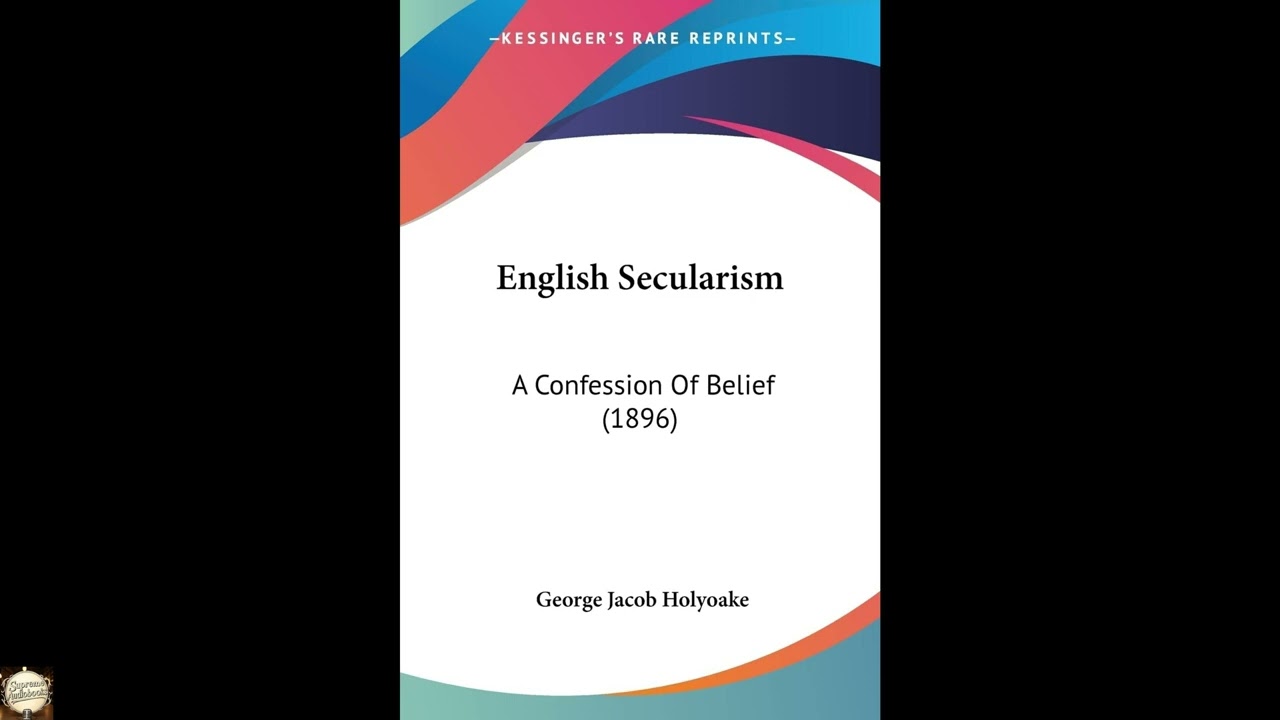
English Secularism: A Confession Of Belief
For anyone who has ever pondered the relationship between belief, reason, and public life, George Jacob Holyoake's English Secularism: A Confession Of Belief stands as a crucial, foundational text. Coining the very term "secularism" in the mid-nineteenth century, Holyoake offered a precise definition of a worldview that sought to ground morality and social action in human experience and empirical evidence, rather than divine decree. This is not merely an historical artifact; it remains a vibrant statement on intellectual freedom, the pursuit of truth through rational inquiry, and the practical ethics of a civil society. Listening to Holyoake’s articulation today offers direct access to the origins of a concept that profoundly shapes modern governance, education, and individual conscience across the globe. Holyoake’s Confession of Belief does not tell a story in the conventional sense, but rather builds a meticulously constructed intellectual argument, laying out the parameters of secularism with clarity and conviction. The book systematically establishes the principles upon which a non-religious approach to life can be both ethical and productive. Holyoake acts as both the central figure and the primary narrator, guiding the listener through his definition of secularism, distinguishing it carefully from atheism and other forms of unbelief. His aim is not to deny the existence of God, but to delineate a sphere of thought and action concerned solely with "the duties of this life," operating independently of any supernatural assumptions. The book’s central conflict, then, is an intellectual one: the struggle to assert the legitimacy and sufficiency of human reason and morality in a world still largely dominated by religious authority. Holyoake outlines the scope of secular knowledge, which he defines as concerning the "material conditions of human improvement." He argues for a public sphere where decisions are based on demonstrable facts and the common good, not on theological pronouncements or prophecies. Throughout this intellectual landscape, Holyoake systematically dismantles common misconceptions about secularism, presenting it not as an enemy of religion, but as a distinct and self-sufficient philosophy for living well in the here and now. The arc of his argument moves from definition, through clarification, to an affirmation of secularism’s ethical power, without revealing any final, dramatic twist, but rather concluding with a robust and reasoned defense of its principles. George Jacob Holyoake, born in Birmingham, England, in 1817, was a remarkable figure whose life was as much a testament to his beliefs as his writings. A working-class intellectual, he began his public career as an Owenite socialist lecturer, actively participating in the Chartist movement advocating for political rights for the working class. His early life was marked by self-education and passionate advocacy for social justice. Famously, in 1842, Holyoake became the last person in England to be imprisoned for blasphemy, following a lecture where he made remarks deemed impious. This formative experience only strengthened his commitment to freedom of thought and expression. It was in 1851 that Holyoake coined the term "secularism," providing a name for a burgeoning intellectual movement that sought to separate matters of public policy and morality from religious dogma. He edited several influential periodicals, including The Reasoner and The Secular World, serving as a leading voice for rationalism and free thought throughout the Victorian era. Beyond his intellectual contributions, Holyoake was also a significant figure in the cooperative movement, championing working-class self-help and mutual aid. His long life, which ended in 1906, spanned an era of immense social and scientific change, and he remained a consistent advocate for human progress grounded in reason and ethical action, securing his place as a pivotal figure in the history of intellectual dissent and social reform. The text enacts several significant themes, most prominently the primacy of reason and empirical evidence. Holyoake makes a clear case that human happiness and societal improvement are best achieved by focusing on demonstrable facts and the "conditions of this life," rather than speculative theological claims. For instance, he insists that questions about the existence of God are not within the scope of secular inquiry, not because they are necessarily false, but because they are unfalsifiable and do not offer a practical basis for immediate moral or social action. This pragmatic approach highlights another key theme: the possibility of ethical living without divine sanction. Holyoake firmly articulates that morality is derived from human experience and the pursuit of social good, showing how actions can be judged right or wrong based on their impact on human welfare, irrespective of religious commandments or supernatural rewards and punishments. Furthermore, Holyoake champion's the vital importance of freedom of thought and speech. His own brushes with the law underscore his belief that individuals must be free to question, to doubt, and to express dissenting views without fear of persecution. He saw this intellectual liberty as fundamental to human progress, arguing that only through open inquiry and unfettered discussion could society move towards greater truth and justice. His work, therefore, is not just a defense of secularism as a philosophy, but a powerful affirmation of the individual's right to intellectual autonomy, demonstrating how the very act of questioning and defining one's own belief system is a moral imperative. Holyoake’s Confession of Belief emerged during a period of profound intellectual and social ferment in the mid-to-late Victorian era. The Industrial Revolution had radically reshaped society, bringing new social classes, economic challenges, and questions about poverty and inequality. Simultaneously, scientific advancements, notably Charles Darwin's theory of evolution, were challenging traditional religious narratives and creating a crisis of faith for many. In this atmosphere, there was a growing desire for explanations and solutions to earthly problems that did not rely solely on divine intervention or scriptural authority. Holyoake’s work provided a coherent framework for those seeking to build a better society based on human effort, reason, and a shared commitment to ethical principles, independent of supernatural belief. This was a time when various reform movements were gaining momentum, from Chartism to the burgeoning labor movement and calls for universal education. Holyoake's secularism offered a philosophical underpinning for these movements, suggesting that practical improvements in living conditions and education, free from sectarian control, were paramount. The political landscape was also gradually shifting towards greater religious tolerance, though significant legal and social obstacles remained for those who openly expressed unbelief. Holyoake’s courage in defining and advocating for secularism helped pave the way for a more open and inclusive public discourse, where diverse viewpoints, including non-religious ones, could be articulated and debated. Listening to English Secularism: A Confession Of Belief as an audiobook offers a unique opportunity to engage with these foundational ideas. The spoken word brings a directness and resonance to Holyoake’s carefully constructed arguments, echoing his own history as a renowned public lecturer and orator. The hours of content provide ample time to absorb the nuances of his definitions and distinctions, allowing the listener to truly wrestle with the historical roots of secular thought. A clear, thoughtful narration allows Holyoake's precise language and measured reasoning to shine through, creating an atmosphere of intellectual engagement rather than hurried consumption. Hearing his ideas articulated can give a fresh perspective on the enduring debates surrounding faith, reason, and the public square that continue to shape our world.
Enjoyed English Secularism: A Confession Of Belief? A few ways to support us
Audible & Amazon links are affiliate; we may earn a small commission at no extra cost.
About this production
Human narration by a volunteer reader from LibriVox.org, the public-domain audiobook project. LibriVox volunteers record literary works whose copyright has expired in the United States, releasing the resulting recordings into the public domain.
English Secularism: A Confession Of Belief by George Jacob Holyoake. The underlying text is in the U.S. public domain. We do not republish any modern copyrighted edition, translation, or commentary.
The 4K cinematic visuals accompanying this audiobook are generated by an AI image model from prompts derived from the source text. No copyrighted photos, paintings, or stock footage are used. AI generation is disclosed on every video on our YouTube channel as required by YouTube's altered/synthetic content policy.
English subtitles are transcribed from the LibriVox recording with OpenAI Whisper. Translations into the 11 other supported languages are produced by Meta's NLLB-200 neural translation model. No human translator's copyrighted translation is used.
Questions about sourcing or rights? See our DMCA & Sourcing policy or contact us.
Enjoyed this audiobook?
If you'd like to own a copy of English Secularism: A Confession Of Belief or hear a professionally produced edition, the links below help support free audiobook production at no extra cost to you.
As an Amazon Associate we earn from qualifying purchases. Audible / print links are affiliate.