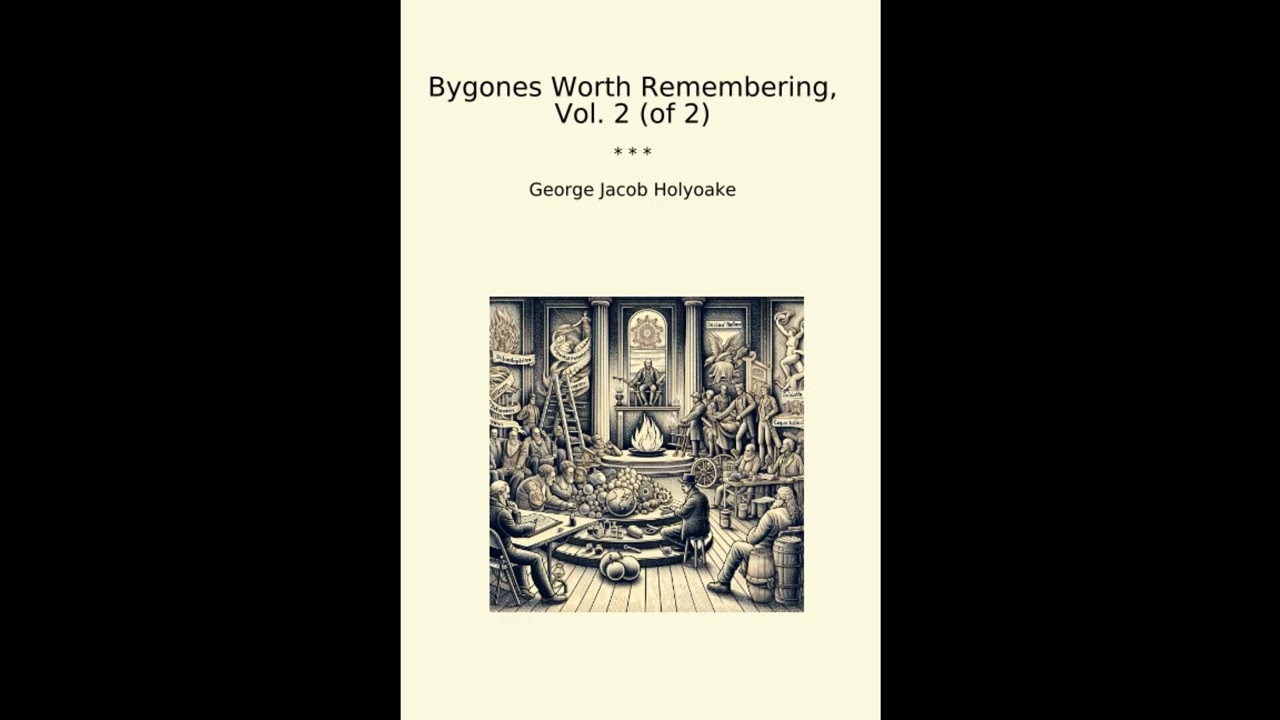
Bygones Worth Remembering, Vol. 2 (of 2)
Bygones Worth Remembering, Vol. 2 (of 2) invites listeners into the mind of a pivotal figure in 19th-century British social history, George Jacob Holyoake. This deeply personal memoir offers an unparalleled, first-person view of the intellectual and political battles that shaped modern society. It is more than just a historical account; it is a testament to the power of conviction, a stirring defense of reason, and a detailed chronicle of movements that continue to resonate today. For anyone interested in the origins of secular thought, cooperative economics, and the enduring fight for civil liberties, Holyoake's reflections provide not just context, but also inspiration, showing how sustained advocacy by an individual can bend the arc of history towards greater equity and understanding. This second volume of Holyoake's recollections picks up the thread of his extraordinary life, charting his continued engagement with the most pressing social questions of Victorian England. From the bustling streets of London to the industrial heartlands, the setting is a nation grappling with the fallout of the Industrial Revolution, where new ideas about labor, governance, and spiritual belief clashed violently with established norms. The main character, Holyoake himself, stands as a self-taught intellectual and indefatigable agitator, constantly challenging the status quo. Having already faced persecution and imprisonment for his radical views, Holyoake here continues his tireless efforts to establish a more just and rational society. His struggles are not just external against legal systems and public opinion, but also intellectual, as he refines his philosophies of secularism and cooperation. The central conflict animating this portion of the memoir remains Holyoake's dedicated push for social reform in the face of widespread opposition and often, outright hostility. Listeners follow his further involvement with the burgeoning Cooperative movement, detailing its organizational challenges and its nascent successes in creating worker-owned enterprises. He recounts his ongoing advocacy for secular principles, striving to separate morality from religious dogma and to foster a society based on ethical humanism. Throughout this period, Holyoake grapples with the complexities of political activism, navigating alliances, public debates, and the constant threat of censure. The arc of the story here describes the culmination of his life's dedicated work, his continuing contributions to public discourse, and his reflections on the progress and setbacks he witnessed in the fight for a more open and equitable world. The narrative builds toward a powerful understanding of his legacy without revealing the specific resolutions or concluding events. George Jacob Holyoake (1817-1906) was a remarkable figure whose life spanned nearly the entire 19th century, making him a living bridge between eras of profound change. Born into a working-class family in Birmingham, he was largely self-educated, a testament to his innate intellectual curiosity and fierce determination. His early years saw him become involved with the Chartist movement, advocating for political rights for the working class, a commitment that foreshadowed his lifelong dedication to social justice. It was his outspoken views on religion, however, that first brought him national notoriety and personal hardship. In 1842, he was the last person in England to be imprisoned for blasphemy, an experience that only hardened his resolve to champion free thought and expression. Holyoake's legacy extends far beyond his personal struggles. He is credited with coining the term "secularism" in 1851, articulating a philosophy that proposed an ethical system independent of religious belief, focusing on human welfare in this life. He was a driving force behind the Cooperative movement, helping to establish its principles and institutions, advocating for economic models that prioritized community benefit over individual profit. His many other written works include The History of Co-operation and Sixty Years of an Agitator's Life, each reflecting his commitment to documenting and advancing social progress. Holyoake stands as a significant voice within Victorian non-fiction, a chronicler of his times, and an influential proponent of rationalism and social reform whose ideas helped lay the groundwork for many modern progressive movements. The pages of Bygones Worth Remembering, Vol. 2 pulsate with several powerful and interconnected themes. Foremost among these is the unwavering pursuit of social justice and reform. Holyoake consistently champions the cause of the disenfranchised, arguing for practical improvements in the lives of ordinary people. Listeners encounter his detailed arguments for the Cooperative movement, seeing how he envisioned a system where workers could own and manage their own enterprises. He describes specific instances, such as the early days of the Rochdale Pioneers, not just as historical events, but as concrete examples of how collective action could alleviate poverty and empower communities, demonstrating a belief that societal structures could, and should, be engineered for greater fairness. Another significant theme is rationalism and the promotion of secular ethics. Holyoake directly confronts religious dogmatism, advocating for a moral framework based on human reason, compassion, and the observable world rather than divine revelation. His memoir recounts his battles for free speech, showing how essential open discourse was to challenging entrenched beliefs and fostering intellectual progress. He presents his arguments for a secular society not as an attack on belief itself, but as a constructive proposal for a society where individuals could pursue ethical lives together, regardless of their private convictions. He chronicles his encounters with those who opposed his views, illustrating the constant struggle to assert the right to independent thought and expression in a society often resistant to new ideas. This memoir emerged from and speaks directly to the tumultuous social and intellectual landscape of Victorian Britain. It was a period defined by rapid industrialization, leading to immense wealth but also widespread poverty and social inequality, fueling movements like Chartism that demanded political representation for the working classes. Simultaneously, scientific advancements, most notably Darwin's theories, began to challenge traditional religious orthodoxies, creating fertile ground for the secularist ideas Holyoake championed. Culturally, the era saw a burgeoning of public debate and self-improvement societies, reflecting a desire for knowledge and reform among ordinary citizens. Holyoake’s work, published in the early 20th century but reflecting decades of activism, is a direct product of these forces, offering a personal narrative from someone who was not merely observing these changes, but actively shaping them. His perspective provides an invaluable window into the intellectual ferment and reformist zeal of an age laying the foundations for modern political and social thought. Listening to Bygones Worth Remembering, Vol. 2 as an audiobook transforms Holyoake's detailed recollections into an immediate and engaging experience. The spoken word allows the listener to connect intimately with Holyoake's voice and conviction, giving life to his meticulous accounts of debates, public meetings, and personal struggles. The steady pacing of the narration permits listeners to absorb his complex arguments about social reform and secular ethics without feeling rushed. The several hours of content offer ample opportunity to sink deeply into the historical moment, making it an ideal companion for commutes, long walks, or quiet evenings. A skilled narrator can convey the earnestness, intelligence, and dry wit that characterized Holyoake, bringing his personality and the atmosphere of his era vividly to the forefront. This format makes the arguments and anecdotes of a crucial historical figure feel remarkably current and accessible.
Enjoyed Bygones Worth Remembering, Vol. 2 (of 2)? A few ways to support us
Audible & Amazon links are affiliate; we may earn a small commission at no extra cost.
About this production
Human narration by a volunteer reader from LibriVox.org, the public-domain audiobook project. LibriVox volunteers record literary works whose copyright has expired in the United States, releasing the resulting recordings into the public domain.
Bygones Worth Remembering, Vol. 2 (of 2) by George Jacob Holyoake. The underlying text is in the U.S. public domain. We do not republish any modern copyrighted edition, translation, or commentary.
The 4K cinematic visuals accompanying this audiobook are generated by an AI image model from prompts derived from the source text. No copyrighted photos, paintings, or stock footage are used. AI generation is disclosed on every video on our YouTube channel as required by YouTube's altered/synthetic content policy.
English subtitles are transcribed from the LibriVox recording with OpenAI Whisper. Translations into the 11 other supported languages are produced by Meta's NLLB-200 neural translation model. No human translator's copyrighted translation is used.
Questions about sourcing or rights? See our DMCA & Sourcing policy or contact us.
Enjoyed this audiobook?
If you'd like to own a copy of Bygones Worth Remembering, Vol. 2 (of 2) or hear a professionally produced edition, the links below help support free audiobook production at no extra cost to you.
As an Amazon Associate we earn from qualifying purchases. Audible / print links are affiliate.