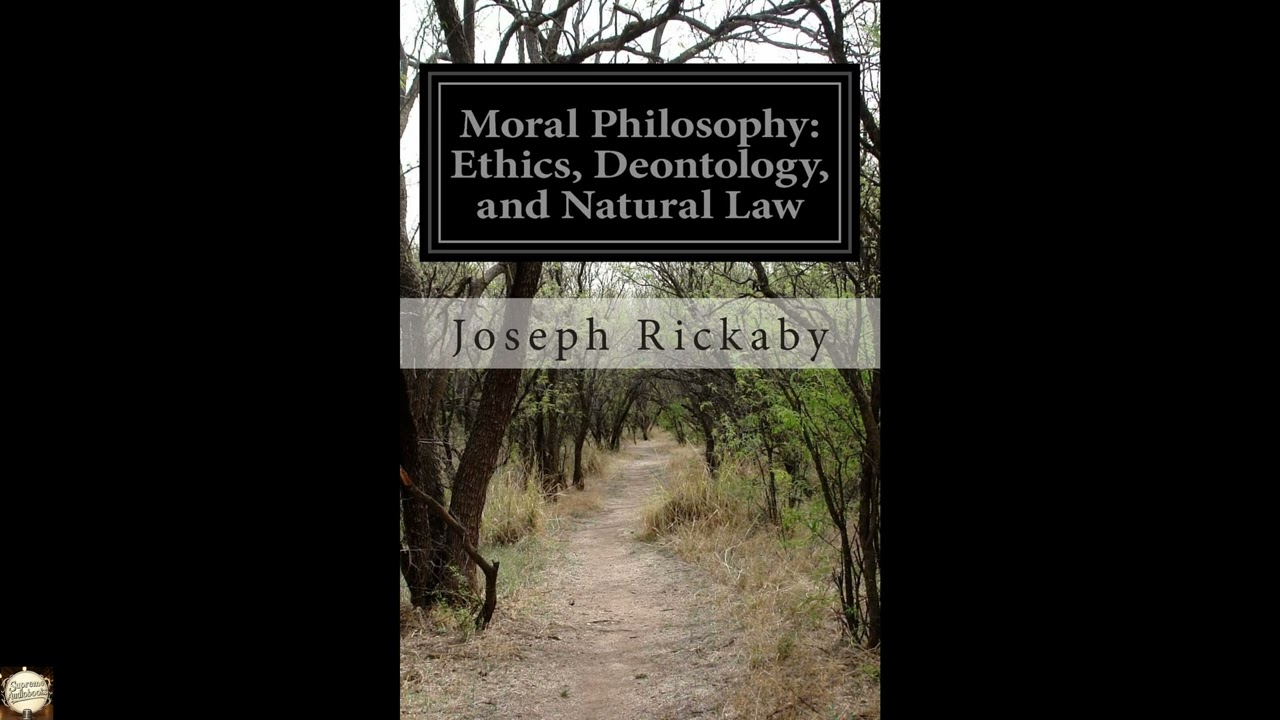
Moral Philosophy: Ethics, Deontology, and Natural Law
In a world increasingly defined by rapid change and complex ethical quandaries, the search for a stable moral compass feels more urgent than ever. From the ethical implications of artificial intelligence to the challenges of global justice, individuals and societies grapple daily with questions of right and wrong, duty and consequence. Joseph Rickaby's Moral Philosophy: Ethics, Deontology, and Natural Law offers more than just a historical artifact of thought; it presents a systematic framework, deeply rooted in classical and scholastic traditions, designed to equip listeners with the tools to critically assess moral problems. This foundational text invites us to consider the very bedrock of ethical decision-making, providing not just answers, but a method for arriving at them, making it a profoundly relevant listen for anyone seeking clarity in an often-confused moral landscape. Rickaby’s work does not present a narrative in the conventional sense, but rather constructs an intellectual edifice, guiding the listener through the systematic development of a comprehensive ethical theory. The "setting" is the philosophical arena itself, where ideas contend and are rigorously examined. The main "characters" are fundamental concepts such as human purpose, freedom of the will, conscience, virtue, obligation, and the ultimate good. The intellectual arc begins by laying the groundwork, probing the nature of human acts and the end towards which all human endeavor is directed. Rickaby methodically addresses free will, the role of passions, and the formation of habits, establishing how these elements contribute to moral character. From this foundation, the text proceeds to dissect various ethical schools, particularly focusing on the concepts of duty and law. It meticulously distinguishes between different types of law—eternal, natural, human, and divine—and shows how these interrelate to create a coherent moral order. The central intellectual challenge, or "conflict," is the perennial human struggle to discern absolute moral truths amidst diverse opinions and cultural practices. Rickaby’s approach emphasizes the objective nature of morality, arguing against purely subjective or relativistic views by grounding ethical principles in the very structure of reality and human nature. He rigorously demonstrates how moral obligations arise from our being, not merely from societal convention or personal preference, culminating in a powerful exposition of Natural Law as the guiding principle for human conduct. Joseph Rickaby, born in 1845, was a distinguished English Jesuit priest, philosopher, and theologian whose intellectual contributions profoundly shaped Catholic thought in the late nineteenth and early twentieth centuries. After entering the Society of Jesus in 1862, he received his education at Stonyhurst College and later taught philosophy and theology at various Jesuit institutions, including the prestigious Campion Hall, Oxford. He became a prominent figure in the Neo-Scholastic movement, which sought to revive and adapt the philosophical and theological insights of Thomas Aquinas to the challenges of modernity. Rickaby’s keen intellect and clear prose made complex scholastic ideas accessible to a wider English-speaking audience. Beyond Moral Philosophy, which first appeared in 1888 and saw several subsequent editions, Rickaby authored numerous other significant works. These included First Principles of Knowledge, an introduction to epistemology, and Aquinas Ethicus, a two-volume translation and commentary on selections from Aquinas's ethical writings, making the Angelic Doctor's thought available to English readers. His work was instrumental in fulfilling Pope Leo XIII's encyclical Aeterni Patris, which called for a renewed emphasis on Thomistic philosophy within Catholic education. Rickaby’s clear and systematic presentation of scholastic philosophy solidified his place as a leading exponent of Neo-Thomism, influencing generations of students and scholars. He passed away in 1932, leaving behind a substantial legacy of scholarly writing. One of the central themes Rickaby articulates is the teleological nature of human existence, positing that all human actions are directed towards an ultimate end or good. He systematically builds on this by explaining how moral precepts derive their force from this inherent drive toward human flourishing. For example, when discussing the cardinal virtues, he doesn’t just list them but shows how prudence, justice, fortitude, and temperance are essential habits that orient an individual towards their true good, illustrating with specific scenarios how a lack in one virtue can distort moral judgment or action. Another crucial theme is the robust defense of Natural Law. Rickaby meticulously shows how basic moral duties are discoverable by reason, arising from universal human inclinations and the inherent order of creation. He might provide an example where even without specific divine revelation, the prohibition against intentional harm or the duty to care for one's children can be rationally deduced from human nature and the societal good. The book also emphasizes the profound significance of human freedom and conscience. Rickaby distinguishes between invincibly ignorant actions and those performed with culpable knowledge, demonstrating the nuances of moral responsibility. He provides clear examples of how an informed conscience functions as the immediate guide for moral action, yet also stresses the duty to educate one's conscience through reason and reflection. This detailed consideration of culpability and the formation of conscience offers a precise framework for understanding individual accountability. The relationship between human law and divine law is another recurring thread, with Rickaby illustrating how just human laws must align with the broader principles of natural and eternal law, and how laws that contravene these higher principles lose their moral binding force. Moral Philosophy emerged during a pivotal era in intellectual history, the late Victorian and early Edwardian periods. This was a time marked by significant challenges to traditional religious and philosophical authority. The rise of scientific naturalism, the impact of Darwinian theory, and the growing influence of utilitarian and positivist philosophies in Britain created a pressing need for a robust defense of objective morality. Philosophers like John Stuart Mill had popularized utilitarianism, which measured morality by consequences, while others questioned the very possibility of universal ethical truths. Within the Catholic Church, Pope Leo XIII's 1879 encyclical Aeterni Patris had called for a resurgence of Thomistic philosophy as a bulwark against perceived modern errors and as a comprehensive intellectual system. Rickaby’s work directly responded to this mandate, providing an articulate and accessible exposition of Thomistic ethics in English. His book offered a structured, rational alternative to the prevailing ethical relativism and consequentialism, reaffirming the existence of inherent moral truths discoverable through reason and grounded in a classical understanding of human nature. Listening to Moral Philosophy: Ethics, Deontology, and Natural Law as an audiobook transforms a potentially dense academic text into an engaging intellectual experience. The sustained focus required for philosophical reasoning becomes more manageable when presented through the clarity of a skilled narrator’s voice. The run length, several hours in duration, lends itself well to both focused listening sessions and segmented study, allowing listeners to pause and reflect on complex arguments before proceeding. A thoughtful narration provides an ideal pacing, giving intricate concepts the space they need to resonate. The narrator’s voice can subtly emphasize key distinctions between ethical theories or highlight the logical progression of Rickaby's arguments, transforming the potentially abstract into something more immediate and comprehensible. Without dialogue in the traditional sense, the narrator’s interpretive skill still conveys the intellectual "conversation" that philosophical texts maintain, presenting counter-arguments and building conclusions with an accessible rhythm. This auditory format creates a contemplative atmosphere, perfect for absorbing profound ideas while commuting, exercising, or simply taking time for quiet contemplation.
Enjoyed Moral Philosophy: Ethics, Deontology, and Natural Law? A few ways to support us
Audible & Amazon links are affiliate; we may earn a small commission at no extra cost.
About this production
Human narration by a volunteer reader from LibriVox.org, the public-domain audiobook project. LibriVox volunteers record literary works whose copyright has expired in the United States, releasing the resulting recordings into the public domain.
Moral Philosophy: Ethics, Deontology, and Natural Law by Joseph Rickaby. The underlying text is in the U.S. public domain. We do not republish any modern copyrighted edition, translation, or commentary.
The 4K cinematic visuals accompanying this audiobook are generated by an AI image model from prompts derived from the source text. No copyrighted photos, paintings, or stock footage are used. AI generation is disclosed on every video on our YouTube channel as required by YouTube's altered/synthetic content policy.
English subtitles are transcribed from the LibriVox recording with OpenAI Whisper. Translations into the 11 other supported languages are produced by Meta's NLLB-200 neural translation model. No human translator's copyrighted translation is used.
Questions about sourcing or rights? See our DMCA & Sourcing policy or contact us.
Enjoyed this audiobook?
If you'd like to own a copy of Moral Philosophy: Ethics, Deontology, and Natural Law or hear a professionally produced edition, the links below help support free audiobook production at no extra cost to you.
As an Amazon Associate we earn from qualifying purchases. Audible / print links are affiliate.
More Audiobooks
Recent Tendencies in Ethics: Three Lectures to Clergy, given at Cambridge
Morality as a Religion An exposition of some first principles
Moral Principles in Education
Progressive Morality: An Essay in Ethics