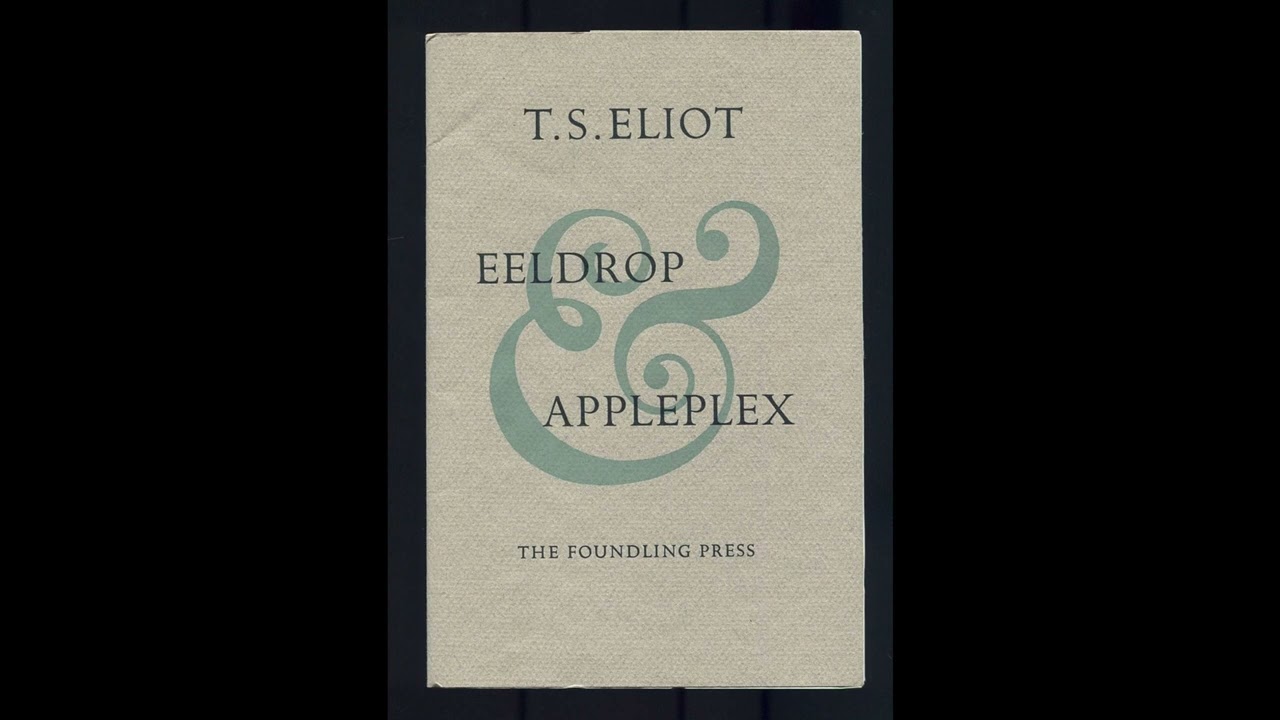
Eeldrop & Appleplex
In a literary landscape dominated by T.S. Eliot’s revolutionary verse and incisive criticism, his prose fiction often receives less attention. Eeldrop & Appleplex offers a rare opportunity to encounter a different facet of the influential poet’s genius: his early foray into short narrative. More than a mere curiosity, this work presents a unique intellectual exercise, probing the complexities of human observation, perception, and the elusive nature of selfhood. For listeners keen to understand the formative intellectual currents that shaped one of the twentieth century's most significant literary figures, or simply those seeking a thought-provoking engagement with early Modernist ideas, this audiobook provides an uncommon window into the mind behind The Waste Land, revealing Eliot's sharp analytical intellect at play in a distinct narrative form. The short narrative introduces us to two primary figures, Eeldrop and Appleplex, intellectual companions who inhabit a London setting, often observing the world from a detached, almost clinical perspective. Eeldrop, the more speculative of the two, possesses a heightened, almost mystical sensitivity to the subtle nuances of human behavior, finding profound significance in fleeting gestures or overheard remarks. He is fascinated by the underlying motives and unconscious drives that shape individuals, often constructing elaborate theories to explain the commonplace. Appleplex, his foil, offers a more grounded, analytical viewpoint. He approaches life with a rational, classificatory impulse, seeking to categorize and define human experience through logical deduction and empirical observation, often challenging Eeldrop’s more intuitive insights with a demand for evidence and concrete explanation. Their interactions largely consist of philosophical discourse, as they dissect various "types" of people they encounter or imagine, from the mundane figures passing on the street to the more abstract concepts of human folly and aspiration. They muse on the secret lives people lead, the masks they wear, and the disparate ways individuals navigate their inner worlds versus their public personas. The central dynamic is not one of external conflict but an internal one, a spirited intellectual debate on the very possibility of truly knowing another person, or indeed, oneself. Through their contrasting methods of understanding, Eliot invites us to consider the limitations and possibilities of both rational and intuitive approaches to comprehending the vast, often contradictory, panorama of human existence, without offering easy answers or definitive conclusions. Thomas Stearns Eliot, born in St. Louis, Missouri, in 1888, would become one of the towering figures of twentieth-century literature. Educated at Harvard, Marburg, and the Sorbonne, he developed a profound engagement with philosophy and classical languages before settling in England in 1914. It was in London that he met the American poet Ezra Pound, a crucial encounter that spurred Eliot’s poetic development. Initially working at Lloyds Bank, he also began to contribute significantly to literary criticism, serving as editor of the influential journal The Criterion. His later conversion to Anglicanism deeply influenced his work, bringing a new spiritual dimension to his already complex intellectual pursuits. Eliot’s literary output was prodigious and varied. He first gained widespread recognition with "The Love Song of J. Alfred Prufrock" in 1915, a groundbreaking poem that captured the angst and fragmentation of modern consciousness. This was followed by his seminal poem, The Waste Land, published in 1922, which cemented his reputation as a leading voice of Modernism. His later works, such as Four Quartets, represent a more contemplative and spiritual phase, while his verse dramas like Murder in the Cathedral demonstrated his versatility across genres. Awarded the Nobel Prize in Literature in 1948, Eliot’s influence as a poet, critic, and cultural commentator extended far beyond his lifetime, shaping the trajectory of English literature and critical thought until his death in 1965. The intellectual sparring between Eeldrop and Appleplex enacts several core themes that would recur throughout Eliot’s broader literary output. A primary theme is the relativity of perception and truth. Eeldrop’s intuitive leaps and Appleplex’s insistence on logic highlight the differing ways individuals attempt to apprehend reality. When they discuss a "man of action," for instance, Eeldrop might focus on the hidden anxieties driving his behavior, while Appleplex would analyze his public achievements. This tension suggests that no single mode of understanding fully captures the world, foreshadowing Eliot's later poetic explorations of fragmentation and elusive meaning. Another significant theme is the isolation of the modern intellect and its struggle to connect with raw human experience. The characters often observe others from a distance, intellectualizing emotions rather than directly participating in them. They are observers rather than actors, a posture that reflects a sense of detachment often associated with Modernist sensibility. This detachment is subtly reinforced when they discuss the "pathetic" qualities of strangers, viewing them almost as specimens for analysis rather than individuals for empathy. The story also touches on the burden of consciousness and the difficulty of finding authentic expression in a complex, often bewildering world. Eeldrop & Appleplex was published in The Little Review in 1917, a period of immense global upheaval. World War I was raging, tearing apart old certainties and challenging established social and political orders. Culturally, the early twentieth century was marked by a profound sense of disillusionment and a questioning of Victorian values. Scientific advancements, particularly in psychology with figures like Freud, were beginning to offer new frameworks for understanding the human mind, often emphasizing the unconscious and irrational. In the literary world, Modernism was taking shape, driven by figures like Eliot and Pound, who sought to break away from traditional narrative forms and poetic conventions. They aimed to reflect the fragmentation, psychological complexity, and intellectual ferment of their time through experimental structures, allusions, and a focus on interiority. Eliot’s prose sketch can be seen as an early manifestation of this Modernist impulse, a philosophical fragment that grapples with the anxieties and intellectual quests characteristic of an age grappling with profound change and the redefinition of what it meant to be human. It emerged as a quiet but potent reflection on perception in a world rapidly losing its coherence. Listening to Eeldrop & Appleplex as an audiobook offers a particularly immersive way to engage with Eliot’s early prose and the intellectual currents it represents. The conversational nature of the text, centered on the discussions between Eeldrop and Appleplex, lends itself perfectly to auditory presentation. A skilled narrator can bring out the distinct voices and intellectual temperaments of the two characters, allowing their philosophical sparring to unfold with nuance and clarity. The pacing can be meditative, inviting listeners to pause and reflect on the ideas presented, rather than simply rushing through a plot. This format allows the subtleties of Eliot's language and the atmospheric quality of his observation to truly resonate, making this collection of several hours a compelling listen for anyone wishing to experience the foundational insights of one of literature's great thinkers directly through performance.
Enjoyed Eeldrop & Appleplex? A few ways to support us
Audible & Amazon links are affiliate; we may earn a small commission at no extra cost.
About this production
Human narration by a volunteer reader from LibriVox.org, the public-domain audiobook project. LibriVox volunteers record literary works whose copyright has expired in the United States, releasing the resulting recordings into the public domain.
Eeldrop & Appleplex by T.S. ELIOT. The underlying text is in the U.S. public domain. We do not republish any modern copyrighted edition, translation, or commentary.
The 4K cinematic visuals accompanying this audiobook are generated by an AI image model from prompts derived from the source text. No copyrighted photos, paintings, or stock footage are used. AI generation is disclosed on every video on our YouTube channel as required by YouTube's altered/synthetic content policy.
English subtitles are transcribed from the LibriVox recording with OpenAI Whisper. Translations into the 11 other supported languages are produced by Meta's NLLB-200 neural translation model. No human translator's copyrighted translation is used.
Questions about sourcing or rights? See our DMCA & Sourcing policy or contact us.
Enjoyed this audiobook?
If you'd like to own a copy of Eeldrop & Appleplex or hear a professionally produced edition, the links below help support free audiobook production at no extra cost to you.
As an Amazon Associate we earn from qualifying purchases. Audible / print links are affiliate.