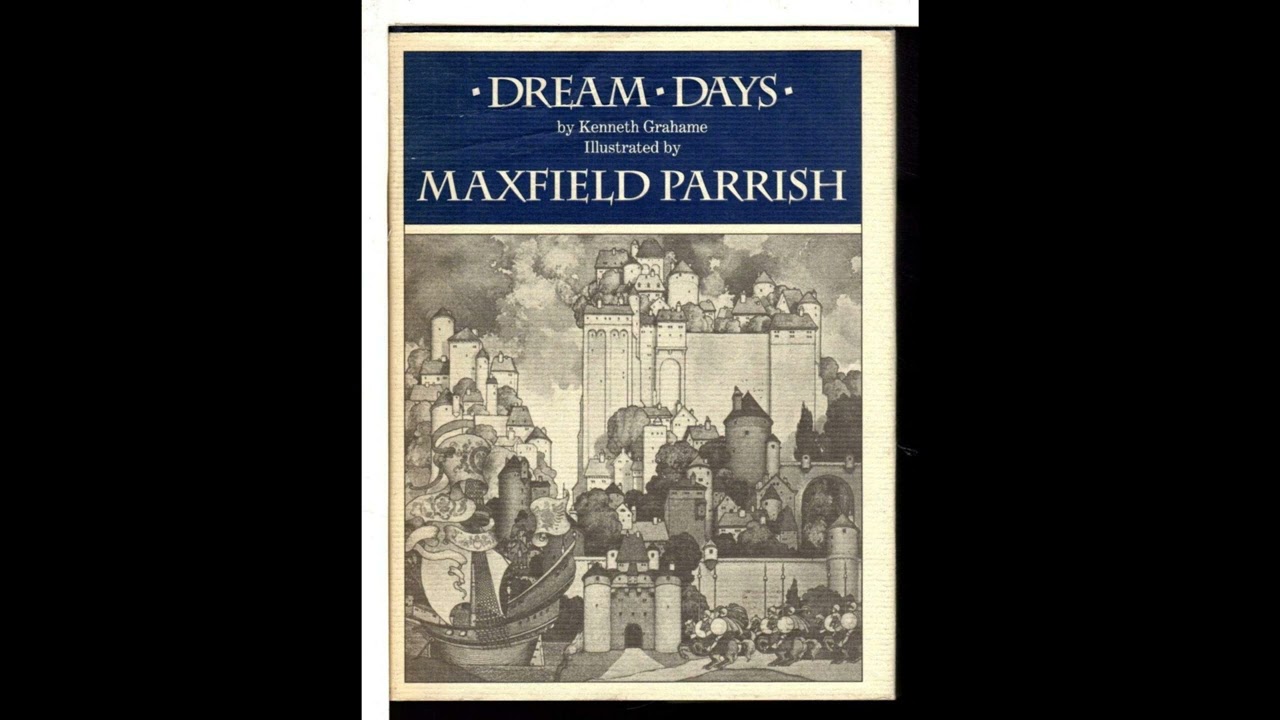
Dream Days
Step into a world where childhood is not merely a phase, but a complete universe, bounded by garden walls and the unspoken rules of make-believe. Kenneth Grahame’s Dream Days invites listeners to revisit that luminous, often melancholic realm through the eyes of children and the fond, reflective gaze of an adult narrator. Published at the close of the nineteenth century, this collection of stories, essays, and vignettes captures the fleeting beauty of youth, the boundless capacity for imagination, and the bittersweet realization of time’s passage. It offers a gentle yet profound escape from the bustle of modern life, reminding us of the enduring power of innocence, the peculiar logic of childhood, and the quiet dignity of memory itself. For anyone who has ever looked back on their younger years with a mix of warmth and longing, these pages offer a comforting echo, a shared recognition of experiences both unique and universal. The setting for these stories is often the quiet, sun-dappled English countryside of late Victorian England, a landscape that fosters imaginative play and introspective thought. The main characters are a group of children, observed primarily through the eyes of an older, wiser, though often bewildered, unnamed narrator who is sometimes a participant, sometimes a detached observer. We meet Harold, Selina, Edward, and the others, each with their distinct quirks and earnest devotion to the serious business of play. Their world is circumscribed by the routines of home and the watchful, often uncomprehending, presence of adults, whom they refer to simply as "The Grown-Ups." There is no grand antagonist or overarching plot that spans the entire collection. Instead, each story presents a miniature drama, a moment of discovery, a shared secret, or a confrontation between the child’s expansive inner life and the limited understanding of the adult world. The central “conflict” in Dream Days arises from this inherent disconnect: the children live in a world of infinite possibility, where a garden shed can become a pirate ship and a simple walk can lead to encounters with mythical beasts, while the adults operate by practical concerns and a logic that often seems baffling or restrictive to the young ones. The arc of the story, therefore, is not one of external progression but of internal reflection. We watch as the children create elaborate narratives to explain their world, whether it’s in “The Magic Ring,” where an ordinary piece of jewelry holds extraordinary powers, or in “A Saga of the Seas,” where the children transform their everyday surroundings into a sweeping maritime adventure. Perhaps the most famous tale within the collection, “The Reluctant Dragon,” perfectly illustrates this gentle tension, presenting a child who befriends a peace-loving dragon, only for the adults to insist on a heroic battle that must be carefully staged to avoid actual harm. The collection flows from one such observation to another, building a cumulative sense of a bygone era and the unique psychology of childhood. Kenneth Grahame, born in Edinburgh, Scotland, in 1859, led a life that, on the surface, seemed far removed from the whimsical worlds he created. His early years were marked by sorrow; his mother passed away when he was five, and his father, a lawyer, struggled with alcoholism and eventually left his children to be raised by their maternal grandmother in Berkshire, England. This rural upbringing, in an old house with a large garden, deeply influenced his later writing, providing the idyllic backdrop for much of Dream Days and its precursor, The Golden Age. Despite his literary inclinations, Grahame pursued a career in finance, joining the Bank of England as a clerk in 1878, where he steadily rose through the ranks to become its Secretary by 1898. It was during his banking career that Grahame began writing stories and essays, often drawing on his own childhood memories and observations. The Golden Age was published in 1895, introducing many of the themes and characters that would reappear in Dream Days three years later. However, his lasting fame rests primarily on The Wind in the Willows, which appeared in 1908, the same year he retired from the bank due to ill health. This beloved novel, featuring the memorable characters of Mole, Ratty, Toad, and Badger, solidified his place in English literature. Grahame passed away in 1932, leaving behind a compact but profoundly influential body of work that continues to resonate with readers of all ages, positioning him as a central figure in the "Golden Age" of children's literature. The stories in Dream Days are rich with significant themes, often presented with gentle humor and a touch of wistfulness. One prominent theme is the power of imagination, particularly in transforming the mundane into the magical. Grahame demonstrates this repeatedly, such as when the children turn the prosaic events of daily life into grand, heroic narratives, or when a simple pond becomes a vast ocean waiting for pirate adventures. Their internal worlds are so vivid that the line between reality and fantasy blurs, allowing them to construct elaborate scenarios that are utterly convincing to them. Another pervasive theme is the contrast between the world of children and the world of adults. The "Grown-Ups" are often portrayed as kind but utterly incapable of understanding the children's logic or the serious import of their play. This gap in understanding leads to amusing misunderstandings and highlights the unique, self-contained universe children inhabit. The children's ingenious solutions to adult demands, like orchestrating a mock battle for a reluctant dragon, are prime examples of this dynamic. A third key theme is nostalgia and the bittersweet passage of time. Although narrated from an adult perspective, Grahame carefully avoids overt sentimentality, instead allowing the quiet poignancy of remembered moments to surface naturally. There is a palpable sense that these days of unbridled imagination and innocent joys are fleeting, treasured memories destined to fade into the past. This undercurrent of longing gives the stories a deeper resonance, suggesting that childhood is a precious, often misunderstood, stage of life that once gone, can only be recaptured through reflection. Finally, the collection celebrates the beauty and solace of nature. The rural setting, with its gardens, fields, and streams, serves as an essential backdrop for the children's adventures, a sanctuary where their imaginations can roam freely, untouched by the complexities of the adult world. The late nineteenth century, when Dream Days was first published in 1898, was a period of significant cultural and social shifts in Britain. It was the twilight of the Victorian era, a time of relative peace and prosperity, but also one where traditional values were starting to yield to modern ideas. There was a growing interest in childhood as a distinct and important stage of life, moving away from viewing children simply as miniature adults. This era saw a blossoming of literature specifically for young people, with authors like Lewis Carroll, Robert Louis Stevenson, and Rudyard Kipling setting new standards for imaginative storytelling. Grahame’s work contributed to this burgeoning genre, offering a more reflective and psychological portrayal of childhood than some of his more adventure-focused contemporaries. His focus on the internal world of children, their imaginative play, and the often-humorous disconnect with adults, spoke to a society that was beginning to appreciate the unique complexities of youth. The collection’s nostalgic tone also resonated with a sentimentality common at the turn of the century, a yearning for simpler times amidst increasing industrialization and social change. Listening to Dream Days as an audiobook transforms Grahame’s gentle prose into an immersive experience. With a run length of several hours, it is ideal for quiet evenings or peaceful mornings, allowing the listener to settle into its unhurried pace. A skilled narrator brings a distinct richness to the stories, lending unique voices to the children and their earnest declarations, as well as to the wry observations of the adult narrator. The dialogue, often understated and imbued with Grahame’s characteristic humor, gains an additional layer of charm when spoken aloud. Listen for the subtle shifts in tone that convey the children’s unwavering belief in their imaginative worlds, juxtaposed with the adults’ bemused tolerance. The atmosphere Grahame creates—one of sun-drenched gardens, hushed secrets, and the limitless potential of a child’s mind—is particularly well-suited to the spoken word, inviting a quiet contemplation that echoes the very nature of these beautifully crafted stories.
Enjoyed Dream Days? A few ways to support us
Audible & Amazon links are affiliate; we may earn a small commission at no extra cost.
About this production
Human narration by a volunteer reader from LibriVox.org, the public-domain audiobook project. LibriVox volunteers record literary works whose copyright has expired in the United States, releasing the resulting recordings into the public domain.
Dream Days by Kenneth Grahame. The underlying text is in the U.S. public domain. We do not republish any modern copyrighted edition, translation, or commentary.
The 4K cinematic visuals accompanying this audiobook are generated by an AI image model from prompts derived from the source text. No copyrighted photos, paintings, or stock footage are used. AI generation is disclosed on every video on our YouTube channel as required by YouTube's altered/synthetic content policy.
English subtitles are transcribed from the LibriVox recording with OpenAI Whisper. Translations into the 11 other supported languages are produced by Meta's NLLB-200 neural translation model. No human translator's copyrighted translation is used.
Questions about sourcing or rights? See our DMCA & Sourcing policy or contact us.
Enjoyed this audiobook?
If you'd like to own a copy of Dream Days or hear a professionally produced edition, the links below help support free audiobook production at no extra cost to you.
As an Amazon Associate we earn from qualifying purchases. Audible / print links are affiliate.
![Children's Classics in Dramatic Form, Book Two. [1909] by Augusta Stevenson — free full audiobook](https://img.youtube.com/vi/h4bTKUeuO7U/maxresdefault.jpg)