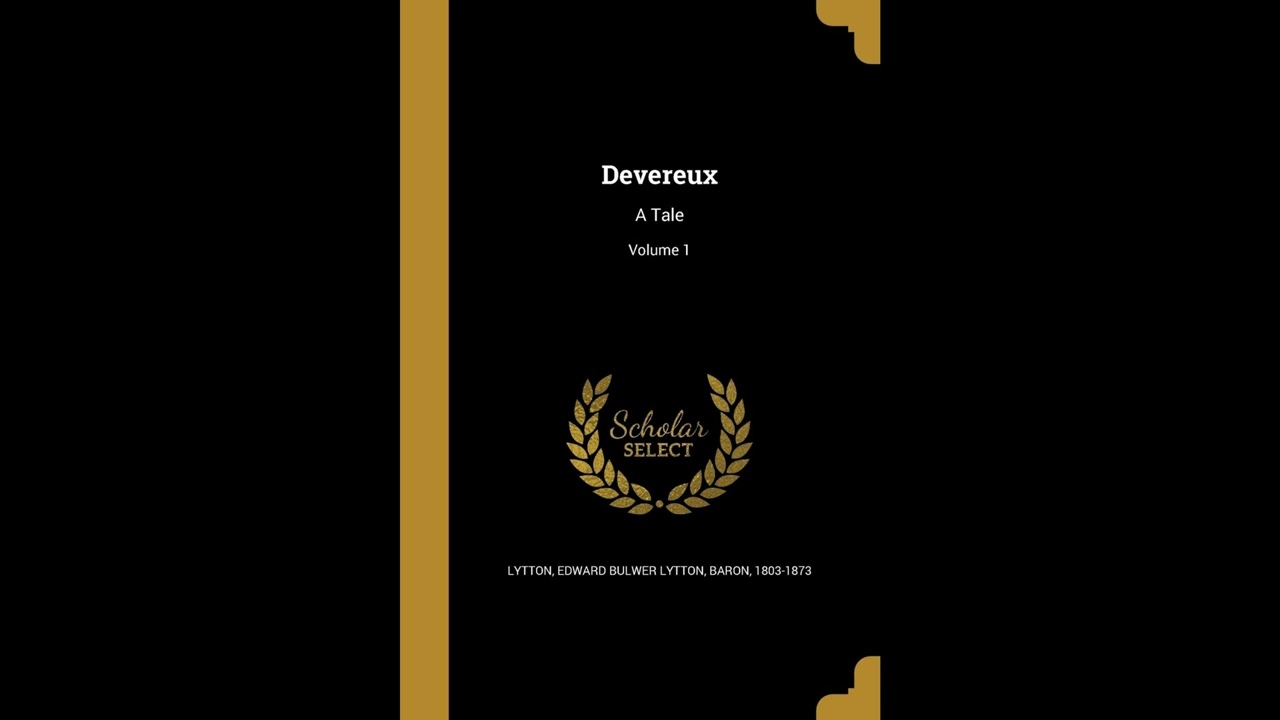
Devereux: A Tale; Volume 1
Step into the gilded, often perilous, world of late 17th and early 18th century Europe with Edward Bulwer Lytton's "Devereux: A Tale; Volume 1." This expansive historical romance introduces us to a protagonist whose experiences resonate across centuries, grappling with questions of identity, destiny, and the search for truth amidst a society defined by both brilliance and profound hypocrisy. Far from a mere period piece, Bulwer Lytton’s novel offers a deeply psychological portrait of a man coming of age, facing trials of love and betrayal, and observing the grand dramas of history unfold around him. It’s a compelling narrative that invites us to consider the eternal struggle between individual will and the forces of fate, making it as thought-provoking for listeners today as it was for its original audience. The story opens by introducing Francis Devereux, a young man of noble birth, whose sensitive nature and keen intellect set him apart from his more boisterous elder brother, Aubrey. Raised in the shadow of a somewhat mysterious family legacy, Francis finds himself drawn to philosophy, literature, and a contemplative life, even as the world around him clamors for action and ambition. Their contrasting temperaments set the stage for much of the novel’s unfolding drama, particularly as they both navigate the complexities of love, rivalry, and societal expectations. The narrative whisks Francis from the quiet countryside of England to the glittering, politically charged courts of France, where he is exposed to the intellectual ferment of the pre-Enlightenment era and the decadent intrigues of aristocratic life. As Francis matures, he encounters a gallery of memorable characters – philosophers, poets, courtiers, and spies – each leaving an indelible mark on his developing worldview. His quest for understanding and happiness is repeatedly challenged by the machinations of those around him, by the often-unspoken rules of social conduct, and by a series of personal tragedies that seem almost predetermined. He seeks love and genuine connection in a world that often values status and superficiality, leading him into situations fraught with both danger and profound emotional resonance. This initial volume follows Francis as he grapples with these foundational experiences, setting him on a path towards self-discovery that promises both enlightenment and further heartbreak, without revealing the ultimate resolution of his grand struggle. Edward Bulwer Lytton, born in 1803, was a titan of Victorian letters, a figure of immense popularity and productivity who left an enduring mark on English literature. Educated at Cambridge, his early life was marked by a challenging family dynamic and a somewhat scandalous elopement, providing fertile ground for the dramatic themes that would infuse his fiction. Beyond his literary pursuits, Bulwer Lytton also maintained a significant political career, serving as a Member of Parliament for many years and even holding the esteemed position of Secretary of State for the Colonies. This dual life—navigating both the hallowed halls of Westminster and the creative demands of a novelist—speaks to his formidable energy and intellect. He was a writer deeply engaged with the social and political currents of his day, often weaving contemporary concerns into his historical romances and domestic novels. Though sometimes criticized for a tendency towards melodrama, his influence on the genre cannot be overstated. He penned dozens of novels, plays, and poems, including such enduring works as "The Last Days of Pompeii," "Rienzi, The Last of the Roman Tribunes," and "Paul Clifford," which famously gave us the phrase, "It was a dark and stormy night." Bulwer Lytton’s distinct voice, blending historical sweep with psychological introspection, secured his place as a central figure in 19th-century literature, paving the way for later Victorian novelists who sought to marry entertainment with substantive social commentary. At the core of "Devereux" are several potent themes that continue to resonate. One central thread is the ongoing debate between fate and free will. Francis frequently grapples with a sense of predestination, particularly in the face of familial misfortunes or societal constraints. He often questions whether he is merely a pawn in a larger game or if his choices genuinely steer his destiny. For instance, an early tragic event in his family history colors his understanding of his own prospects, making him wonder if he can truly escape a predetermined path. This internal struggle is keenly felt as he attempts to forge his own happiness. Another prominent theme is identity and self-discovery, as Francis’s journey charts his development from an idealistic youth to a more experienced, albeit sometimes disillusioned, man. His encounters with different philosophical viewpoints and the varying moral codes of courtly life force him to constantly re-evaluate who he is and what he believes. We see this in his philosophical debates with mentors and in his quiet moments of reflection, where he tries to reconcile his inner world with the often-harsh realities of the external. This search for an authentic self against a backdrop of performance and expectation gives the novel its powerful psychological dimension, making his growth and struggles feel deeply personal even within a historical setting. Published in 1829, "Devereux" emerged during a period of dynamic change, both culturally and politically, often referred to as the Regency era transitioning into early Victorianism. Great Britain was still reeling from the Napoleonic Wars and grappling with the dawn of the Industrial Revolution, leading to widespread social unrest and calls for political reform. In the literary world, the Romantic movement, with its emphasis on individual emotion and historical grandeur, was still potent, yet new currents of realism and social commentary were beginning to surface. Authors like Sir Walter Scott had popularized the historical novel, and Bulwer Lytton, while influenced by Scott's epic scope, sought to infuse his own historical narratives with deeper psychological insight and philosophical speculation. This context explains why a novel like "Devereux" would resonate so strongly. It provided an escape into a glamorous historical past, yet it also engaged with intellectual questions pertinent to its own time—the nature of progress, the role of reason, and the individual's quest for meaning in an increasingly complex world. By setting his tale in the previous century, Bulwer Lytton could both critique contemporary society indirectly and foreground the philosophical debates that characterized the Enlightenment, a period of profound intellectual awakening that shaped modern thought. The novel thus offered its readers both vivid entertainment and thoughtful engagement with enduring human concerns. Listening to "Devereux: A Tale; Volume 1" as an audiobook offers a unique opportunity to truly immerse oneself in Bulwer Lytton’s expansive prose and the intricate world he constructs. A skilled narrator can bring to life the rich period language, navigating its sometimes elaborate sentence structures with clarity and grace, allowing the listener to fully appreciate the novel’s intellectual depth without losing the thread of the narrative. The several hours of listening time provide ample room for the story to unfold at a natural pace, drawing you into Francis Devereux’s reflections and the grand historical sweep of his experiences. A good performance will differentiate the distinct voices of the diverse cast of characters, from the witty courtiers to the earnest philosophers, making the dialogue sparkle and the emotional beats resonate. The auditory experience enhances the atmosphere, whether conveying the hushed tension of a political intrigue or the tender intimacy of a personal revelation, transforming the act of reading into a vivid, unfolding drama.
Enjoyed Devereux: A Tale; Volume 1? A few ways to support us
Audible & Amazon links are affiliate; we may earn a small commission at no extra cost.
About this production
Human narration by a volunteer reader from LibriVox.org, the public-domain audiobook project. LibriVox volunteers record literary works whose copyright has expired in the United States, releasing the resulting recordings into the public domain.
Devereux: A Tale; Volume 1 by Edward Bulwer Lytton Baron Lytton. The underlying text is in the U.S. public domain. We do not republish any modern copyrighted edition, translation, or commentary.
The 4K cinematic visuals accompanying this audiobook are generated by an AI image model from prompts derived from the source text. No copyrighted photos, paintings, or stock footage are used. AI generation is disclosed on every video on our YouTube channel as required by YouTube's altered/synthetic content policy.
English subtitles are transcribed from the LibriVox recording with OpenAI Whisper. Translations into the 11 other supported languages are produced by Meta's NLLB-200 neural translation model. No human translator's copyrighted translation is used.
Questions about sourcing or rights? See our DMCA & Sourcing policy or contact us.
Enjoyed this audiobook?
If you'd like to own a copy of Devereux: A Tale; Volume 1 or hear a professionally produced edition, the links below help support free audiobook production at no extra cost to you.
As an Amazon Associate we earn from qualifying purchases. Audible / print links are affiliate.