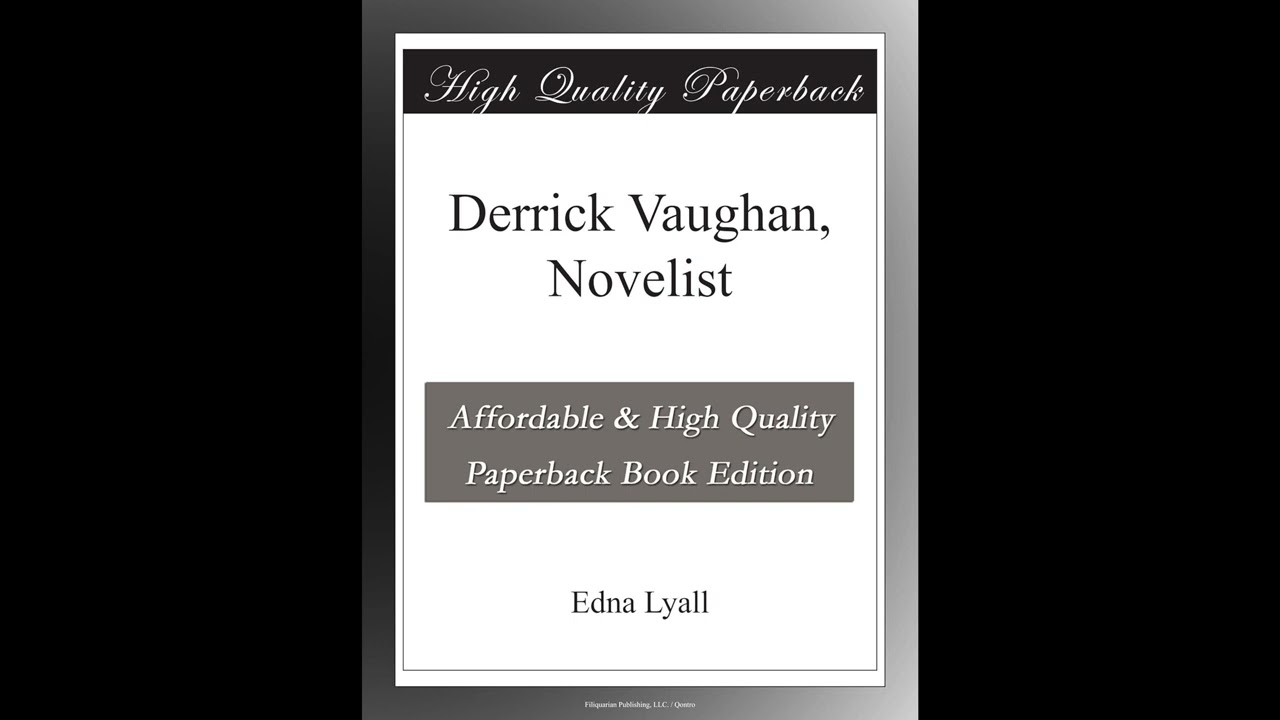
Derrick Vaughan, Novelist
Step back into the gaslit drawing rooms and bustling literary circles of late Victorian England with Edna Lyall’s compelling novel, Derrick Vaughan, Novelist. This isn’t merely a period piece; it’s a remarkably prescient examination of artistic integrity, public scrutiny, and the moral dilemmas faced by creators in an increasingly media-conscious world. Lyall, a hugely popular author in her own time, crafts a story that resonates profoundly even today, speaking to anyone who has grappled with the tension between personal values and professional demands, or the chasm between public perception and private truth. It asks what it truly means to be an artist, and more importantly, what it means to be a person of principle, when the world is watching. At the heart of the story stands Derrick Vaughan himself, a young writer who has, against his own inclinations, achieved a surprising degree of fame and critical acclaim. Set against the backdrop of London’s literary scene, Vaughan finds himself caught in a whirlwind of expectations and judgments. He is an earnest and deeply moral individual, whose greatest desire is to use his gift for writing to illuminate truth and inspire goodness, rather than simply to entertain or accumulate wealth. The central conflict arises when a past indiscretion, a youthful error of judgment that has been misconstrued and exaggerated, threatens to derail his career and tarnish his reputation. This personal attack, combined with the pressures of his success—the demands of publishers, the whims of critics, and the sometimes-intrusive gaze of the public—forces Derrick to confront profound questions about honesty, forgiveness, and the very nature of storytelling. As the narrative unfolds, Derrick Vaughan must navigate a treacherous path. He faces betrayal from those he trusted, misunderstanding from the public, and intense self-doubt. His struggle is not just against external forces, but also an internal battle to remain true to his artistic vision and moral compass. Lyall skillfully introduces a cast of supporting characters—fellow writers, socialites, critics, and a quiet, compassionate woman who sees beyond the superficial—each playing a role in Vaughan's ordeal, either as allies, adversaries, or mirrors reflecting his own principles. The story follows Vaughan as he attempts to clear his name, defend his artistic intentions, and ultimately, find a way to reconcile his public persona with his private convictions, all while striving to maintain his integrity in a world that often rewards compromise. The ending leaves the reader to consider the true cost of authenticity and the enduring power of character. The author behind Derrick Vaughan, Novelist was Ada Ellen Bayly, better known by her pen name, Edna Lyall. Born in Brighton, England, in 1857, she was the daughter of a prominent barrister, Alfred Bayly, and his wife, Anna. Lyall was the third of four daughters and enjoyed a comfortable, educated upbringing that fostered her literary talents. She remained unmarried throughout her life, dedicating herself to her writing and her strong Anglican faith. Lyall's health was often delicate, and she passed away relatively young in 1903, at the age of 45, leaving behind a substantial body of work that was widely read and admired during the late Victorian era. Lyall was a prolific writer, publishing over twenty novels, many of which became bestsellers and were translated into several languages. Her most famous works include Donovan (1882) and its sequel, We Two (1884), both of which grappled with themes of faith, doubt, and social justice, and firmly established her reputation. Other notable titles include In the Golden Days (1885) and Knight-Errant (1887). While her contemporary popularity rivaled that of authors like Mary Augusta Ward and even Thomas Hardy, Lyall's work later faded from the mainstream canon, partly due to its strong didactic tone and overtly moralistic stance, which became less fashionable in the modernist period. Nevertheless, her novels provided a significant voice within Victorian literature, often championing liberal social causes and exploring complex ethical questions with earnestness and conviction. One of the prominent themes Lyall addresses in Derrick Vaughan, Novelist is the tension between artistic integrity and the pressures of commercial success and public opinion. Derrick's struggle to write honest, meaningful literature rather than simply pandering to popular tastes or critics’ expectations is a central thread. We see this when he steadfastly refuses to alter a challenging moral message in one of his books, even when advised that doing so would increase its sales and critical reception. This unwavering commitment to his vision, despite potential financial or reputational costs, exemplifies Lyall’s own belief in the moral responsibility of the artist. The novel also powerfully interrogates the theme of public perception versus private reality, showing how quickly a person's character can be distorted by rumor and sensationalism. A whispered story about Derrick's past, for instance, spirals out of control, painting him as a morally compromised figure, entirely at odds with his true nature and intentions. Furthermore, Derrick Vaughan, Novelist is a thoughtful commentary on the nature of truth and the power of forgiveness. Derrick's journey involves not only defending his own truth but also learning to forgive those who have wronged him, and even to understand the perspectives of his detractors. This theme is particularly evident in a pivotal scene where Derrick confronts a former friend who has spread damaging rumors, choosing understanding and quiet resolution over public vengeance. Lyall uses Derrick’s experiences to illustrate the profound importance of moral courage—the fortitude to stand by one's principles even when it means facing isolation or public opprobrium. His quiet resilience in the face of adversity, his refusal to descend to the level of his accusers, highlights the strength found in adherence to one's own internal code of ethics. Derrick Vaughan, Novelist was published in 1889, a period of significant change and ferment in Victorian England. The late nineteenth century was marked by increasing industrialization, a burgeoning mass media, and growing debates about morality, religion, and the role of women in society. The "New Woman" movement was gaining traction, challenging traditional gender roles, and authors like Lyall, while not always aligning perfectly with its more radical elements, often presented strong, principled female characters and grappled with the evolving social landscape. The literary world itself was dynamic, with a thriving publishing industry catering to a growing middle-class readership, and a lively, sometimes contentious, critical scene. The novel emerged as a response to the very pressures it describes: the heightened public interest in authors, the blurring lines between art and celebrity, and the intense scrutiny that accompanied fame. Lyall, through Derrick Vaughan, offered a timely reflection on the ethics of public life and the enduring value of integrity in an increasingly complex world. Listening to Derrick Vaughan, Novelist as an audiobook allows for a truly immersive experience, bringing the distinct atmosphere and nuanced characterizations of Victorian England directly to the listener. The narrative unfolds over several hours, offering ample time to settle into Lyall's thoughtful prose and the intricate details of Derrick's personal and professional trials. A skilled narrator can breathe life into the various voices—from the earnest introspection of Derrick Vaughan himself to the often-cutting remarks of his critics and the supportive tones of his allies—highlighting the subtle humor and underlying gravity of the dialogue. The pacing, often reflective yet punctuated by moments of quiet drama, lends itself perfectly to audio, enabling a deeper appreciation for Lyall's careful construction of plot and character. It's an opportunity to experience a significant, if often overlooked, voice from English literary history, and to consider its surprisingly contemporary themes through the power of spoken word.
Enjoyed Derrick Vaughan, Novelist? A few ways to support us
Audible & Amazon links are affiliate; we may earn a small commission at no extra cost.
About this production
Human narration by a volunteer reader from LibriVox.org, the public-domain audiobook project. LibriVox volunteers record literary works whose copyright has expired in the United States, releasing the resulting recordings into the public domain.
Derrick Vaughan, Novelist by Edna Lyall. The underlying text is in the U.S. public domain. We do not republish any modern copyrighted edition, translation, or commentary.
The 4K cinematic visuals accompanying this audiobook are generated by an AI image model from prompts derived from the source text. No copyrighted photos, paintings, or stock footage are used. AI generation is disclosed on every video on our YouTube channel as required by YouTube's altered/synthetic content policy.
English subtitles are transcribed from the LibriVox recording with OpenAI Whisper. Translations into the 11 other supported languages are produced by Meta's NLLB-200 neural translation model. No human translator's copyrighted translation is used.
Questions about sourcing or rights? See our DMCA & Sourcing policy or contact us.
Enjoyed this audiobook?
If you'd like to own a copy of Derrick Vaughan, Novelist or hear a professionally produced edition, the links below help support free audiobook production at no extra cost to you.
As an Amazon Associate we earn from qualifying purchases. Audible / print links are affiliate.