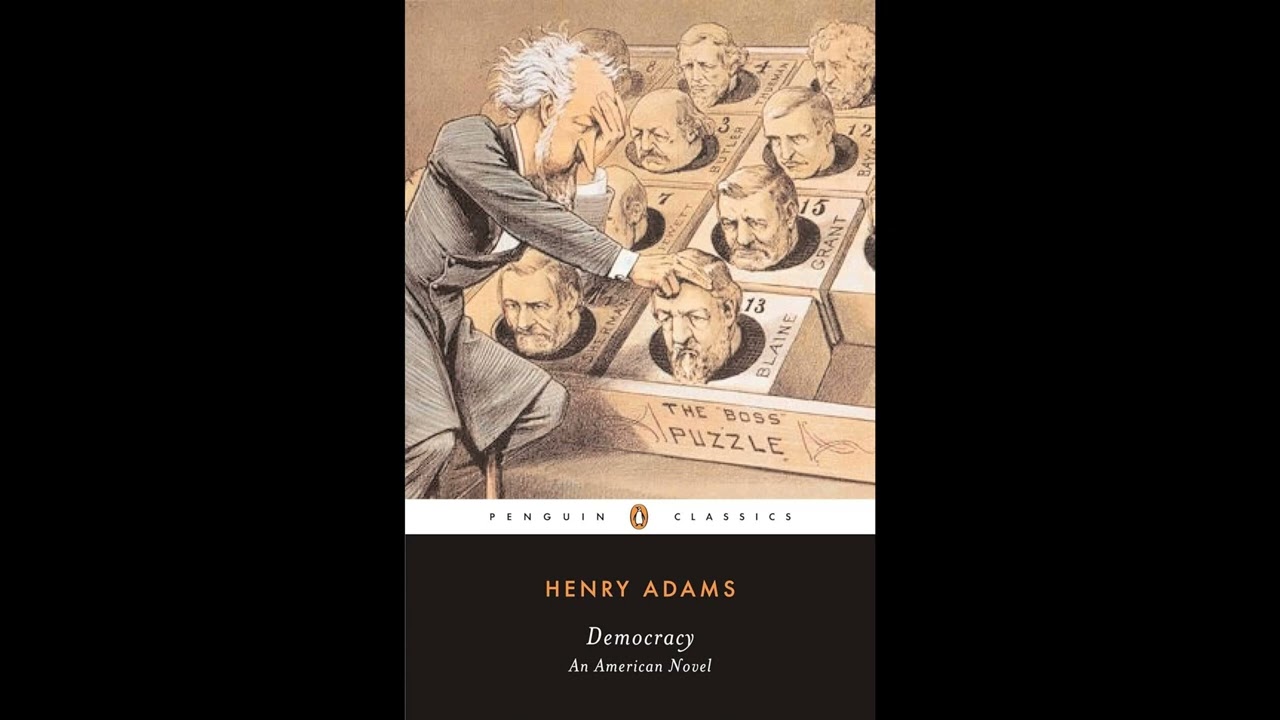
Democracy: An American Novel
What happens when a sharp, idealistic mind attempts to penetrate the often-murky world of American politics? Henry Adams’s Democracy: An American Novel offers a penetrating, often witty, and still strikingly relevant examination of power, principle, and the sometimes-dispiriting realities of governing. Published anonymously in the late nineteenth century, this novel remains a trenchant study of the American experiment, posing questions about integrity and influence that resonate powerfully in any era marked by political turbulence and the clash of ideals against ambition. For anyone who has ever pondered the true nature of leadership or the compromises inherent in public service, this novel offers a compelling and uncannily familiar reflection on the American political soul. The story centers on Madeleine Lee, a wealthy, intelligent, and recently widowed woman from New York. Dissatisfied with the superficiality of high society and driven by a profound desire to understand the mechanics of power, she decides to move to Washington D.C. with her younger sister, Sybil, during a bustling congressional session. Her stated goal is to observe democracy firsthand, to “see the great experiment, whether it was to succeed or fail.” Madeleine’s salon quickly becomes a gathering place for the capital’s elite, attracting politicians, diplomats, and intellectuals. It is here that she encounters Senator Silas Ratcliffe of Illinois, a formidable figure widely considered a political titan and a strong contender for the presidency. Ratcliffe is a man of immense will and practical experience, possessing an unyielding ambition and a mastery of political maneuvering that both fascinates and repels Madeleine. He embodies the pragmatic, often ruthless, side of American politics, a stark contrast to Madeleine’s more theoretical ideals. A central tension develops as Ratcliffe, drawn to Madeleine’s intellect and charm, begins to court her, both personally and politically. Madeleine finds herself increasingly embroiled in the ethical dilemmas of the capital, observing the transactional nature of power, the subtle corruptions, and the often-cynical calculations that drive the legislative process. She must contend with the unsettling realization that the very system she wishes to comprehend and perhaps influence might be built on foundations she finds morally questionable, forcing her to confront the painful gap between her high-minded aspirations and the grimy details of political reality. The novel follows Madeleine’s disillusioning education, charting her internal struggle as she navigates the complexities of the capital and the magnetic, yet troubling, presence of Senator Ratcliffe. The author, Henry Adams, was born into one of America’s most distinguished political families in 1838, a lineage that included two U.S. Presidents: his great-grandfather John Adams and his grandfather John Quincy Adams. This heritage provided him with a unique vantage point from which to observe and critique American society and government. Educated at Harvard and in Germany, Adams began his career as a journalist and later served as a private secretary to his diplomat father, Charles Francis Adams, during the Civil War in London. This experience deeply immersed him in international affairs and the intricacies of diplomacy at a critical historical juncture. Upon his return to the United States, Adams took up a professorship at Harvard, teaching medieval history, and edited the North American Review. However, his most enduring legacy lies in his writing, which spanned history, biography, and autobiography. His monumental nine-volume History of the United States of America during the Administrations of Thomas Jefferson and James Madison is still considered a landmark work of American historiography. After the tragic death of his wife, Marian “Clover” Hooper Adams, in 1885, Adams traveled extensively and devoted himself increasingly to his writing, producing works that reflected a growing skepticism about modern progress and a profound engagement with history and philosophy. His later autobiographical work, The Education of Henry Adams, posthumously awarded the Pulitzer Prize, offers a deeply personal and intellectual account of his efforts to make sense of a rapidly changing world, cementing his place as a seminal figure in American letters and a keen observer of the forces shaping the late nineteenth and early twentieth centuries. Democracy enacts several enduring themes, most notably the tension between idealism and the practical, often compromising, nature of politics. Madeleine Lee arrives in Washington with a firm belief in the potential for good government, an almost philosophical approach to the “great experiment” of American democracy. She imagines a “palace of truth” where statesmanship reigns supreme. Yet, through her interactions, particularly with Senator Ratcliffe, she quickly encounters a different reality. For instance, when Ratcliffe dismisses a rival senator as “a man who votes on conviction, as he calls it; I vote for my party, and my party is the country,” Madeleine is forced to confront the moral ambiguity of such a stance. Her initial hope for pure principles clashing with the senator’s frank discussion of patronage and necessary political deals reveals the core struggle. Another key theme centers on the corrupting influence of power and ambition. Senator Ratcliffe, despite his undeniable talents and charm, is portrayed as a man whose pursuit of power has led him to embrace methods that Madeleine finds ethically troubling. The novel illustrates how personal ambition can override public good, as characters navigate a system rife with backroom deals, favors, and the constant pressure to maintain influence. Madeleine’s quiet observations of these machinations, from the discreet maneuvering for appointments to the open discussion of financial inducements, offer a nuanced look at the moral cost of political success, questioning whether true integrity can survive the Washington crucible. The novel appeared during the Gilded Age, a period in American history roughly spanning the late 1860s to the 1890s, characterized by rapid economic growth, industrial expansion, and an accompanying rise in political corruption and social inequality. The Civil War had just ended, leaving the nation grappling with Reconstruction, while burgeoning industries led to immense wealth for some and widespread poverty for others. Washington D.C., still consolidating its identity as the definitive center of federal power, was a hotbed of patronage, lobbying, and backroom deals, often viewed with cynicism by the wider public. Against this backdrop, American literature began to shift away from the romanticism of earlier eras toward realism, a movement that sought to depict life as it truly was, without idealization. Henry Adams, with his deep understanding of history and his patrician detachment, was perfectly positioned to offer such a critique. His anonymity upon publication was perhaps a reflection of the delicate nature of his social and political commentary, lampooning figures and practices that were recognizable to contemporary insiders. The novel emerged as a direct response to the political climate of the time, channeling Adams’s own disillusionment with the direction of American democracy and its susceptibility to the very human flaws of ambition and venality, presenting a cautionary tale for a nation striving to define its future. Listening to Democracy: An American Novel as an audiobook offers a singular opportunity to immerse oneself in the nuanced world of late nineteenth-century Washington. The performance can truly bring to life the sophisticated and often subtle dialogue, allowing the listener to catch the precise tone of irony or earnestness in each character’s voice. The story, told over several hours, unfolds at a deliberate pace, giving ample room for the listener to absorb Madeleine Lee’s observations and her internal struggles without rushing past the profound questions she confronts. A skilled narrator can make the social gatherings in Madeleine’s salon, the hushed conversations in congressional offices, and the quiet moments of introspection palpable. The subtle political maneuvering and the clash of personalities—the shrewdness of Ratcliffe against the contemplative nature of Madeleine and her companions—gain additional texture when heard, making the atmosphere of the nation’s capital during this pivotal era feel immediate and personal.
Enjoyed Democracy: An American Novel? A few ways to support us
Audible & Amazon links are affiliate; we may earn a small commission at no extra cost.
About this production
Human narration by a volunteer reader from LibriVox.org, the public-domain audiobook project. LibriVox volunteers record literary works whose copyright has expired in the United States, releasing the resulting recordings into the public domain.
Democracy: An American Novel by Henry Adams. The underlying text is in the U.S. public domain. We do not republish any modern copyrighted edition, translation, or commentary.
The 4K cinematic visuals accompanying this audiobook are generated by an AI image model from prompts derived from the source text. No copyrighted photos, paintings, or stock footage are used. AI generation is disclosed on every video on our YouTube channel as required by YouTube's altered/synthetic content policy.
English subtitles are transcribed from the LibriVox recording with OpenAI Whisper. Translations into the 11 other supported languages are produced by Meta's NLLB-200 neural translation model. No human translator's copyrighted translation is used.
Questions about sourcing or rights? See our DMCA & Sourcing policy or contact us.
Enjoyed this audiobook?
If you'd like to own a copy of Democracy: An American Novel or hear a professionally produced edition, the links below help support free audiobook production at no extra cost to you.
As an Amazon Associate we earn from qualifying purchases. Audible / print links are affiliate.