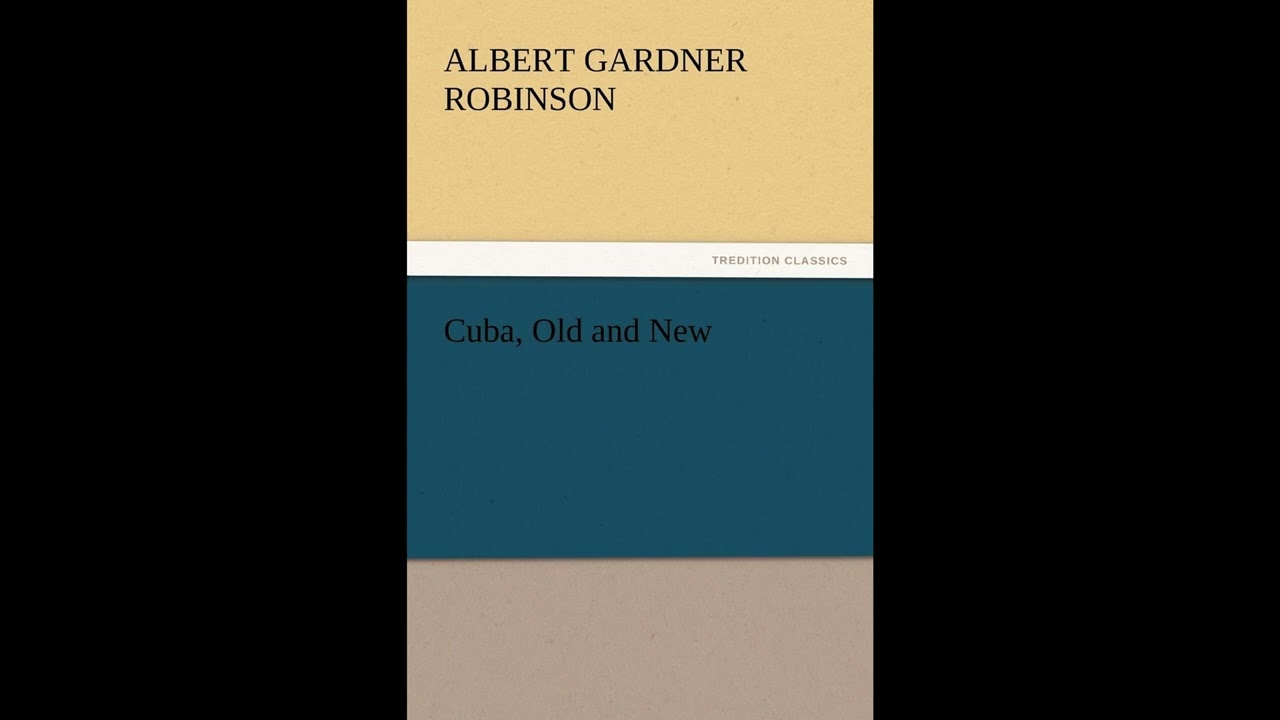
Cuba, Old and New
Step into a fascinating historical account, "Cuba, Old and New," penned by the discerning journalist Albert G. Robinson, and discover an island nation at a pivotal moment in its history. This isn't merely a dry recitation of facts; it is a vivid, opinionated snapshot of Cuba in the early twentieth century, offering a window into a complex society grappling with its past, defining its present, and charting an uncertain future. Why should a modern listener care about a book written over a century ago? Because Robinson’s observations, his concerns about American influence, and his analysis of Cuba's struggle for true sovereignty resonate with persistent global questions about nation-building, post-colonial identity, and the delicate balance of international relations. Listening today provides not only a detailed historical record but also a valuable framework for understanding the enduring legacies that shape Cuba even now. Robinson’s comprehensive study opens by establishing the deep historical roots of Cuba, tracing its foundational struggles under Spanish colonial rule through centuries of conflict and cultural formation. He meticulously sets the stage, painting a picture of an island defined by its unique blend of indigenous heritage, European overlay, and the indelible marks of the transatlantic slave trade. The narrative then shifts its focus to the immediate aftermath of the Spanish-American War, examining how Cuba, ostensibly liberated, wrestled with the realities of burgeoning American influence and the challenges of self-governance. Robinson introduces the listener to the various social strata of Cuba at the time – the planter class, the urban professionals, the rural laborers – each with their own perspectives on the island's trajectory. The central progression of the book, rather than a fictional plot, is Robinson’s detailed analysis of the inherent conflicts and opportunities facing Cuba. He details the economic landscape, particularly the dominance of the sugar industry and its susceptibility to external markets, alongside nascent attempts at diversifying the economy. He scrutinizes the political machinations of the fledgling Cuban republic, highlighting instances of corruption, inefficiency, and the often heavy-handed guidance from Washington. Robinson’s examination extends to the daily lives of Cubans, their customs, education, and public health initiatives, presenting a full spectrum of an island in flux. He systematically builds an argument about the delicate balance between Cuban autonomy and foreign intervention, questioning whether the "new" Cuba truly belonged to its people or was simply exchanging one master for another, albeit a more beneficent one. Albert Gardner Robinson, born in 1859, carved out a distinguished career as an American journalist and foreign correspondent during an era of significant global change. His work often placed him at the forefront of international events, reporting from various corners of the world for prominent American newspapers. Before authoring "Cuba, Old and New," Robinson distinguished himself with publications like "The Philippines: The War and the People" (1901), which stemmed from his direct observations during the Philippine-American War, and "Letters of a Returned Volunteer" (1902), offering a more personal perspective on military service abroad. He wasn't simply a reporter; he was an analyst, keen to dissect the broader geopolitical implications of the events he witnessed. Robinson's journalistic background informed his literary approach, favoring direct observation, detailed reporting, and a clear, persuasive writing style. He wasn't associated with a specific literary movement in the fictional sense, but rather belongs to a tradition of engaged, public-minded intellectuals who used non-fiction prose to shape public opinion and inform policy during the Progressive Era. His body of work places him within the canon of early twentieth-century American non-fiction authors who grappled with the nation's expanding international role and the complexities of its newfound global responsibilities. He passed away in 1937, leaving behind a legacy of insightful commentary on American foreign policy and the nations it touched. "Cuba, Old and New" enacts several significant themes. One primary theme is the struggle for national sovereignty in a post-colonial world. Robinson repeatedly draws attention to the paradox of Cuban independence, where the departure of Spain led not to absolute self-rule, but to a new form of tutelage under the United States via the Platt Amendment. He illustrates this by detailing the American economic interests that swiftly moved into Cuba following the war, demonstrating how economic ties could exert a powerful, sometimes overwhelming, influence over political decisions. Another theme Robinson masterfully handles is the tension between tradition and modernity. He describes the quaint, time-honored customs of Cuban life alongside the rapid imposition of American infrastructure and business practices, showing how these forces clashed and mingled in the streets of Havana and the plantations of the interior. For example, he presents scenes of traditional Cuban markets operating just blocks from new American-built factories, highlighting the abrupt changes Cuba was undergoing. A third prominent theme is the debate over interventionism versus self-determination. Robinson often grapples with the question of whether American intervention, however well-intentioned, ultimately benefited or hindered Cuba’s long-term development. He provides examples of American administrative efficiency in public works and sanitation, juxtaposing these successes with the resentment and calls for greater autonomy from Cuban citizens who felt their destiny was being dictated externally. This theme is particularly potent when he discusses the various American military occupations and the conditions under which they occurred. When "Cuba, Old and New" was published in 1915, the world stood on the precipice of global conflict, but the immediate context for Cuba was its ongoing, complicated relationship with the United States. The Spanish-American War, which had ended just 17 years prior, had irrevocably altered the geopolitical landscape of the Caribbean, thrusting Cuba into the American sphere of influence. This period, roughly from the turn of the century to World War I, was characterized by significant American expansionism, often justified by notions of "manifest destiny" and the perceived need to stabilize or civilize "lesser" nations. It was a time of immense cultural and political debate in the U.S. about the responsibilities and ethics of its growing international power. Robinson’s book emerged directly from this zeitgeist, contributing to a broader public discourse about the wisdom and consequences of American foreign policy in the nascent stages of its global ascendancy. It provided an informed, if sometimes biased, perspective from someone who had witnessed these transformations firsthand. Listening to "Cuba, Old and New" as an audiobook offers a unique way to engage with Robinson's detailed observations and opinions. The several hours of narration allow the listener to absorb the intricate layers of Cuban history and society at a comfortable pace, as if a well-traveled correspondent were sharing his insights directly. Pay attention to the narrator’s voice as it shifts between factual reporting and Robinson’s more editorialized commentary, bringing the author’s distinct perspective to the forefront. The flow of information, moving from deep historical context to contemporary analysis, creates a compelling sense of unfolding understanding. This auditory experience invites a sustained reflection on the complexities of nation-building, the legacies of colonialism, and the often-unseen hands that guide a country’s fate.
Enjoyed Cuba, Old and New? A few ways to support us
Audible & Amazon links are affiliate; we may earn a small commission at no extra cost.
About this production
Human narration by a volunteer reader from LibriVox.org, the public-domain audiobook project. LibriVox volunteers record literary works whose copyright has expired in the United States, releasing the resulting recordings into the public domain.
Cuba, Old and New by Albert G Robinson. The underlying text is in the U.S. public domain. We do not republish any modern copyrighted edition, translation, or commentary.
The 4K cinematic visuals accompanying this audiobook are generated by an AI image model from prompts derived from the source text. No copyrighted photos, paintings, or stock footage are used. AI generation is disclosed on every video on our YouTube channel as required by YouTube's altered/synthetic content policy.
English subtitles are transcribed from the LibriVox recording with OpenAI Whisper. Translations into the 11 other supported languages are produced by Meta's NLLB-200 neural translation model. No human translator's copyrighted translation is used.
Questions about sourcing or rights? See our DMCA & Sourcing policy or contact us.
Enjoyed this audiobook?
If you'd like to own a copy of Cuba, Old and New or hear a professionally produced edition, the links below help support free audiobook production at no extra cost to you.
As an Amazon Associate we earn from qualifying purchases. Audible / print links are affiliate.