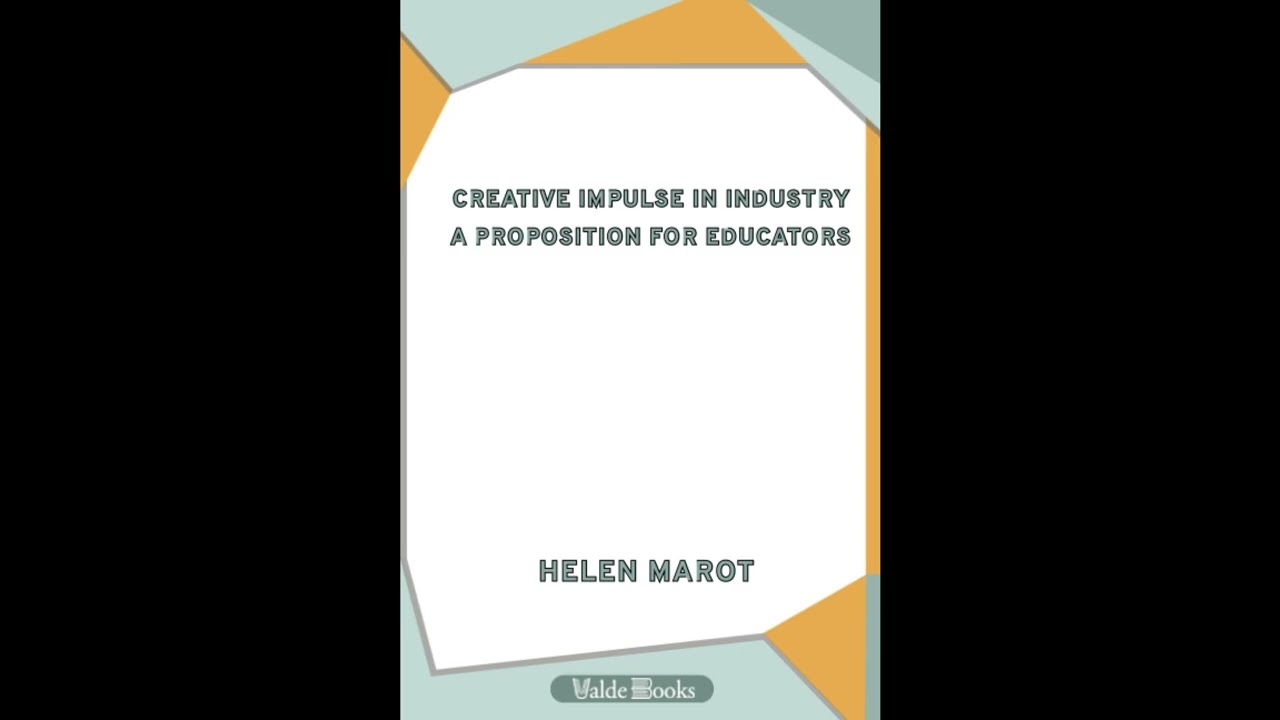
Creative Impulse in Industry: A Proposition for Educators
In an age where the relentless march of automation and artificial intelligence increasingly redefine the nature of work, the fundamental question of human creativity within industrial and educational systems feels more urgent than ever. Helen Marot’s profoundly prescient "Creative Impulse in Industry: A Proposition for Educators," a seminal text from the early twentieth century, emerges not merely as a historical document but as a clarion call, resonating powerfully with contemporary anxieties and aspirations. This groundbreaking work challenges us to reconsider how our educational philosophies shape not only individual potential but also the very fabric of our working lives, arguing that fostering an inherent human drive for innovation and self-expression is paramount—a concept that holds startling relevance for today’s educators, policymakers, and indeed, anyone concerned with the future of human ingenuity. Marot’s compelling argument unfolds against the backdrop of an industrialized America, a period characterized by the rise of scientific management and the seemingly inexorable specialization of labor. She establishes a compelling setting: the vast, often dehumanizing landscape of the modern factory and the seemingly detached world of traditional schooling. The book’s central figures are not fictional characters but rather the individual worker whose spirit risks being crushed by repetitive tasks, and the educator whose methods, Marot suggests, often inadvertently perpetuate this system. Her primary concern is the palpable disconnect between the natural human desire to create, to innovate, and to find meaning in one’s labor, and the prevailing industrial structures that often prioritize efficiency above all else, thereby stifling this "creative impulse." The arc of Marot’s proposition begins with a trenchant diagnosis of this problem. She delineates how the standardized, often rigid educational models of her time, focused heavily on rote memorization and conformity, inadequately prepare students for anything beyond a subservient role in a mechanistic industrial world. She suggests that these methods, far from cultivating independent thought or problem-solving skills, instead condition individuals to accept passive participation rather than active engagement. The central conflict, therefore, lies in the collision between a humanistic vision of work as an avenue for personal growth and societal contribution, and an economic model that reduces labor to a mere commodity. Marot’s solution involves a radical re-imagining of education, positioning it as the vital conduit through which the innate drive to create can be nurtured and ultimately applied to all forms of industry, transforming monotonous tasks into opportunities for intellectual and artistic engagement. She proposes a shift in pedagogical focus, moving from passive reception to active, experimental learning, aiming to cultivate a generation capable of bringing ingenuity and personal investment to even the most seemingly mundane tasks. Helen Marot (1865-1940) was a prominent American librarian, labor activist, and writer, whose life and work were deeply entwined with the Progressive Era’s commitment to social and economic reform. Born in Philadelphia, she began her professional life at the Library of Congress and later became an influential voice in the burgeoning labor movement, particularly advocating for women workers. Her engagement with social issues led her to become a leading figure in the Women's Trade Union League, where she championed better working conditions, fair wages, and the empowerment of female laborers. Marot was also a co-founder of the New York branch of the National Women's Party, demonstrating her dedication to broader women’s rights. Beyond "Creative Impulse in Industry," Marot authored "American Labor Unions" (1914), a foundational text offering a comprehensive overview of the labor movement’s structure and goals during a pivotal period. Her intellectual curiosity and reformist spirit also led her to be associated with the Greenwich Village bohemian scene and the radical literary magazine The Masses. Her writings consistently placed her within the intellectual currents of her time that sought to humanize industrial capitalism and democratize opportunity. She stands as a significant, though sometimes overlooked, figure in the history of American social thought, her contributions forming an important part of the Progressive movement’s broader intellectual canon. "Creative Impulse in Industry" enacts several core themes with thoughtful precision. Foremost among them is the tension between creativity and mechanization. Marot vividly illustrates this by contrasting the satisfaction of a traditional artisan, who conceives, designs, and executes their work from start to finish, with the factory worker whose role is often limited to a single, repetitive motion on an assembly line. She argues that this fragmentation of labor not only diminishes the quality of the product but, more critically, strips the worker of their intrinsic motivation and sense of accomplishment. Another central theme is the redefined purpose of education. Marot pushes beyond the then-dominant vocational or purely academic models, asserting that education's true role is to cultivate inherent human potential—not just to impart facts or specific skills, but to foster critical thinking, problem-solving, and a deeply felt sense of agency. She might, for instance, describe an educational scenario where students learn by doing, by designing and building, rather than passively absorbing information, thereby preparing them to inject innovation into any field they enter. A third significant theme woven throughout the text is labor reform and worker dignity. Marot connects the suppression of creative impulse directly to the degradation of labor. She implicitly argues that a system which fails to value the intellectual and creative contributions of its workers is inherently flawed, leading to disengagement, discontent, and ultimately, lower productivity and societal well-being. By proposing that educators cultivate creativity, she is simultaneously advocating for a more humane and dignifying industrial environment. Finally, the book speaks to the broader concept of social engineering and progressivism, embodying the era's belief that societal ills could be systematically addressed through thoughtful reform. Marot’s proposition for educators is not just about individual growth; it’s a blueprint for building a more equitable and productive society by changing the fundamental relationship between human beings, their work, and the learning institutions that prepare them for it. This seminal work emerged during a truly transformative period in American history—the early years of the twentieth century, widely known as the Progressive Era. Culturally, the nation was grappling with the profound changes wrought by rapid industrialization, urbanization, and mass immigration. Politically, there was a growing awareness of social inequality, corporate power, and the need for government intervention to protect public welfare, as evidenced by muckraking journalism and the rise of figures like Theodore Roosevelt. In the literary world, authors were increasingly turning their attention to social realism and the harsh realities of industrial life. The philosophy of scientific management, epitomized by Frederick Winslow Taylor, was gaining traction in factories, promising unprecedented efficiency but often at the cost of worker autonomy. "Creative Impulse in Industry" was a direct intellectual response to these powerful forces. Marot’s proposition arose from the widespread concern among reformers that while industrial progress was undeniable, it often came at a human cost. The emergence of compulsory public education also spurred debates about its true purpose: was it to create compliant factory workers, or engaged citizens? Marot's book speaks to this crucial crossroads, advocating for a vision that prioritized human flourishing and creativity over sheer industrial output, placing her firmly within the intellectual and reformist currents that sought to humanize a rapidly modernizing world. Listening to "Creative Impulse in Industry: A Proposition for Educators" as an audiobook offers a unique opportunity to absorb Helen Marot’s detailed arguments at a thoughtful, considered pace. With a run length of several hours, it provides ample time for her ideas to unfurl, allowing listeners to reflect on the nuances of her historical context and her forward-thinking proposals without the interruptions of visual text. A well-modulated narration, attentive to the gravity and intellectual rigor of Marot’s prose, will bring her propositions to life, allowing the listener to truly engage with her voice and her impassioned advocacy. You will find yourself listening for the careful construction of her arguments, the clarity of her examples, and the underlying conviction in her belief that education holds the key to unlocking human potential within the industrial sphere, making for an experience that is both intellectually stimulating and deeply reflective.
Enjoyed Creative Impulse in Industry: A Proposition for Educators? A few ways to support us
Audible & Amazon links are affiliate; we may earn a small commission at no extra cost.
About this production
Human narration by a volunteer reader from LibriVox.org, the public-domain audiobook project. LibriVox volunteers record literary works whose copyright has expired in the United States, releasing the resulting recordings into the public domain.
Creative Impulse in Industry: A Proposition for Educators by Helen Marot. The underlying text is in the U.S. public domain. We do not republish any modern copyrighted edition, translation, or commentary.
The 4K cinematic visuals accompanying this audiobook are generated by an AI image model from prompts derived from the source text. No copyrighted photos, paintings, or stock footage are used. AI generation is disclosed on every video on our YouTube channel as required by YouTube's altered/synthetic content policy.
English subtitles are transcribed from the LibriVox recording with OpenAI Whisper. Translations into the 11 other supported languages are produced by Meta's NLLB-200 neural translation model. No human translator's copyrighted translation is used.
Questions about sourcing or rights? See our DMCA & Sourcing policy or contact us.
View 10 famous quotes from this book →
Enjoyed this audiobook?
If you'd like to own a copy of Creative Impulse in Industry: A Proposition for Educators or hear a professionally produced edition, the links below help support free audiobook production at no extra cost to you.
As an Amazon Associate we earn from qualifying purchases. Audible / print links are affiliate.