Increasing Human Efficiency in Business
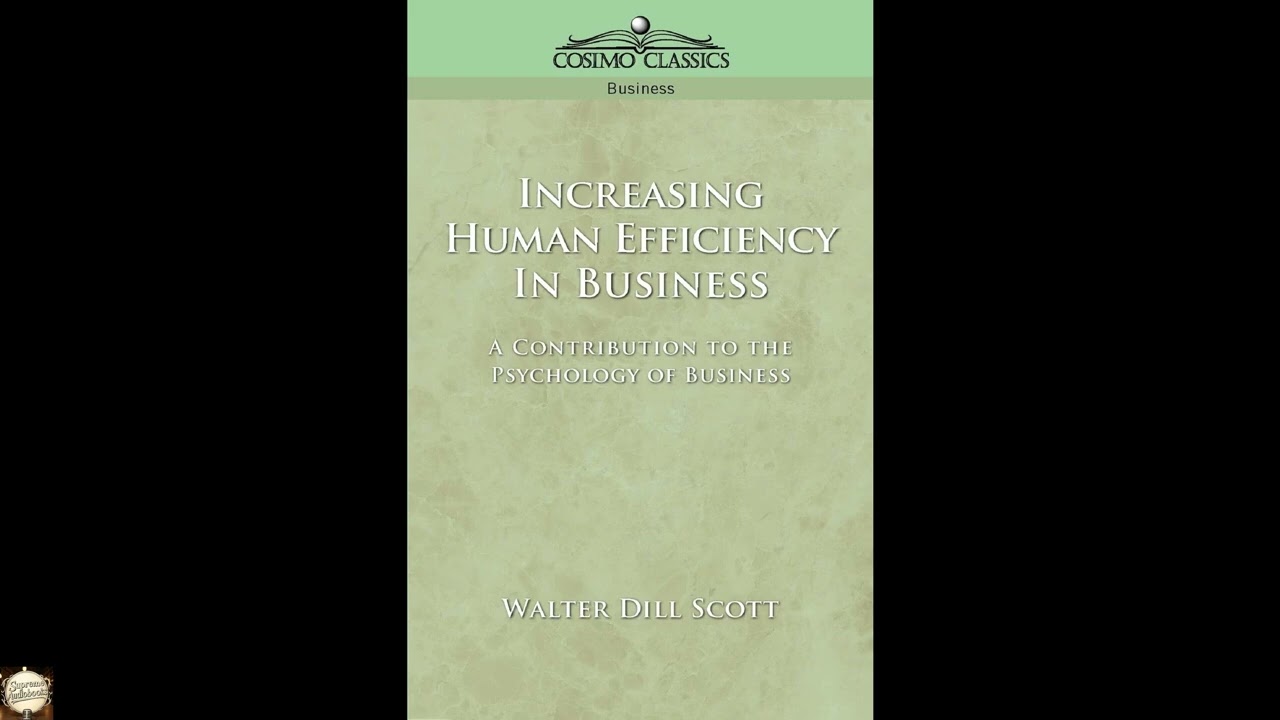
Walter Dill Scott’s Increasing Human Efficiency in Business, first published in 1911, stands as a foundational text in the realm where psychology meets commerce. Far from a dusty relic, this pioneering book offers a startlingly relevant investigation into the very nature of human productivity and motivation within the professional world. At a time when businesses of all sizes grapple with optimizing performance, fostering engagement, and understanding the subtle psychological currents that shape individual output, Scott’s arguments resonate with surprising clarity. He asks a question that remains central to modern management: how can we best align human capabilities with organizational goals, not through coercion, but through a scientific understanding of the mind? This seminal work presents an early, insightful answer, challenging listeners to reconsider the fundamental drivers behind efficiency and achievement, whether in a sprawling factory of the past or today’s fast-paced digital office. Instead of a traditional narrative, Increasing Human Efficiency in Business unfolds as a systematic, almost forensic examination of the human element within the industrial and commercial landscape of its era. Scott begins by setting the scene: a world increasingly driven by industrial production and the relentless pursuit of economic growth, yet often failing to account for the most complex variable—the worker. The central conflict, then, isn't between characters, but between the potential for human accomplishment and the systemic inefficiencies that stifle it. Scott posits that the human mind, with its inherent capacities and limitations, is the key battleground. He introduces the reader to the concepts of "attention" and "habit," presenting them not merely as abstract psychological constructs, but as tangible forces that can be harnessed or squandered in the workplace. The arc of Scott's argument progresses logically, moving from individual psychological principles to their collective application. He dedicates significant attention to the power of "suggestion," arguing that indirect influence, through environment and communication, can subtly shape employee behavior and morale. He then weighs the impact of "imitation" and "competition," illustrating how individuals are often motivated by the actions and achievements of their peers, sometimes unconsciously. Throughout these early chapters, Scott builds a case for a more enlightened approach to managing people, suggesting that the purely mechanistic views of labor were profoundly short-sighted. He paints a picture of the human worker not as a cog, but as a complex psychological entity deserving of scientific understanding. Scott then turns his focus to more direct motivators, analyzing the roles of "wages" and "pleasure" in driving efficiency. He dissects various compensation structures, comparing their psychological impacts and practical outcomes, questioning what truly incentivizes consistent, high-quality work. He also considers the often-overlooked psychological cost of monotony and fatigue, suggesting that even seemingly minor adjustments to work design can have profound effects on an individual’s sustained output and satisfaction. While he proposes specific methods for improvement, Scott maintains a spirit of empirical inquiry, continually advocating for observation and scientific method over arbitrary rules, leaving the listener with a renewed perspective on the intricate balance between human nature and economic endeavor. Walter Dill Scott, born in 1869 in Cooksville, Illinois, emerged as a seminal figure in the nascent field of applied psychology. His early intellectual curiosity led him to study in Germany, a hotbed of psychological thought at the time, where he trained under the renowned Wilhelm Wundt—often credited with establishing the first psychology laboratory. This rigorous academic foundation provided Scott with the tools and perspective to apply scientific principles of the mind to real-world problems. Upon his return to the United States, Scott took up a position at Northwestern University, a place that would become his professional home for decades. It was there that he began to synthesize his understanding of human psychology with the burgeoning demands of the American commercial landscape. Scott's career was marked by a pioneering spirit. He quickly recognized the potential for psychological insights to revolutionize areas like advertising and business management, publishing The Theory of Advertising in 1903, followed by The Psychology of Advertising in 1908. These works, which preceded Increasing Human Efficiency in Business, laid much of the groundwork for what would become known as industrial and organizational psychology. During World War I, his expertise gained national significance when he was instrumental in developing personnel selection methods for the United States Army, creating tests like the Army Alpha and Beta that were designed to efficiently assess the cognitive abilities of recruits. This practical application of psychological science on a vast scale further cemented his reputation as a pragmatic innovator. Eventually, Walter Dill Scott's leadership abilities were recognized beyond the lecture hall; he served as president of Northwestern University from 1920 to 1939. His influence extends far beyond his institutional roles, however. Scott is widely regarded as one of the founders of industrial-organizational psychology, contributing significantly to the understanding of how psychological principles could be leveraged to improve human performance and satisfaction in occupational settings. His writings represent a critical early phase in the scientific approach to business and management, placing the human mind, rather than just machinery or capital, at the center of organizational success. He passed away in 1955, leaving a legacy that continues to shape contemporary thought on human behavior in the workplace. Central to Scott’s arguments is the overriding theme of applying psychology to practical affairs. He consistently demonstrates how abstract psychological principles like attention, memory, and habit directly influence daily work performance. For example, he illustrates how a worker’s ability to focus—or lack thereof—can be cultivated and managed to reduce errors and increase output. This isn't merely theoretical; Scott offers concrete suggestions, such as designing workspaces to minimize distractions or structuring tasks to encourage automatic, efficient behaviors, showing a clear pathway from psychological understanding to tangible business improvements. His analysis of advertising in earlier works similarly underscores this practical bent, seeking to understand the human mind not for its own sake, but for its utility in commerce. Another prominent theme is the scientific approach to human efficiency. Scott’s work belongs to an era that embraced scientific methods to dissect and optimize every aspect of life, from engineering to social welfare. He approaches the human worker not as an unpredictable variable, but as a subject amenable to scientific study and improvement. When discussing wages, for instance, he doesn't simply advocate for higher pay; he meticulously breaks down various compensation schemes, examining their psychological effects on motivation and sustained effort. He might present how a bonus system tied to individual output compares to a team-based incentive, considering the subtle psychological pressures and rewards each method creates. Furthermore, the book consistently underscores the importance of motivation itself, analyzing how external factors like competition and internal drives like the desire for pleasure or recognition can be leveraged, or mismanaged, in the pursuit of greater productivity. When Walter Dill Scott’s Increasing Human Efficiency in Business appeared in 1911, the Western world was undergoing profound transformations. The Second Industrial Revolution had solidified the factory system and the rise of large-scale corporations, creating unprecedented demands for efficient production and organized labor. At the same time, the Progressive Era in the United States fostered a widespread belief in the power of science and rational management to solve social and economic problems. This was the environment that gave birth to "scientific management," championed by figures like Frederick Winslow Taylor, who meticulously timed and optimized physical labor tasks. Scott's work emerged as a parallel, yet distinct, response to this quest for efficiency, shifting the focus from the purely mechanical aspects of work to the psychological dimensions of the worker. The book also reflects the growing maturity of psychology as an academic discipline. While still relatively young, psychology was moving beyond philosophical speculation and into empirical research, seeking practical applications for its findings. Scott, with his training under Wundt, was perfectly positioned to bridge this gap between abstract theory and commercial utility. Businesses, facing increased competition and the complexities of managing larger workforces, were eager for any advantage. Increasing Human Efficiency in Business offered a fresh perspective, suggesting that understanding the human mind—its biases, motivations, and limitations—was just as crucial, if not more so, than optimizing machinery or raw materials. It was a recognition that human capital, properly understood and managed, held the key to future success. To experience Increasing Human Efficiency in Business in audiobook format is to engage directly with Scott’s original arguments, allowing his thoughtful explanations to unfold at a comfortable pace. The spoken word brings a particular clarity to what might otherwise be dense theoretical discussions, transforming them into a direct conversation with a pioneering thinker. Listeners will appreciate a narrator whose steady, articulate voice can convey the measured authority of Scott’s insights, making complex psychological concepts easily digestible. The "several hours" run length is perfectly suited for absorbing these foundational ideas without feeling rushed, making it ideal for commutes, focused study sessions, or quiet contemplation. As the narrator distinguishes between Scott’s observations on attention, habit, or the nuances of motivation, the atmosphere becomes one of quiet instruction and revelation, offering not just a historical document, but a set of enduring principles that resonate with contemporary challenges in productivity and human resources.
Enjoyed Increasing Human Efficiency in Business? A few ways to support us
Audible & Amazon links are affiliate; we may earn a small commission at no extra cost.
About this production
Human narration by a volunteer reader from LibriVox.org, the public-domain audiobook project. LibriVox volunteers record literary works whose copyright has expired in the United States, releasing the resulting recordings into the public domain.
Increasing Human Efficiency in Business by Walter Dill Scott. The underlying text is in the U.S. public domain. We do not republish any modern copyrighted edition, translation, or commentary.
The 4K cinematic visuals accompanying this audiobook are generated by an AI image model from prompts derived from the source text. No copyrighted photos, paintings, or stock footage are used. AI generation is disclosed on every video on our YouTube channel as required by YouTube's altered/synthetic content policy.
English subtitles are transcribed from the LibriVox recording with OpenAI Whisper. Translations into the 11 other supported languages are produced by Meta's NLLB-200 neural translation model. No human translator's copyrighted translation is used.
Questions about sourcing or rights? See our DMCA & Sourcing policy or contact us.
View 10 famous quotes from this book →
Enjoyed this audiobook?
If you'd like to own a copy of Increasing Human Efficiency in Business or hear a professionally produced edition, the links below help support free audiobook production at no extra cost to you.
As an Amazon Associate we earn from qualifying purchases. Audible / print links are affiliate.