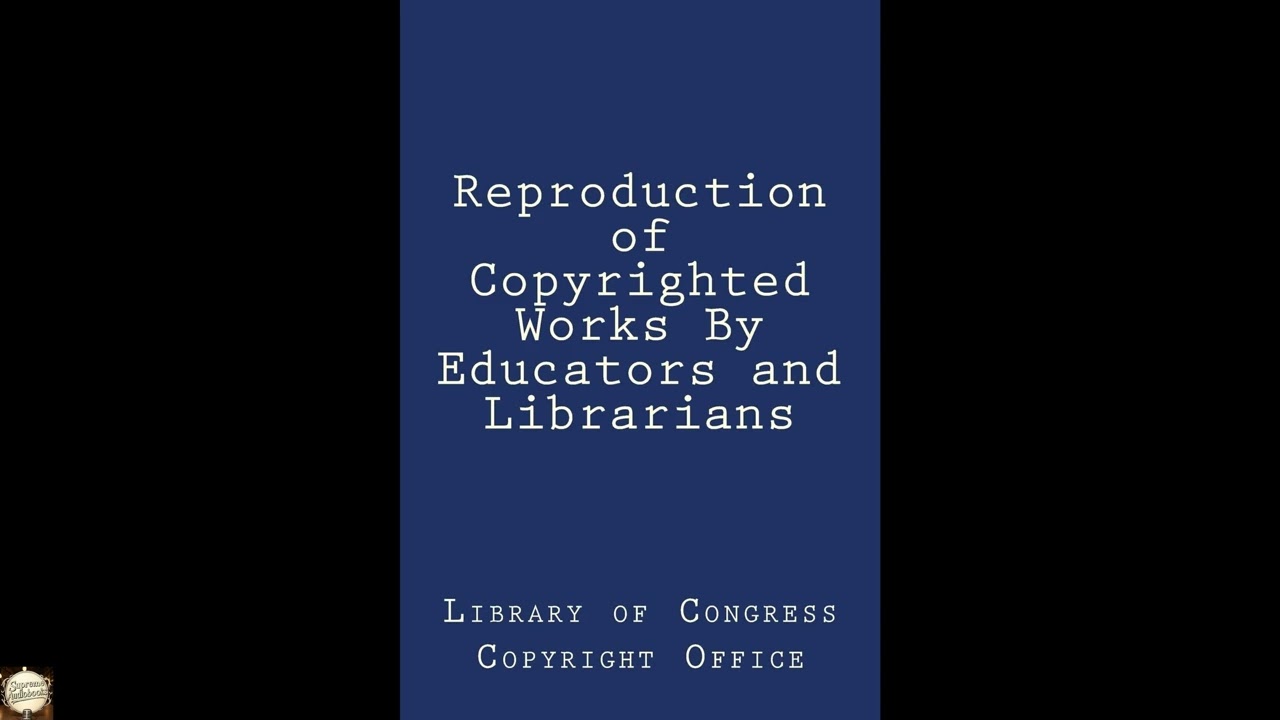
Reproduction of Copyrighted Works By Educators and Librarians
In an age where information flows at an unprecedented pace, where knowledge is both freely shared and fiercely protected, the precise guidelines governing its lawful reproduction become not merely a bureaucratic detail, but a foundational pillar of our educational and cultural institutions. This unique and quietly profound work, Reproduction of Copyrighted Works By Educators and Librarians, stands as a vital touchstone in this ongoing discourse. Far from a dry legal manual, it acts as a canonical statement, a classic exposition of the principles that underpin intellectual property rights and the public's right to access knowledge. Why should anyone engage with such a text today? Because the fundamental questions it addresses – how we foster learning, how we preserve our collective memory, how we empower educators and librarians without diminishing the rights of creators – remain as pressing, if not more so, in our digital era than ever before. This is a text that frames the very architecture of shared learning, a crucial blueprint for navigating the complexities of creation and dissemination. The "story" within these pages unfolds not with characters in a conventional sense, but with the interplay of powerful concepts and the societal roles they define. The setting is the vast, often contested, landscape where creativity meets utility—the classrooms, the research desks, the library stacks, and the burgeoning digital repositories that characterize modern learning. Our "main characters" are the dedicated educator, striving to enlighten students with a breadth of materials; the meticulous librarian, tasked with stewarding vast collections and ensuring equitable access; and, implicitly, the copyright holder, whose creative efforts merit protection and remuneration. The central conflict arises from the inherent tension between these entities: how does one facilitate the vital work of education and scholarship—which often requires making copies, sharing excerpts, and preserving materials—while simultaneously upholding the legitimate economic and moral rights of authors, artists, and publishers? The arc of this "narrative" progresses by systematically dissecting this complex problem. It begins by establishing the bedrock principles of copyright law itself, setting the stage for understanding the rights granted to creators. From there, the exposition carefully moves to delineate the exceptions and limitations crafted specifically to accommodate the unique circumstances of educational and library activities. Listeners will follow the logical progression from broad definitions to specific examples, illustrating permissible uses versus those that infringe upon copyright. The text acts as a patient guide, clarifying when a teacher may duplicate materials for classroom use, or when a librarian may make copies for interlibrary loan or preservation purposes. It lays out the carefully constructed frameworks designed to allow the free flow of information essential for learning and research, all while respecting the legal and ethical boundaries that sustain creative industries. The "plot" culminates not in a single resolution, but in a robust framework of understanding, offering clarity for situations that once seemed ambiguous, illuminating the pathways through a labyrinth of legalities without giving away the specific, granular details that make up the day-to-day application. The authorship of this foundational work is attributed to the Library of Congress, an entity whose very existence is intertwined with the history of the United States. Founded in 1800, it initially served as a reference library for Congress itself, growing through the years to become the national library of the United States and the world's largest library. Its "biography" is a story of national ambition and intellectual stewardship. In 1870, Congress enacted a law requiring that all copyrighted works be registered with the Library of Congress, solidifying its role as the nation's repository for intellectual property and culture. This mandate transformed it into the unofficial chronicler of American creativity and thought. Beyond its vast collections—numbering over 170 million items, including books, recordings, photographs, maps, and manuscripts—the Library of Congress is also deeply involved in the administration of copyright law. The U.S. Copyright Office, a department within the Library, is responsible for registering copyright claims and advising Congress on matters of intellectual property. This institutional "author" thus brings an unparalleled authority and impartiality to the subject, drawing on centuries of legal precedent, legislative intent, and practical experience in managing the nation's creative output. This document is not merely the opinion of one legal scholar, but rather a distillation of the collective wisdom and legislative efforts nurtured within an institution dedicated to both the preservation of knowledge and the protection of its origins. Its significance stems from its role as an official interpretation and practical guide, emanating from the heart of American intellectual property administration. Several key themes emerge with striking clarity from this often-overlooked yet profoundly relevant work. Foremost among them is the delicate balance between intellectual property rights and the public good. The text doesn't argue for one over the other but meticulously illustrates how legislation attempts to harmonize these seemingly competing interests. For instance, when it discusses the conditions under which a teacher may make multiple copies of an article for a class, it highlights the careful calibration required—considering factors like brevity, spontaneity, and cumulative effect—to ensure that educational needs are met without unduly encroaching on the creator's market. Another core theme is the enabling power of clear legal interpretation. The work serves as a practical demonstration of how abstract legal statutes are translated into actionable guidelines for real-world scenarios. Consider the detailed explanations for librarians seeking to preserve deteriorating materials; the guidance provides a framework that empowers them to protect our shared cultural heritage, knowing they operate within legal bounds, ensuring future access to materials that might otherwise be lost forever. A third significant theme is the evolving nature of information access and its legal frameworks. While the underlying principles of copyright remain constant, their application shifts with technological advancements. The text implicitly acknowledges the historical challenges posed by the advent of photocopying and, by extension, anticipates the complexities introduced by digitization and online dissemination. It subtly illustrates how the law strives to adapt, offering a durable framework for addressing new technologies. Finally, the work underscores the theme of professional ethics and responsibility. It places a clear onus on educators and librarians to understand and adhere to the guidelines, presenting them not just as legal mandates but as professional standards essential for upholding integrity within their fields. This is evident in the distinction between occasional, limited use for instruction versus systematic reproduction that would require licensing, fostering a culture of informed decision-making. The historical context for a document addressing such complex issues is as broad as the history of intellectual property itself, but its particular emphasis here signals a critical juncture in the late twentieth century. With the widespread adoption of photocopying machines in schools and libraries from the 1960s onward, the act of making copies became simple, cheap, and ubiquitous. This technological leap brought with it unprecedented convenience for educators and researchers, but also created immense confusion and friction regarding what constituted fair use and what constituted infringement. Publishers and authors grew increasingly concerned about potential losses in revenue, while educators and librarians championed the need for flexible access to materials to support learning and scholarship. This burgeoning tension led to significant revisions in copyright law, notably the Copyright Act of 1976 in the United States, which sought to clarify and codify the rights and limitations concerning reproduction. This document, or the principles it distills, emerged directly from that period of legislative re-evaluation and public debate, acting as a crucial interpretive guide to the new legal landscape. It was born out of a societal need to bridge the gap between rapidly advancing copying technologies and the traditional protections afforded to creators, offering practical applications of the newly formalized "fair use" doctrine specifically for the academic and library communities. It represents a monumental effort to provide clarity and prevent endless litigation, fostering an environment where both creativity and education could flourish in equilibrium. To encounter Reproduction of Copyrighted Works By Educators and Librarians as an audiobook offers a surprisingly engaging and profoundly useful experience. The narration transforms what could be dense, technical prose into an accessible and easily digestible stream of information. With a run length of several hours, this allows for a deep, unhurried absorption of critical legal details, making it perfect for focused listening during a commute, while performing tasks, or as a dedicated study aid. A skilled narrator brings precision and a measured pace to the articulation of specific sections, ensuring that the listener grasps the nuances of legal distinctions and the careful wording of exceptions. There's no "dialogue" in the traditional sense, but the voice artist’s clear articulation and thoughtful phrasing create an atmosphere of careful instruction, a professional tone that enhances comprehension. Listen for the subtle vocal shifts that emphasize key phrases and conditions—these guide the ear through the often-complex labyrinth of legal language, making the underlying logic of the argument beautifully clear. It’s an auditory guide to essential principles, allowing for sustained engagement with a topic of enduring professional and societal importance.
Enjoyed Reproduction of Copyrighted Works By Educators and Librarians? A few ways to support us
Audible & Amazon links are affiliate; we may earn a small commission at no extra cost.
About this production
Human narration by a volunteer reader from LibriVox.org, the public-domain audiobook project. LibriVox volunteers record literary works whose copyright has expired in the United States, releasing the resulting recordings into the public domain.
Reproduction of Copyrighted Works By Educators and Librarians by Library of Congres. The underlying text is in the U.S. public domain. We do not republish any modern copyrighted edition, translation, or commentary.
The 4K cinematic visuals accompanying this audiobook are generated by an AI image model from prompts derived from the source text. No copyrighted photos, paintings, or stock footage are used. AI generation is disclosed on every video on our YouTube channel as required by YouTube's altered/synthetic content policy.
English subtitles are transcribed from the LibriVox recording with OpenAI Whisper. Translations into the 11 other supported languages are produced by Meta's NLLB-200 neural translation model. No human translator's copyrighted translation is used.
Questions about sourcing or rights? See our DMCA & Sourcing policy or contact us.
View 10 famous quotes from this book →
Enjoyed this audiobook?
If you'd like to own a copy of Reproduction of Copyrighted Works By Educators and Librarians or hear a professionally produced edition, the links below help support free audiobook production at no extra cost to you.
As an Amazon Associate we earn from qualifying purchases. Audible / print links are affiliate.