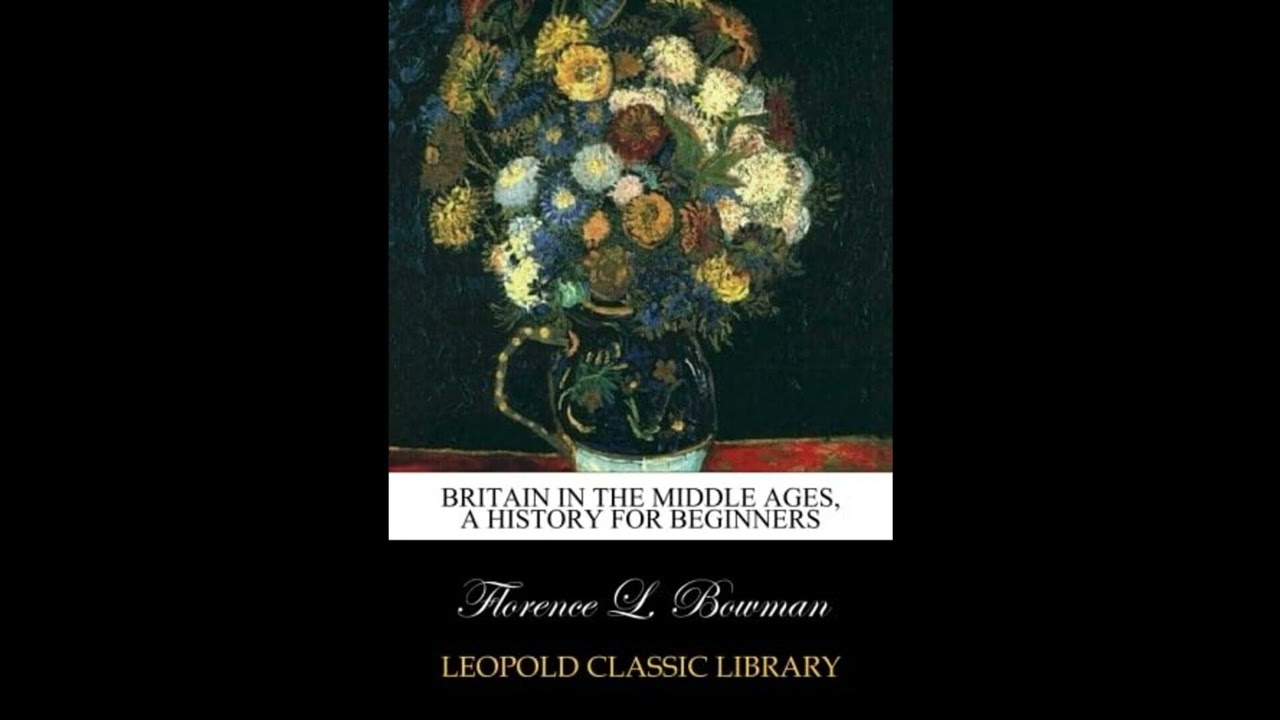
Britain in the Middle Ages, a history for beginners
Step into a world shaped by kings and commoners, where shifting allegiances carved out nations, and the very foundations of modern society were laid. Florence L. Bowman’s "Britain in the Middle Ages, a history for beginners" offers a clear and compelling look at a thousand years of British history, a period often shrouded in myth and misconception. This is not merely a recounting of battles and coronations; it is an invitation to understand the deep currents that have flowed from those turbulent centuries into our present day. Why did England become a unified kingdom? How did its unique legal and political systems arise? And what can the struggles and triumphs of people long past teach us about resilience, identity, and the ceaseless human quest for meaning and order? Bowman’s accessible prose answers these questions and more, making a complex era approachable for anyone seeking to connect with the origins of the English-speaking world. Bowman begins her narrative not with a clean slate, but with the crumbling edifice of Roman Britain, sketching the twilight of imperial rule and the ensuing power vacuum that plunged the island into its so-called Dark Ages. We witness the gradual arrival and settlement of Germanic tribes—Angles, Saxons, Jutes—who would eventually give England its name. The picture she paints is one of fragmented kingdoms, fierce pagan traditions clashing with the slow, persistent spread of Christianity, and the constant threat of Viking incursions. The early heroes of this era, figures like Alfred the Great, emerge from the mists of legend as determined leaders battling for survival and the nascent idea of a unified English identity. The book then moves inexorably towards the pivotal year of 1066, a date etched into the collective memory, as William the Conqueror’s Norman invasion forever altered the course of British destiny, superimposing a new French-speaking aristocracy and a continental feudal system onto the Anglo-Saxon framework. From this dramatic turning point, the story unfolds through the reigns of powerful Plantagenet monarchs. We observe the evolving relationship between the crown and its barons, leading to epoch-making documents such as Magna Carta in 1215, a landmark agreement that began to constrain royal power and lay groundwork for constitutional governance. Bowman details the development of Parliament, the slow professionalization of law, and the complex societal hierarchy that defined medieval life. The narrative continues through periods of both internal strife, like the Wars of the Roses which pitted rival noble houses against each other for the throne, and external entanglements, most notably the Hundred Years' War with France, which helped forge a distinct sense of English nationhood amidst shared hardship and military ambition. The period concludes with the dawn of the Tudor era, leaving the listener with a comprehensive understanding of how medieval Britain transitioned into early modern England. Florence L. Bowman, an influential popular historian writing in the early decades of the twentieth century, brought a fresh perspective and a gift for clarity to subjects often reserved for academic specialists. Born in the final years of the nineteenth century, Bowman was educated at a time when opportunities for women in scholarship were expanding, though still challenging. She quickly distinguished herself not through obscure academic papers, but through her ability to synthesize vast amounts of historical information into engaging and accessible narratives for general readers. Her work aimed to demystify history, presenting it not as a dry collection of dates and names, but as a living story of human endeavor and societal evolution. Bowman’s commitment to making history comprehensible to a wider audience defined her career. Beyond "Britain in the Middle Ages," she published several other well-received works, including "Everyday Life in a Medieval Castle" and "The Dawn of Parliament: A Study in English Governance," each characterized by her meticulous research and lucid prose. She was often associated with a generation of public intellectuals who believed that historical understanding was crucial for an informed citizenry, especially during a period of rapid social and political change in Britain. Her work occupies a significant place within the canon of popular historical writing, celebrated for its enduring readability and its foundational contribution to how a broad audience understands the complexities of the past. Among the central themes Bowman illuminates is the gradual, often painful, formation of a national identity. She illustrates how the varied peoples inhabiting Britain—from the Celtic Britons to the Anglo-Saxons, Vikings, and Normans—each contributed layers to a composite English character, language, and culture. For example, she traces how Alfred the Great's struggles against the Danes fostered a sense of shared Anglo-Saxon resistance that foreshadowed later national unity, while the Norman Conquest, though initially a violent subjugation, ultimately blended cultures to create a uniquely English synthesis. Another significant theme is the evolving nature of power and governance, particularly the perennial tension between absolute monarchy and the burgeoning desire for shared authority. The detailed account of the events leading to Magna Carta, with the barons forcing King John to acknowledge limits to his rule, stands as a stark example of this struggle, showing how early seeds of constitutionalism were sown through direct conflict. Bowman also highlights the profound impact of belief systems and institutions on society. The Christian Church, introduced to Anglo-Saxon England, played a dual role as both a spiritual guide and a powerful political entity, shaping everything from legal codes to educational practices. She describes the monastic orders not only as centers of piety but as crucial preservers of knowledge and agricultural innovators. Furthermore, her narrative conveys the sheer resilience of medieval populations in the face of relentless challenges—warfare, famine, and devastating plagues like the Black Death. She details how communities rebuilt, adapted, and innovated in the wake of catastrophic losses, demonstrating humanity’s enduring capacity to overcome adversity and reconstruct social order. When Florence L. Bowman first published "Britain in the Middle Ages," the cultural and political landscape of Britain was undergoing significant transformation. The early twentieth century was a time of burgeoning national self-awareness, especially as the British Empire reached its zenith, prompting a renewed interest in the island nation's foundational history. This era also saw a rise in literacy and the proliferation of accessible literature, creating a fertile ground for well-researched, yet unburdened, popular histories. Bowman’s ability to present complex historical processes with clarity resonated deeply with a public eager to understand the lineage of their institutions and national character, especially as the shadow of global conflict began to lengthen across Europe. Her book emerged at a moment when clarity and grounded historical understanding were not just academic pursuits, but essential components of public discourse. Listening to "Britain in the Middle Ages" as an audiobook offers a distinctive path into this pivotal historical period. The narrator’s clear, measured delivery allows the complex chronology and numerous historical figures to unfold at a comfortable pace, making it an ideal companion for commutes, extended walks, or any moment when your hands are occupied but your mind is free. The several hours of listening time provide ample opportunity to become thoroughly immersed in the historical narrative, absorbing the sweep of centuries without feeling rushed. A skilled narrator can bring Bowman's conversational yet authoritative tone to life, ensuring that the listener not only grasps the factual information but also apprehends the underlying drama and human experience of the age. Pay attention to the subtle shifts in pacing as the story moves from quiet periods of development to moments of high conflict—the narrator’s voice becomes a trusted guide through the ebb and flow of British medieval history.
Enjoyed Britain in the Middle Ages, a history for beginners? A few ways to support us
Audible & Amazon links are affiliate; we may earn a small commission at no extra cost.
About this production
Human narration by a volunteer reader from LibriVox.org, the public-domain audiobook project. LibriVox volunteers record literary works whose copyright has expired in the United States, releasing the resulting recordings into the public domain.
Britain in the Middle Ages, a history for beginners by Florence L. Bowman. The underlying text is in the U.S. public domain. We do not republish any modern copyrighted edition, translation, or commentary.
The 4K cinematic visuals accompanying this audiobook are generated by an AI image model from prompts derived from the source text. No copyrighted photos, paintings, or stock footage are used. AI generation is disclosed on every video on our YouTube channel as required by YouTube's altered/synthetic content policy.
English subtitles are transcribed from the LibriVox recording with OpenAI Whisper. Translations into the 11 other supported languages are produced by Meta's NLLB-200 neural translation model. No human translator's copyrighted translation is used.
Questions about sourcing or rights? See our DMCA & Sourcing policy or contact us.
Enjoyed this audiobook?
If you'd like to own a copy of Britain in the Middle Ages, a history for beginners or hear a professionally produced edition, the links below help support free audiobook production at no extra cost to you.
As an Amazon Associate we earn from qualifying purchases. Audible / print links are affiliate.
More Audiobooks
History of the English People, Volume V - Puritan England, 1603-1660
History of the English People, Volume III - The Parliament, 1399-1461; The Monarchy
Notes and Queries, Number 169, January 22, 1853
History of the English People, Volume VII - The Revolution, 1683-1760; Modern Engla