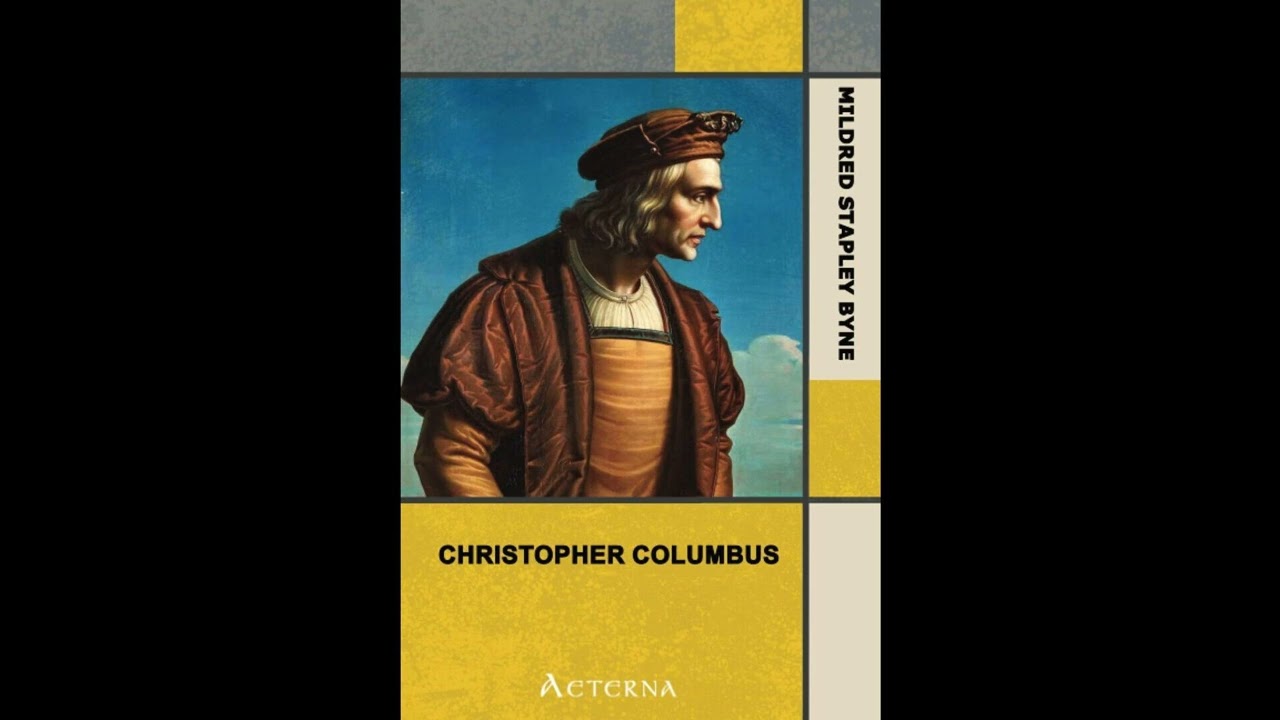
Christopher Columbus
Mildred Stapley Byne's Christopher Columbus offers more than a simple recounting of the mariner's life; it presents a vivid historical portrait of an age consumed by curiosity, ambition, and the relentless drive to push beyond the known horizons. This isn't merely a biography of a man; it’s a narrative that plunges into the motivations, the beliefs, and the stark realities of late fifteenth-century Europe and the nascent Age of Exploration. Listening to this account today invites us to reflect on the nature of ambition, the impact of discovery, and the complex legacy of figures whose actions continue to shape our world, prompting a necessary re-evaluation of heroism and consequence in the annals of history. The story begins with the relentless conviction of a Genoese sailor, Christopher Columbus, fixated on a radical idea: reaching Asia by sailing west across the uncharted Atlantic. We witness his early days, his studies of maps and celestial navigation, and the burgeoning scientific — albeit flawed — understanding of the world's sphericity that fueled his vision. The setting is a Europe on the cusp of immense change, where kingdoms vied for power and wealth, and where the promise of new trade routes to the East held intoxicating allure. Columbus, a figure of singular determination, navigates the labyrinthine courts of Portugal and Spain, facing years of skepticism, ridicule, and repeated rejections from monarchs and their learned advisors, who largely deemed his proposed route impractical, if not impossible. His primary struggle is not against the elements initially, but against entrenched dogma and the sheer conservatism of institutional power. He is portrayed as a man of profound faith, viewing his enterprise as divinely inspired, yet also a pragmatic visionary, meticulously calculating distances and resources. The central conflict culminates in his eventual, grudging patronage from Ferdinand and Isabella of Spain, who, swayed by the promise of untold riches and the expansion of Christendom, provide him with three small ships: the Niña, the Pinta, and the Santa María. The narrative meticulously chronicles the harrowing first voyage, the anxieties of the crew facing weeks without sight of land, the near-mutinies, and Columbus's unwavering resolve to press onward, culminating in the monumental moment of landfall in the Caribbean. The initial encounters with the indigenous inhabitants, the Arawak-speaking Taino people, are described through Columbus's own perspective, marking the dawn of an irreversible global transformation. Mildred Stapley Byne (1872-1959) was an American historian and writer, known for her deep scholarship and expertise in Spanish culture and history. Born in St. Louis, Missouri, she dedicated a significant portion of her life to living in Spain, meticulously researching and documenting its rich artistic and historical heritage. Her close association with the Hispanic Society of America, an institution dedicated to the study of the arts and cultures of Spain, Portugal, and Latin America, underscores her profound commitment to understanding the Iberian Peninsula. She was not merely an observer but an interpreter, bringing Spanish history and its prominent figures to an English-speaking audience. Byne’s extensive body of work includes titles such as Spanish Architecture of the Sixteenth Century, a seminal study often cited in art history, and Provincial Letters from Spain, which showcased her intimate knowledge of the country's diverse regions. She often collaborated with her husband, Charles H. Byne, on projects that spanned art, architecture, and biography. Her writing style, characteristic of early 20th-century historical narrative, is marked by clarity, detailed research, and a commitment to presenting facts in an accessible manner. She belonged to a generation of scholars who aimed to bridge cultural divides through meticulous historical accounts, positioning her work as a valuable contribution to the understanding of transatlantic history and European influence. One of the prominent themes woven through Christopher Columbus is the relentless perseverance against overwhelming odds. Columbus's journey to secure funding is a testament to this, as he spends years petitioning, persuading, and enduring countless rejections before finally gaining the ear of the Spanish monarchs. The text vividly portrays the scenes of his repeated pleas at court, highlighting his steadfast belief in his own calculations and vision despite widespread skepticism. Another significant theme is the clash of cultures and the initial moments of contact between the Old World and the New. The descriptions of Columbus's first encounters with the Taino people on San Salvador exemplify this, noting their curiosity, generosity, and lack of familiar European technologies, which Columbus immediately interprets through a lens of potential conversion and resource acquisition, foreshadowing the complex and often tragic interactions to follow. The book also underscores the theme of scientific vision challenging accepted wisdom. While Columbus’s specific calculations were indeed flawed, his fundamental belief in sailing west to reach the east defied the conventional geographic understanding of his era, which held that such a voyage was either impossible or too long to be survivable. His determination to test this hypothesis, even with the threat of mutiny from a terrified crew, showcases a commitment to empirical exploration that defined the spirit of discovery. Furthermore, the burden of leadership is a palpable theme, especially during the perilous transatlantic crossing. Byne details the constant struggle Columbus faced in maintaining morale among his increasingly anxious sailors, who grew desperate as weeks turned into months without sight of land, requiring him to employ both cunning and unwavering authority to prevent their rebellion. This biographical work by Mildred Stapley Byne emerged during the early decades of the twentieth century, a period marked by a surging interest in historical figures and national origins. In the United States, there was a particular fascination with the foundational narratives of the Americas, and figures like Columbus were frequently revisited as symbols of discovery and expansion. Culturally, the early 1900s saw a rise in accessible historical biographies, often aimed at educating the general public and fostering a sense of shared heritage. Byne's work fits squarely into this trend, offering a meticulously researched yet engaging account of a pivotal historical figure. Her background as a Hispanist also reflects a growing American academic and public curiosity about Spain, its history, and its role in global exploration, particularly in the wake of the Spanish-American War, though her scholarly approach generally transcended immediate political concerns to focus on a broader historical understanding. Listening to Christopher Columbus as an audiobook offers a unique opportunity to immerse oneself in this foundational historical narrative. The multi-hour run length allows for a comprehensive yet manageable experience, perfect for sustained listening during daily commutes, while performing household tasks, or on a leisurely afternoon walk. A skilled narrator will imbue Byne's detailed prose with the necessary gravitas and sense of unfolding drama, bringing to life the arduous debates in royal courts, the vast, intimidating silence of the open ocean, and the tension aboard the cramped ships. The pacing shifts between moments of intense historical detail and the palpable anxiety of the unknown, and a good performance will highlight these changes. Listen for the narrator's interpretation of Columbus's unwavering voice and the hushed apprehension of his crew, making the listener a virtual passenger on this incredible, consequential voyage.
Enjoyed Christopher Columbus? A few ways to support us
Audible & Amazon links are affiliate; we may earn a small commission at no extra cost.
About this production
Human narration by a volunteer reader from LibriVox.org, the public-domain audiobook project. LibriVox volunteers record literary works whose copyright has expired in the United States, releasing the resulting recordings into the public domain.
Christopher Columbus by Mildred Stapley Byne. The underlying text is in the U.S. public domain. We do not republish any modern copyrighted edition, translation, or commentary.
The 4K cinematic visuals accompanying this audiobook are generated by an AI image model from prompts derived from the source text. No copyrighted photos, paintings, or stock footage are used. AI generation is disclosed on every video on our YouTube channel as required by YouTube's altered/synthetic content policy.
English subtitles are transcribed from the LibriVox recording with OpenAI Whisper. Translations into the 11 other supported languages are produced by Meta's NLLB-200 neural translation model. No human translator's copyrighted translation is used.
Questions about sourcing or rights? See our DMCA & Sourcing policy or contact us.
Enjoyed this audiobook?
If you'd like to own a copy of Christopher Columbus or hear a professionally produced edition, the links below help support free audiobook production at no extra cost to you.
As an Amazon Associate we earn from qualifying purchases. Audible / print links are affiliate.